
Written by revera-admin

Finally, a Solution for Nipple Reshaping Without the Visible Scars

The Hidden Insecurity

While breast augmentation and lifts are commonly discussed, many patients struggle silently with insecurities regarding the nipple-areola complex. Whether due to genetics, hormonal changes, or the aftermath of breastfeeding, common complaints include:

  • Large Areolae: An areola that feels disproportionately large for the breast.
  • Undefined Contours: A lack of crisp definition between the nipple and the surrounding skin.
  • Herniated Tissue: Often called “puffy nipples,” where glandular tissue pushes out, creating a dome-like appearance.

For years, patients have hesitated to fix these issues for one main reason: The fear of scarring.

Usual Scars
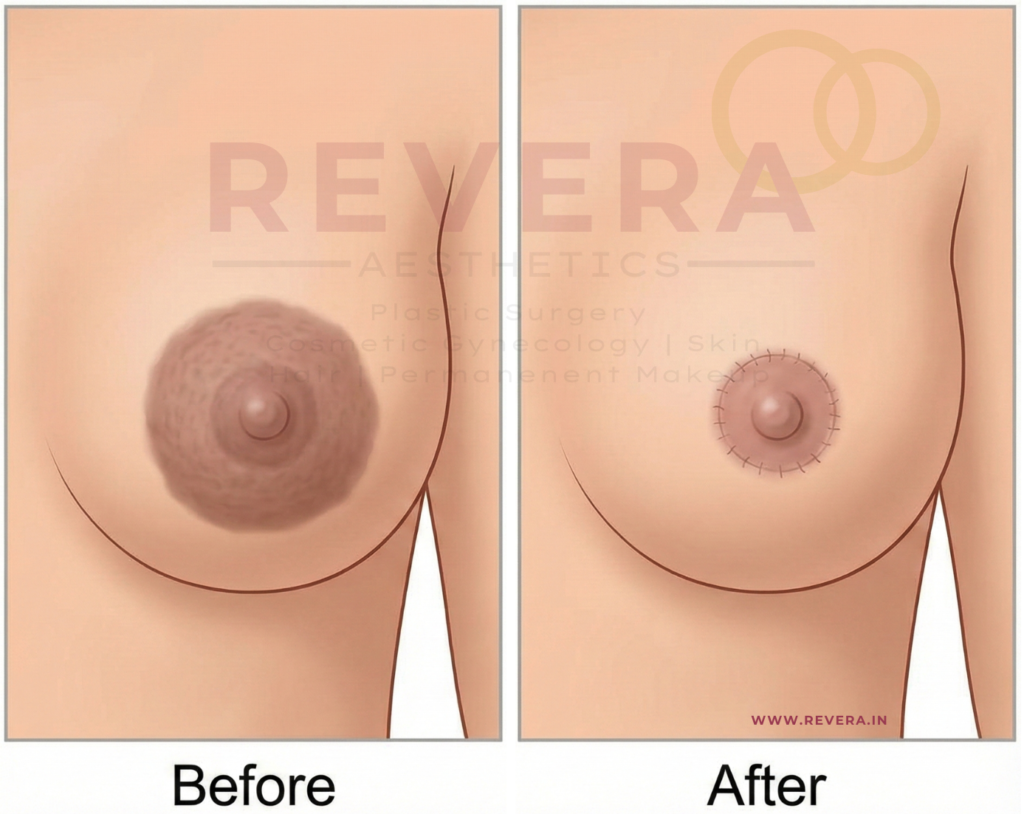
The Old Trade-Off: Shape vs. Scars

Historically, correcting the shape of the nipple or reducing the size of the areola came with a compromise. Previous techniques, such as the “petal pattern method,” were effective at contouring but often limited in how much they could reduce the areola size.

More importantly, these older methods frequently resulted in visible scars from the front. For a patient seeking aesthetic improvement, trading a shape issue for a visible scar was often a difficult choice.

The Innovation: The “Crown-Shape” Method

A breakthrough study published in Plastic and Reconstructive Surgery (June 2025) introduces a refined solution: the Crown-Shape Debulking Method.

Developed by Dr. Ju Young Go and Dr. Won Lee from leading clinics in Seoul and Anyang, South Korea, this technique is a “single-stage” procedure designed to reshape the nipple without leaving obvious marks.

How It Works

The “Crown-Shape” technique is an advanced evolution of previous methods. It involves:

  1. Debulking: Removing the herniated or excess glandular tissue that causes puffiness.
  2. Structuring: Using a specific “crown” pattern to tighten the skin and define the nipple.
  3. Hiding the Evidence: The key innovation is that it allows for significant reduction and reshaping “without visible scars in the frontal areolar area”.

Why This Is a Game-Changer

This new Korean technique addresses the limitations of the past. It offers greater control during surgery to ensure the new shape is aesthetically pleasing while minimizing the risk of the problem recurring (recurrence).

Key Benefits:

  • Scar-Free Frontal View: No distracting scar lines on the face of the areola.
  • Effective Reduction: Can handle larger reductions than previous methods.
  • Better Definition: Creates a distinct, attractive nipple contour.

Is This Right for You?

If you have been bothered by “puffy” nipples or large areolas but have avoided surgery because you didn’t want scars, the Crown-Shape Debulking method might be the answer. This technique allows for a natural look that stands up to close inspection.


Frequently Asked Questions (FAQ)

Q: What specific problems does this fix?

A: This technique is designed for patients with large areolae, undefined nipple contours, or herniation of glandular tissue (bulging/puffy nipples) around the areola.

Q: How is this different from the “Petal Pattern” method?

A: The “Petal Pattern” was a previous technique that was good for contouring but had limitations in how much it could reduce the areola size. Furthermore, the Petal Pattern often left visible scars when viewed from the front. The Crown-Shape method improves upon this by allowing for better reduction without the visible frontal scars.

Q: Is there really no scar?

A: All surgery involves incisions, but this technique is described as “scar-free” in the frontal areolar area. This means the incisions are strategically placed and hidden so that when looking at the breast directly, there are no obvious surgical markings.


Reference

Go, Ju Young MD, PhD; Lee, Won MD, PhD. “Scar-Free Nipple and Areola Contouring: A Crown-shape Debulking Method for Enhanced Aesthetic Outcomes.” Plastic and Reconstructive Surgery. June 20, 2025. Seoul and Anyang, Korea.
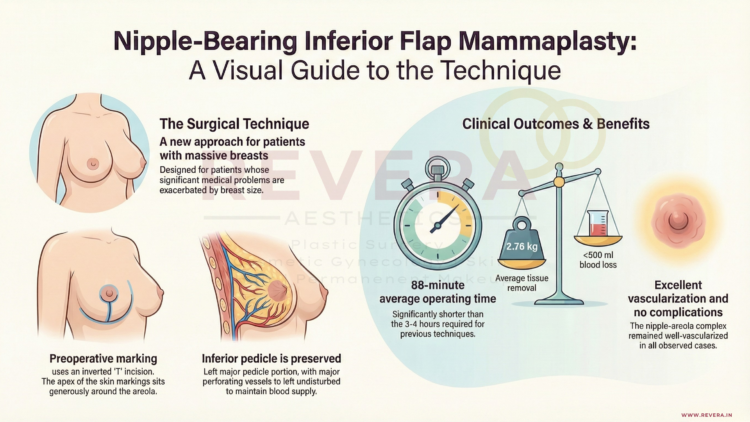
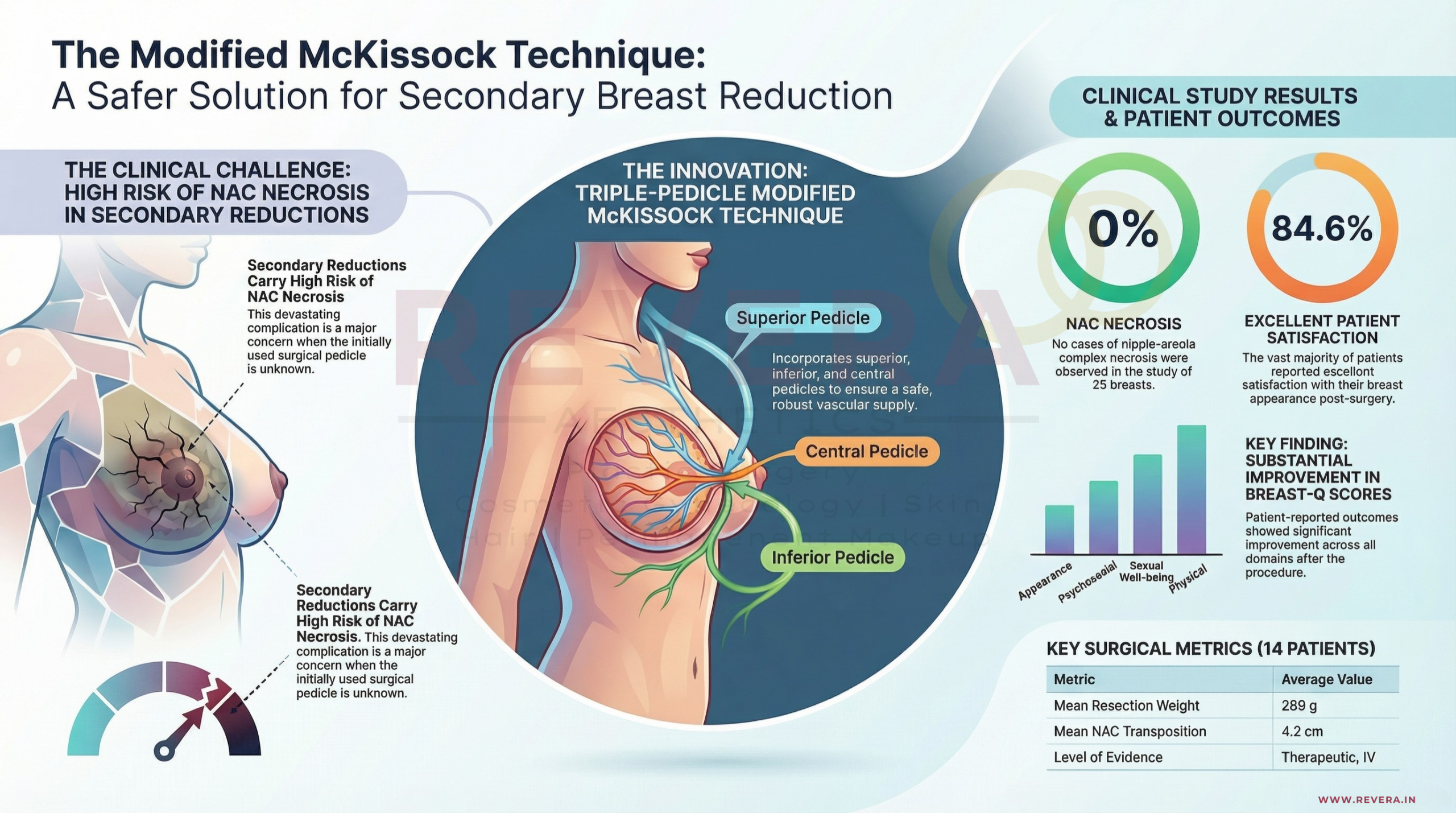
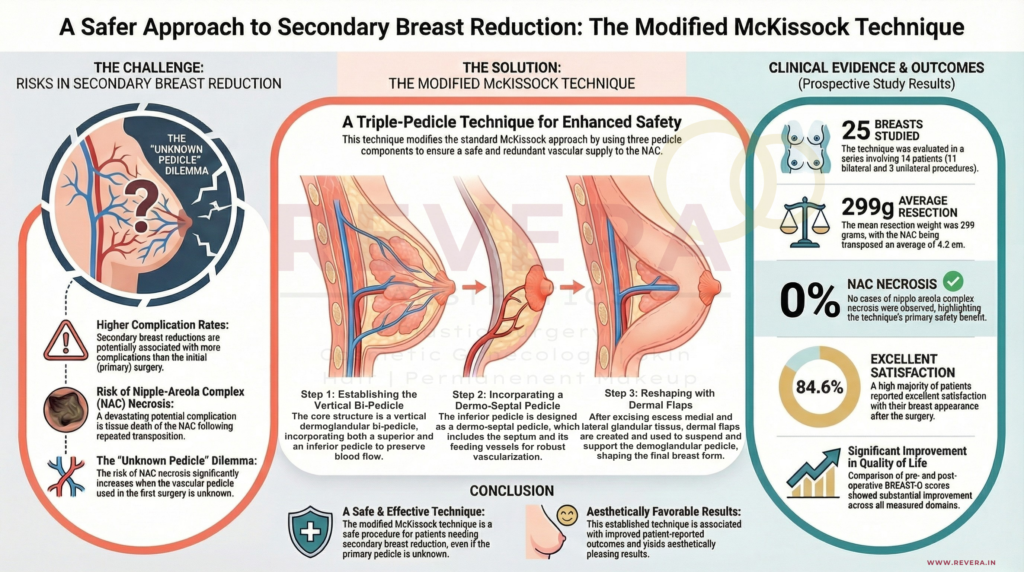
Image depicts infographic of Nipple Sparing Inferior Flap Mammaplasty, the time taken, amount of tissue removed and Blood loss
Written by revera-admin

Relief for Massive Breasts: A Safer, Faster Technique for High-Risk Patients

When Breast Reduction is a Medical Necessity

For many women, breast reduction is about comfort and confidence. But for women with Gigantomastia (massive breasts), the condition is a severe medical burden.

Patients with massive breasts often suffer from debilitating back pain, skin infections, and significant mobility issues. Even more concerning, the sheer weight of the tissue can exacerbate pre-existing cardiac (heart) and respiratory (lung) problems.

For these patients, surgery is not a luxury—it is a necessity. However, because these patients often battle obesity or heart conditions, undergoing a long surgical procedure can be risky.

The Challenge: The 4-Hour Marathon

The most popular traditional methods for breast reduction (such as the McKissock or Robbins techniques) rely on complex internal sculpting. While effective, these surgeries typically require 3 to 4 hours of operative time.

For a patient with heart or lung issues, being under general anesthesia for four hours can be dangerous. Consequently, some women feel forced to consider a Total Mastectomy (complete removal of the breast) just to get relief, or they avoid surgery altogether.

The Solution: Nipple-Bearing Inferior Flap Mammaplasty

A technique published in Plastic and Reconstructive Surgery offers a powerful solution specifically designed for massive weight reduction with maximum safety.

Developed by a surgical team in Preston, England, this technique focuses on speed and blood supply safety.

How It Works

Unlike complex sculpting methods that require separating the breast tissue from the chest wall (“undermining”), this technique leaves the base of the breast undisturbed.

  1. Wide Base: The surgeon creates a wide, supportive base of tissue (the “inferior flap”) that keeps the nipple attached to its natural blood supply.
  2. No Grafting Needed: Unlike some rapid reduction techniques that cut the nipple off and sew it back on as a skin graft, this method keeps the nipple connected, preserving its vitality.
  3. Efficient Removal: A wedge of tissue is removed down to the pectoral fascia, and the remaining flaps are brought together securely.

The Results: Faster and Safer

The study followed patients with massive breasts and significant medical problems who underwent this specific procedure. The results were transformative:

  • Drastically Reduced Surgery Time: The average operation took only 88 minutes (compared to the standard 3–4 hours).
  • Massive Weight Loss: The average tissue removal was 2.76 kg (over 6 lbs) per patient.
  • Safety: There was minimal blood loss (less than 500 mL on average).
  • Nipple Survival: Because the nipple was carried on a wide, robust flap, it remained well-vascularized with no complications in the study group.

Is This Right For You?

This technique is ideal for women who:

  • Have extremely large breasts causing medical distress.
  • Have been told they are “high risk” for long surgeries due to obesity or heart/lung conditions.
  • Want significant size reduction without resorting to a total mastectomy.

We believe that health and mobility should never be out of reach. If you are suffering from the weight of massive breasts, contact us to discuss if this rapid-reduction technique is an option for you.


Frequently Asked Questions (FAQ)

Q: Will I lose my nipple sensation? A: This technique is a “Nipple-Bearing” procedure. Unlike a “Free Nipple Graft” (where the nipple is completely detached), this method maintains a wide bridge of tissue connecting the nipple to the body’s blood and nerve supply, which helps preserve the nipple-areola complex.

Q: How are the scars placed? A: The incision design usually results in an inverted-U or inverted-L shape on the lower breast. While scarring is inevitable in reduction surgery, the primary goal of this specific technique is massive volume reduction to improve heart and lung health.

Q: Why is a shorter surgery better? A: For patients with pre-existing medical conditions (like high blood pressure, asthma, or obesity), prolonged anesthesia increases the risk of complications such as clots (DVT) or respiratory distress. Reducing the time from 4 hours to roughly 90 minutes significantly lowers this risk.


Reference

Alvi, R. F.R.C.S.I.; Jaffe, W. F.R.C.S.; Laitung, J. K. G. Ch.M., F.R.C.S.Ed.. “Nipple-Bearing Inferior Flap Mammaplasty: A New Technique for Reducing Massive Breasts.” Plastic and Reconstructive Surgery 101(1):p 174-176, January 1998.

Written by revera-admin

Thinking About a Second Breast Reduction? New Research Makes “Revisions” Safer Than Ever

When One Surgery Isn’t Enough

Breast reduction surgery typically has one of the highest satisfaction rates in cosmetic medicine. However, bodies change. Due to weight fluctuations, hormonal shifts, or pregnancy, breast tissue can sometimes regrow, or gravity may cause sagging to return years after the initial procedure.

Many women find themselves wanting a Secondary Breast Reduction (a revision surgery) but hesitate due to safety concerns.

Historically, performing a reduction on a breast that has already been operated on was considered risky. The main fear? Compromising the blood supply to the nipple.

The “Unknown Pedicle” Problem

In a primary breast reduction, the surgeon creates a “pedicle”—a bridge of tissue that keeps the nipple and areola attached to their blood and nerve supply while the surrounding tissue is removed.

The challenge with revision surgery is that the new surgeon often doesn’t know which technique the previous surgeon used. If they cut into the old “lifeline” by mistake, it can lead to Nipple-Areola Complex (NAC) Necrosis (loss of the nipple tissue).

The Austrian Solution: A Triple-Safety Technique

A new prospective study published in April 2025 in the Plastic and Reconstructive Surgery journal offers a reassuring solution.

A team of researchers from Linz and Innsbruck, Austria, led by Dr. Sandra Feldler and Dr. Manfred Schmidt, has developed a “Modified McKissock Technique” specifically designed for these complex revision cases.

How It Works

The classic “McKissock” technique uses a vertical bipedicle (a bridge with a top and bottom attachment) to supply blood to the nipple.

The Austrian team modified this by adding a third component: a Central Pedicle.

  • Superior Pedicle (Top)
  • Inferior Pedicle (Bottom)
  • Central Pedicle (Middle)

Think of it as adding an extra emergency power line. Even if the surgeon doesn’t know exactly how the first surgery was performed, this “triple-threat” approach ensures the nipple retains a robust blood supply from multiple directions.

The Results: 100% Safety Record

The study followed 25 breast revisions using this new technique. The results were remarkably positive:

  • Zero Necrosis: There were no cases of nipple loss or tissue death.
  • Significant Reduction: The average patient had roughly 300g of tissue removed per breast.
  • High Satisfaction: 84.6% of patients rated their aesthetic appearance as “excellent” after the surgery.

Why This Matters For You

If you have been told that a second breast reduction is “too risky” or that you aren’t a candidate because your previous surgical records are lost, this research changes the conversation.

This modified technique allows surgeons to navigate the “unknowns” of your previous surgery with a safety net, ensuring you can achieve the smaller, lifted shape you desire without compromising your safety.


Frequently Asked Questions (FAQ)

Q: Why do breasts get big again after a reduction?

A: While the fat and glandular tissue removed during surgery is gone forever, the remaining cells can expand. Weight gain, pregnancy, menopause, and certain hormonal medications can stimulate the remaining breast tissue to grow.

Q: Is a revision recovery harder than the first time?

A: Surprisingly, many patients find the recovery similar or even slightly easier, as less tissue is usually removed compared to the first massive reduction. However, strict adherence to post-op care is vital to protect the blood supply.

Q: Does this technique leave more scars?

A: This technique generally utilizes the “inverted-T” or “anchor” scar pattern. Since most primary breast reductions also use this pattern, the surgeon simply goes through the old scar lines, meaning you likely won’t have new scars, just refreshed ones.

Q: Can I breastfeed after a secondary reduction?

A: Breastfeeding after a primary reduction is already difficult (about 50% success rate). A secondary reduction involves further manipulation of the milk ducts. While the nipple is kept alive and sensitive, the ability to breastfeed is unlikely after a second procedure.


Reference

Feldler, Sandra MD; Zaussinger, Maximilian MD; Ehebruster, Gudrun MD; Bachleitner, Kathrin MD; Steinkellner, Theresia MD; Schmidt, Manfred MD. “Modified McKissock Technique for Secondary Breast Reduction: A Prospective Study on Safety and Surgical and Aesthetic Outcomes.” Plastic and Reconstructive Surgery. April 2025. Linz and Innsbruck, Austria.


Written by revera-admin

Natural Volume Without Implants: A New Brazilian Technique for Restoring Breast Volume in Breast Lift & Breast Reduction

The Quest for the Perfect Profile

For many women considering a Mastopexy (Breast Lift) or Reduction Mammoplasty, the goal is simple: a lifted, youthful shape and a more manageable size.

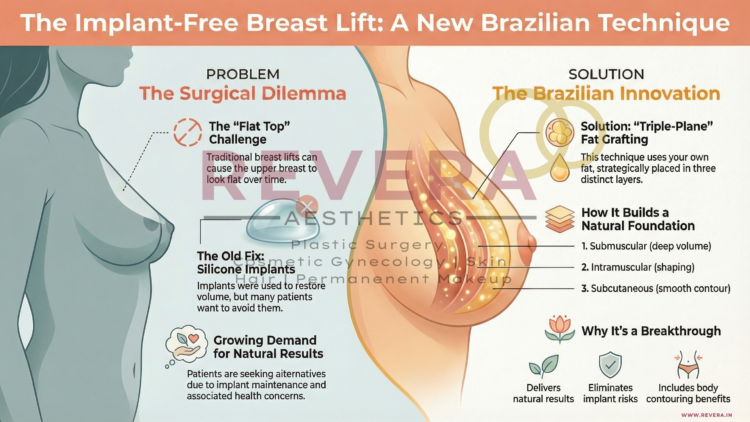
However, there has always been a surgical dilemma. Traditional lifts are excellent at removing excess skin and reshaping the breast, but they often struggle to maintain “upper pole projection”—that desirable fullness at the top of the breast (the décolletage). Over time, gravity can cause the breast tissue to settle, sometimes leaving the upper breast looking flat.

Historically, the solution to this was using silicone implants to fill that upper volume. But what if you don’t want implants?

The “Implant-Free” Movement

While implants remain a popular choice, many of our patients are seeking natural alternatives. Some wish to avoid the maintenance of implants, while others are concerned about rare but documented risks associated with silicone, such as Breast Implant-Associated Anaplastic Large-Cell Lymphoma (BIA-ALCL) or autoimmune symptoms.

If you desire fullness and lift but want to stay 100% natural, a groundbreaking new technique known as Triple-Plane Autologous Fat Grafting might be the answer.

Innovative Research from Brazil

We pride ourselves on staying up-to-date with global advancements in aesthetic medicine. This specific technique comes from a cutting-edge study titled “Breast codes: triple plane autologous fat grafting,” published in August 2025 in the prestigious Plastic and Reconstructive Surgery journal.

The study was conducted by Dr. Ricardo T. Nóra, a plastic surgeon based in Sinop, Mato Grosso, Brazil, in collaboration with Dr. Lydia M. Ferreira from the Division of Plastic Surgery at the Federal University of São Paulo, Brazil.

Brazil has long been recognized as a world leader in cosmetic surgery innovation. In this study, Dr. Nóra and Dr. Ferreira standardized a method to enhance breast shape without foreign bodies, addressing the limitations of previous techniques.

What is the “Triple-Plane” Technique?

Autologous Fat Grafting involves taking fat from an area where you have a little extra (like the abdomen or thighs) and transferring it to the breasts.

The innovation introduced by Dr. Nóra and Dr. Ferreira is the “Triple-Plane” approach. Instead of randomly injecting fat, this technique systematically places fat in three specific layers (planes) to build a lasting structural foundation:

  1. Submuscular: Deep placement under the muscle for foundational volume.
  2. Intramuscular: Placement within the muscle for dynamic shaping.
  3. Subcutaneous: Placement just under the skin for smooth contouring and softness.

Why This Matters for You

This innovative approach addresses the “flat top” issue without requiring a foreign object in your body. By strategically layering the fat according to these new “Breast Codes,” surgeons can now create that coveted upper-breast fullness during a lift or reduction.

Key Benefits:

  • Natural Results: Uses your own tissue, so the look and feel are entirely you.
  • Safety: Eliminates the risks associated with long-term silicone implants.
  • Body Contouring: You get the added benefit of liposuction in the donor area.
  • Scientifically Backed: Based on rigorous surgical protocols developed by leading experts in Brazil.

Experience the Future of Breast Surgery

If you are looking for a natural, long-lasting enhancement, let’s discuss if this technique is right for your body goals. Contact our clinic today at +919866224871 to schedule a consultation. Chat with us on WhatsApp.

We are located in Hyderabad – Himayatnagar and Gachibowli – Kondapur.


Reference

Nóra, Ricardo T. M.D., MSc; Ferreira, Lydia M. M.D., PhD. “Breast codes: triple plane autologous fat grafting in mastopexies and reduction mammoplasties without implants.” Plastic and Reconstructive Surgery. August 13, 2025.

1 3 4 5