Woman in a Grey Shirt Giving a Thumbs up and holding a measuring tape in another hand. Dr. John Tebbetts Vertical Skin Excess measurement for Breast Reduction and Breast Lift Surgery
Written by revera-admin

Math Over Art: How Quantifying Your Skin Prevents Surgical Errors in Breast Reduction and Breast Lift!

The Problem: The “Artistic” Guess

For a long time, breast reduction and lift (mastopexy) planning relied heavily on the surgeon’s “artistic eye.” A surgeon would pinch the skin, draw some markings, and estimate how much tissue to remove.

While often successful, this subjective approach has a flaw: Imprecision. “Eyeballing” the skin excision can lead to nipples that are too high, scars that stretch, or breasts that “bottom out” because the skin envelope was left too loose.

The Solution: The Tebbetts Process

In March 2014, Dr. John Tebbetts published a landmark study from his practice in Dallas, Texas, detailing a strictly mathematical approach to planning these surgeries.

This paper represents a major shift from surgery as an “art” to surgery as an “objective science”.

Instead of guessing, he developed a process to quantify the skin envelope—measuring exactly how much excess skin exists down to the millimeter. He applied this rigorous measuring process to 124 mastopexy and 122 breast reduction patients.

1. Measuring “Vertical Skin Excess” (VSE)

The core of this technique is measuring Vertical Skin Excess. This is the specific amount of skin between the nipple and the breast crease that needs to be removed to lift the breast correctly.

Dr. Tebbetts found that this number—not a guess—should dictate which incision pattern is used:

Simple Formula:

VSE=Actual Nipple-to-IMF DistanceDesired Nipple-to-IMF Distance (typically 8-10 cm)cap V cap S cap E equals Actual Nipple-to-IMF Distance minus Desired Nipple-to-IMF Distance (typically 8-10 cm)

Quantified approach (More Detailed Calculation):

VSE=Existing Nipple-to-IMF Dimension(Desired Nipple-to-IMF Distance+Areola Diameter2)cap V cap S cap E equals Existing Nipple-to-IMF Dimension minus open paren Desired Nipple-to-IMF Distance plus the fraction with numerator Areola Diameter and denominator 2 end-fraction close paren

Illustration showing Nipple to IMF distance (Inframammary Fold)

2. Designing the “New” Envelope

Once the excess is measured, the surgeon calculates exactly where the new nipple position should be. In Dr. Tebbetts’ study, the planning was so precise that 0% of the 246 patients required nipple repositioning after surgery.

The Results: Why Math Wins

The study followed patients for an average of 4.6 years, providing long-term data on how these “quantified” breasts aged.

  • High Accuracy: As mentioned, no patient needed their nipples moved again.
  • Low Complications: “Bottoming out” (excessive lower pole stretch) occurred in only 4% of cases.
  • Learning Curve: Interestingly, the reoperation rate dropped from 6.5% in the first five years of using this method to just 1.6% in the later years, proving that once a surgeon masters the math, the results are incredibly consistent.

What This Means for You

If you are considering a breast reduction or lift, you want a surgeon who plans, not one who guesses.

This “Quantified Dimensions” approach ensures that the surgery is tailored to your specific skin elasticity and measurements. It removes the “surprise” factor, ensuring that the incision chosen is exactly the right one to handle your specific amount of excess skin.


Ask yourself “Who is the Best Plastic Surgeon Near Me?”.

Revera Clinic caters with the Best Plastic Surgeon in Hyderabad!

Breast Reduction Surgery Cost varies between individuals!

Contact us to know if you are a suitable candidate for Breast Reduction Surgery!


Frequently Asked Questions (FAQ)

Q: Does “quantifying” mean I get a cookie-cutter breast?

A: No, it means the opposite. Because the measurements are specific to your body, the surgical plan is customized to your exact anatomy rather than a generic template.

Q: Can this method prevent all stretching?

A: No surgery can stop gravity completely. However, this study showed that “excessive restretch” was rare (4%), meaning the results are stable for years.

Q: Is this technique used for implants too?

A: Dr. Tebbetts is famous for applying similar mathematical principles (“High Five” system) to breast augmentation, ensuring that implants fit the patient’s footprint perfectly.


References


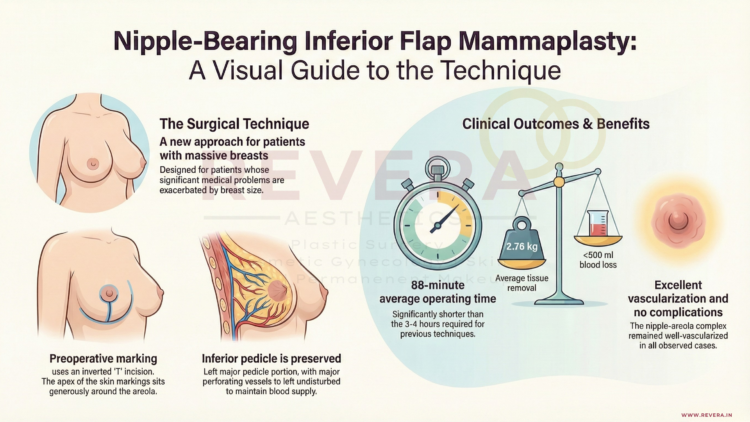
Image depicts infographic of Nipple Sparing Inferior Flap Mammaplasty, the time taken, amount of tissue removed and Blood loss
Written by revera-admin

Relief for Massive Breasts: A Safer, Faster Technique for High-Risk Patients

When Breast Reduction is a Medical Necessity

For many women, breast reduction is about comfort and confidence. But for women with Gigantomastia (massive breasts), the condition is a severe medical burden.

Patients with massive breasts often suffer from debilitating back pain, skin infections, and significant mobility issues. Even more concerning, the sheer weight of the tissue can exacerbate pre-existing cardiac (heart) and respiratory (lung) problems.

For these patients, surgery is not a luxury—it is a necessity. However, because these patients often battle obesity or heart conditions, undergoing a long surgical procedure can be risky.

The Challenge: The 4-Hour Marathon

The most popular traditional methods for breast reduction (such as the McKissock or Robbins techniques) rely on complex internal sculpting. While effective, these surgeries typically require 3 to 4 hours of operative time.

For a patient with heart or lung issues, being under general anesthesia for four hours can be dangerous. Consequently, some women feel forced to consider a Total Mastectomy (complete removal of the breast) just to get relief, or they avoid surgery altogether.

The Solution: Nipple-Bearing Inferior Flap Mammaplasty

A technique published in Plastic and Reconstructive Surgery offers a powerful solution specifically designed for massive weight reduction with maximum safety.

Developed by a surgical team in Preston, England, this technique focuses on speed and blood supply safety.

How It Works

Unlike complex sculpting methods that require separating the breast tissue from the chest wall (“undermining”), this technique leaves the base of the breast undisturbed.

  1. Wide Base: The surgeon creates a wide, supportive base of tissue (the “inferior flap”) that keeps the nipple attached to its natural blood supply.
  2. No Grafting Needed: Unlike some rapid reduction techniques that cut the nipple off and sew it back on as a skin graft, this method keeps the nipple connected, preserving its vitality.
  3. Efficient Removal: A wedge of tissue is removed down to the pectoral fascia, and the remaining flaps are brought together securely.

The Results: Faster and Safer

The study followed patients with massive breasts and significant medical problems who underwent this specific procedure. The results were transformative:

  • Drastically Reduced Surgery Time: The average operation took only 88 minutes (compared to the standard 3–4 hours).
  • Massive Weight Loss: The average tissue removal was 2.76 kg (over 6 lbs) per patient.
  • Safety: There was minimal blood loss (less than 500 mL on average).
  • Nipple Survival: Because the nipple was carried on a wide, robust flap, it remained well-vascularized with no complications in the study group.

Is This Right For You?

This technique is ideal for women who:

  • Have extremely large breasts causing medical distress.
  • Have been told they are “high risk” for long surgeries due to obesity or heart/lung conditions.
  • Want significant size reduction without resorting to a total mastectomy.

We believe that health and mobility should never be out of reach. If you are suffering from the weight of massive breasts, contact us to discuss if this rapid-reduction technique is an option for you.


Frequently Asked Questions (FAQ)

Q: Will I lose my nipple sensation? A: This technique is a “Nipple-Bearing” procedure. Unlike a “Free Nipple Graft” (where the nipple is completely detached), this method maintains a wide bridge of tissue connecting the nipple to the body’s blood and nerve supply, which helps preserve the nipple-areola complex.

Q: How are the scars placed? A: The incision design usually results in an inverted-U or inverted-L shape on the lower breast. While scarring is inevitable in reduction surgery, the primary goal of this specific technique is massive volume reduction to improve heart and lung health.

Q: Why is a shorter surgery better? A: For patients with pre-existing medical conditions (like high blood pressure, asthma, or obesity), prolonged anesthesia increases the risk of complications such as clots (DVT) or respiratory distress. Reducing the time from 4 hours to roughly 90 minutes significantly lowers this risk.


Reference

Alvi, R. F.R.C.S.I.; Jaffe, W. F.R.C.S.; Laitung, J. K. G. Ch.M., F.R.C.S.Ed.. “Nipple-Bearing Inferior Flap Mammaplasty: A New Technique for Reducing Massive Breasts.” Plastic and Reconstructive Surgery 101(1):p 174-176, January 1998.