
BREAST REDUCTION – HOW WILL IT HELP?
Choose Revera Clinic for Breast Reduction Surgery in Hyderabad!
It is performed by a Senior and Expert Plastic Surgeon (Our Promise!) at an affordable cost.
Breast Reduction is also known as Reduction Mammoplasty, Reduction Mammaplasty.
When Should I Consider This?
- Your Breasts are too large for your Body frame
- You suffer from Neck ache and Back Ache
- You have Skin irritation under your Breasts
- You have Difficulty Breathing
- You notice grooves in your shoulders from your Bra straps
- You have poor posture or Numbness in parts of your breasts and upper chest from excessive Breast weight.
- You have one Breast that is much larger than the other.
- It is difficult to find dresses, blouses, tops and bras that fit.
- You lack confidence to wear the dresses that you desire due to embrassment
Overly large and disproportionate breasts cause a lot of physical discomfort and emotional burden to women.
Disproportionate Breasts can be of widely unequal size, nipples pointing inwards.
Women with overly large Breasts Often experience Back Pain, Neck Pain, Shoulder Pain, Embarrassment in Public & Lack of confidence to wear Form fitting wear.
In such instances this surgery helps to reduce the size of breasts, help you breathe better and alter their shape to a better proportion.
Not only the size reduction but a final aesthetic outcome improves the satisfaction from the procedure.
Breast Reduction is also shown to improve Psychosocial and Sexual Wellbeing.
Even Obese women & Older women can Opt for this if they suffer from Heavy Breasts.
If you are Morbidly Obese, you do not have to lose weight before you get a Breast Reduction.
This procedure is very commonly requested by women.

 ___________________________________
View this post on Instagram
PHOTO GALLERY
RELATED PROCEDURES
Many women who opt for breast reduction surgery also consider liposuction , breast lift and mommy makeover.
| WHERE IS IT DONE |
|---|
| Operation Theatre |
| DURATION |
|---|
| 3-4 Hours |
ANAESTHESIA
- General Anaesthesia.
- Thoracic Epidural Anesthesia (Awake Surgery)
INCISIONS, STITCHES & SCARS
Various incisions are used and the surgeon suggests the best one for you based on your current contour of your breasts.
Though the ones made over the breast are visible, the ones made in the breast creases are concealed.
The surgeon strategically plans and places the incisions and stitches for the surgery in terms of number, size, material, location and technique aiming to keep the resulting scar minimal, hidden and not easily visible eye. Special tissue handling and suture techniques further minimize scars.
Special techniques are employed for Overly Large Breasts (Gigantomastia):
Typically Used incisions on the Breast are:
- 1. Anchor incision (Wise Pattern): This commonly used incision is made along the natural contours of the breast and delineates the new location for the nipple. Two of the most famous techniques are the Inferior Pedicle (Robbins technique) and the Vertical Bipedicle (McKissock technique).
- 2. Vertical Incision (Lollipop Pattern): This is Less commonly used. It leaves a shorter scar. But may necessitate further revision surgeries. Two Techniques are there: Lejour technique (Combining Central Mound) and the Hall-Findlay modifications.
- 3. Owl Incision: It offers the best of both Worlds.
- 4. Y Shaped Incision: This leaves the Upper half of the Areola untouched.
To help you visualize your options, here is a comparison of the three most common incision patterns used in breast reduction surgery. This table highlights how the “Owl” technique bridges the gap between the traditional Anchor and the modern Lollipop.
Breast Reduction: Incision & Shape Comparison
| Feature | Traditional Anchor (Wise Pattern) | Lollipop (Vertical/Lejour) | The “Owl” Incision |
| Visual Pattern | Inverted “T” shape. | A circle around the areola and a vertical line. | Circles around the areola with a vertical line and a very short horizontal base. |
| Scar Length | Longest: Circle, vertical line, and a long horizontal scar in the fold. | Minimal: Only the circle and the vertical line. | Moderate: Circle, vertical line, and a “mini” horizontal scar. |
| Breast Shape | Tends to be flatter on the bottom; can look “boxy” over time. | Excellent projection (perkiness), but can “bottom out” without support. | Superior Projection: The internal “pillar” move creates immediate and lasting perkiness. |
| Volume Capacity | Excellent for massive reductions (Gigantomastia). | Traditionally for small/medium, but modified for up to 1000g. | High: Proven safe for large reductions up to 1900g per breast. |
| Recovery Features | Often requires surgical drains due to skin undermining. | Often requires gathered/pleated sutures that take months to flatten. | No Drains Needed: Minimal skin undermining leads to faster healing and less fluid. |
Which One is Right for You?
-
Choose the Anchor if: You need a massive reduction and are less concerned about the length of the scar in the breast fold.
-
Choose the Lollipop if: You have moderate-sized breasts and want to completely avoid any horizontal scarring, bottoming out of Breasts over a period of time.
-
Choose the “Owl” if: You want a large reduction with maximum “perkiness” and want to avoid the long horizontal scar and the need for surgical drains.
The “Natural Bra” Effect
A key difference of the Owl and Vertical techniques is how they handle the internal tissue. Instead of just removing weight, they use the remaining tissue to build a “central pillar.” This acts as an internal support system, pushing the breast forward and upward for a more youthful contour.
The Surgeon performs the Vertical Skin Excess Measurement which further helps in Planning the Type of Incision.
Commonly Used incisions around the Nipple –Areola are:
- 1. A jagged, shelving incision technique gives a more natural looking Areola, rather than the one that looks like a target.
- 2. Crown Shaped Debulking Method – could give a scar free frontal view for the Areola.
- If the patient is obese and is a smoker, the surgeon might opt for a Three Dermoglandular Flap Technique.
- After the breast tissue, fat and skin are removed – the skin is repositioned appropriately to bring it down and together to reshape the breast.
Large breasts that sag often lead to back pain and other physical and emotional discomfort.
After surgery, breasts will be in proportion to your body and scars will fade over time.
| STAY AT CLINIC |
|---|
| 2-3 Days |
HOW IS IT PERFORMED?
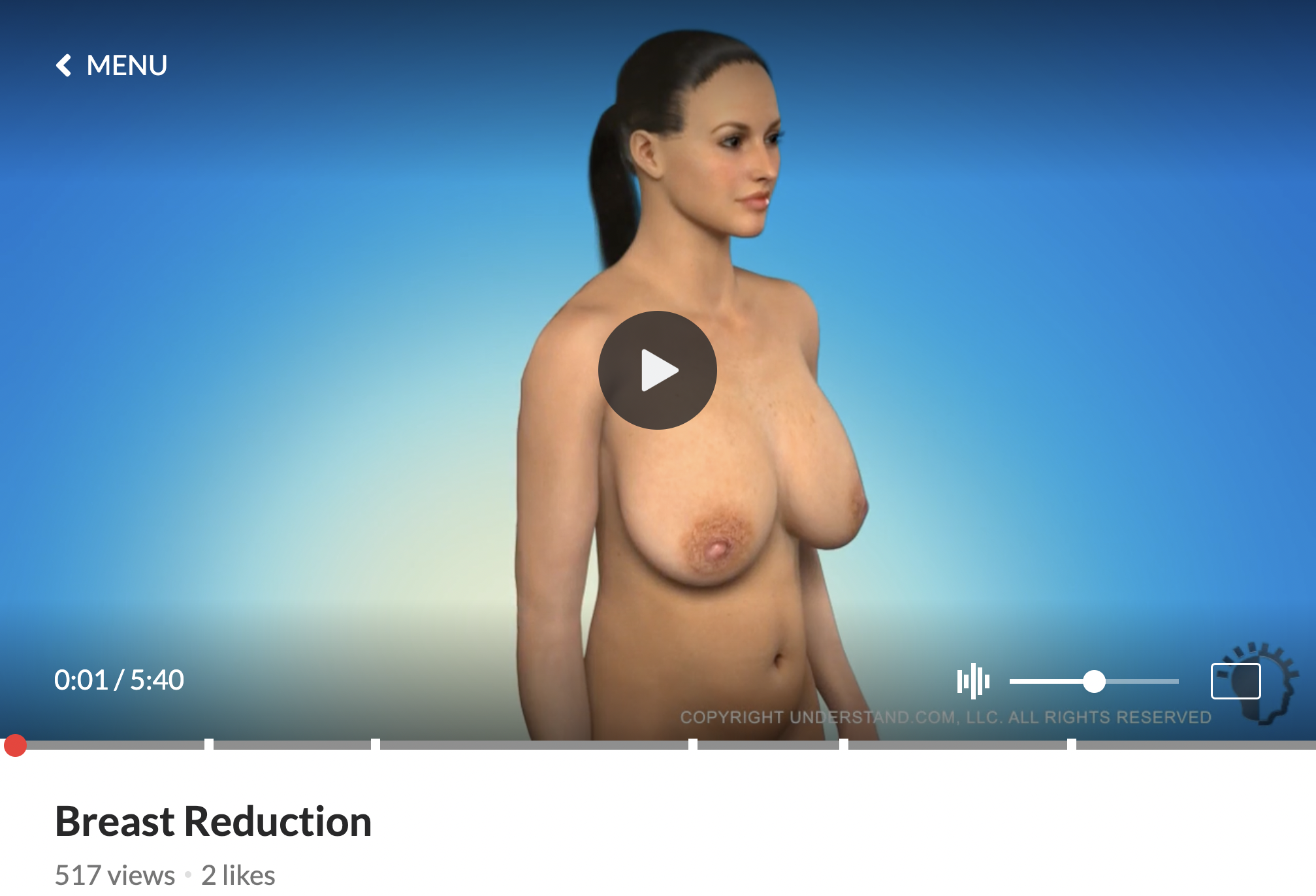
Breast Reduction Surgery Animation
Breast weight can be estimated before Breast Reduction Surgery. Sternal Notch to Nipple distance, 3D Imaging with Crisalix and Vectra are useful Tools.
The surgery typically involves three incisions. After removing the excess breast tissue, fat and skin, the areola and nipple are shifted to a higher position. The size of the areolas may be reduced. The skin above the is brought down and approximated together to reshape the breast. Liposuction may advised as an additional procedure to improve the body contour under the arm.
The Surgeon uses A Special Zebra technique for De-epithelisation step.
The sensation from Breasts is carried out by 3rd ,4th & 5th Intercostal Nerves. The surgeon takes special care around these nerves.
The Surgeon uses advanced anatomical layouts such as Würinger’s Septum in the Breast. Planning around it helps preserve the viability of Nipple and Areola .
Women after Breast Reduction may experience Breast Sagging again due to Gravity effect. By combining use of the Wise Pattern Incision along with the Medial Pedicle , surgeons found they could create a more stable internal structure that resists gravity better than older methods.
If you have already underwent Breast Reduction before, and are looking for a revision surgery for better results, the surgeon might opt for a Modified McKissock Technique.
Overtime, post traditional methods of this Breast Reduction, women might experience as flat upper chest. In such cases, the Surgeon might suggest Breast Implants or Breast Fat injections(Triple Plane Breast Lift) to achieve the upper pole fullness.
The Surgeon could take support from the Breast’s Superficial Fascial System to fix the Breast Tissue. This could help in preventing future sagging.
During Procedure the surgeon would check for viability of the Nipple Areola Complex. They might use advanced technologies like Fluorescein or ICG dye.
To adjust for the apparent shifting of the Nipple–Areola Upwards during the course of post op recovery – the surgeon might place the nipple slightly lower than the actual level.
To check the Breast for any hidden cancer lesions, the surgeon might send the removed breast tissue to the Lab for analysis.
Liposuction for breast reduction
For women fatty breasts who need a minor reduction, and do not need to correct sagging liposuction may be right for them.
| REST AT HOME BEFORE RESUMING OFFICE WORK |
|---|
| 2-3 Weeks |
AFTERCARE AND RECOVERY
Removal of drains within: 7 days. Till then you and your care taker will be instructed on how to measure and keep track of the amount of fluid collected and how to empty them.
Sutures will be removed after 10 days.
Don’t lift your hands above your head or lift any weights with your hands for 2 weeks after the surgery. If you have to take a head bath seek help from your care taker or you may use a hand shower.
Keep your suture sites, dry and hygienic.
The Surgeon may advise a Pain Pump with a numbing medication such as Bupivacaine with can help in a comfortable recovery.
Swelling is a natural phenomenon seen with all surgeries. Most of the swelling would subside within 10 days and a residual swelling (which can only be noticeable to you) may persist for 3-4 months. This should gradually subside. You can further augment for the decrease of swelling by increasing your fluid intake and restricting your salt intake.
Sleeping
For at least 3-4 weeks after the surgery, sleep on your back, this helps avoid any undue stress on your breasts. You can make yourself comfortable, by placing 3-4 pillows around you and one below your knees to avoid rolling over during sleep.
Healing is a gradual process and you should gradually slide into your daily routine, rather than suddenly increasing your work activity. You should regain your full range of motion in six to 10 weeks, depending on your healing.
Don’t do any strenuous physical activity until the surgeon clears you for it.
Within 6 months you should be able to do all those activities, which you were facing difficulty with when you had large breasts.
Refrain from sexual activity for a minimum of one or two weeks, the plastic surgeon may advise you to wait longer depending on your case. After that, take care and be extremely gentle with your breasts for at least 1 month after the surgery.
| FOLLOW UP VISITS |
|---|
| 1 Week After the Surgery |
HOW LONG WILL MY RESULTS LAST?
The results of a breast reduction usually last for decades, provided that you don’t undergo significant fluctuations in weight or do not go through pregnancy.
Even if some droop occur, the newly crafted position of the nipple should remain intact.
The surgeons usually contour the entire breast tissue, and not just a skin lift for a longer-lasting result.
Additionally, the following factors influence the size and shape of your breast
- Weight gain or loss
- Aging
- Hormonal factors
- Childbirth
- Gravity
Maintain good communication with the aesthetic plastic surgeon
Keeping safety in mind as well as for the most beautiful outcome of the procedure, we advise that you visit the clinic for post procedure review and evaluation at prescribed times. Also do not hesitate to contact the doctor if you notice any changes in the treatment areas or when you have any concerns and queries.
ASSOCIATED COSTS
Click here for the cost for Breast Reduction Surgery Hyderabad.
Breast Reduction Surgery Cost varies between individuals.
HOW DO I PREPARE FOR THE PROCEDURE?
For Breast Reduction Surgery Hyderabad, it is better to plan well for a smooth procedure and recovery.
The surgeon would advise a series of Lab tests to check your fitness for the Procedure.
A Special pre op Ultrasound to Map the Blood supply to the Nipple and Areola helps towards a better plan.
If you are above 35 years of age or have a family history of cancer, the doctor might suggest an X-Ray Mammogram.
————-
Ask yourself “Who is the Best Plastic Surgeon Near Me?”.
Contact us to know if you are a suitable candidate for Breast Reduction.
Revera Clinic caters with the Best Plastic Surgeon in Hyderabad! being highly reputed since 2005!
WHO ARE HIGH RISK PATIENTS?
These patients with Heavy Breasts seeking Reduction Mammoplasty are often considered high risk for the Procedure.
- Are older than 50 years.
- Have a Body Mass Index (BMI) greater than 35.
- On chronic corticosteroids use.
- Tobacco Smoking
The Surgeon would advise on the suitability of the procedure for you after an in-person consultation.
LIMITATIONS & RISKS
Significant complications from Breast reduction, fortunately, are infrequent. Every year, thousands of women undergo this procedure successfully and are glad with the results. Women in Hyderabad suffering from Heavy Breasts are also opting for Breast Reduction Surgery in Hyderabad.
The risks specific to your health will be discussed during your consultation.
Some degree of risk will be present with every surgery. Some of the potential complications involved in all surgeries are:
- Allergies
- Infection and bleeding
- Adverse response to the specific medications
- Damage to the underlying structures during the procedure
- Scarring
- Hematoma or seroma (an aggregation of blood or liquid under the skin that might require removal)
- Changes in sensation.
- Unsatisfactory results that might necessitate additional procedures.
For optimal results and to minimize certain risks and it is crucial that you follow the instructions given by the doctor both before and after the surgery.
The Breast Reduction Recovery Timeline
Month 1: The “High and Tight” Phase
Immediately after surgery, your breasts will not look like their final result.
Initial Placement: Your breasts and nipples will likely appear very high on your chest wall.
Swelling: Significant swelling is normal, which can make the breasts feel firm or “boxy”.
The “Lollipop” Pleats: If you had a vertical reduction, the vertical scar may look bunched or pleated; this is a deliberate surgical technique to manage excess skin.
Months 2–3: The “Drop and Fluff”
This is the phase where the most dramatic changes in shape occur.
Gravity Takes Effect: The internal breast tissue begins to settle into the lower part of the “skin brassiere”.
Softening: The tissue begins to feel softer and more natural as internal inflammation subsides.
Symmetry Checks: Surgeons often perform a major follow-up at 6 weeks to evaluate psychosocial well-being and initial satisfaction.
Months 4–6: Reaching the Final Shape
By this point, the “settling” process is nearly complete.
Tissue Slumping: Between months 3 and 6, the breast mound completes its natural “slump” into the final position.
Nipple Alignment: As the breast settles, the nipples move into their permanent relationship with the breast mound.
Final Contour: It takes a full 6 months for the final shape of the breast to fully develop and stabilize.
———————
Managing the “Skin Brassiere”
The skin of your breast acts like a natural brassiere. In the months following surgery, this skin will naturally stretch.
Scar Stretching: It is common for the vertical scar to stretch slightly (sometimes up to 2 cm) as the breast weight settles.
Pseudoptosis: In some cases, the tissue may settle lower than the nipple, a process called “bottoming out”. Specialized techniques such as using the “Medial Pedicle” are often used to minimize this and keep the shape stable.
Pro-Tips for a Smooth Recovery
1. Wear Your Surgical Bra: Proper support during the first 6 weeks helps manage the “slump” and reduces tension on your scars.
2. Be Patient with Scars: Scars often look worst at 3 months (red and raised) before they begin to fade and flatten by the 6-to-12-month mark.
3. Monitor Sensation: Nipple sensation often fluctuates during the first 6 months but is usually well-maintained in most modern techniques.
The Ultimate Scar Care Guide: The First 12 Months
Following a breast reduction, your scars will go through a predictable lifecycle. Understanding this process helps you manage your expectations and take the right steps to ensure they fade as much as possible.
Phase 1: Protection and Initial Healing (Weeks 1–6)
During this stage, the primary goal is to ensure the incisions close securely without tension.
-
Keep it Clean: Follow your surgeon’s specific wound care instructions to prevent infection, which is the leading cause of widened or thickened scars.
-
Minimize Tension: Avoid heavy lifting or overhead reaching. Tension on the incision line can cause the scar to stretch or “widen” permanently.
-
Surgical Bras: Wear your recommended supportive bra 24/7. This takes the weight of the breast off the internal stitches and the skin closure.
Phase 2: The “Angry” Phase (Months 2–4)
Surprisingly, scars often look their worst during this period.
-
The Redness: Scars typically become red, raised, and firm during these months as the body sends extra blood and collagen to the area.
-
The “Pleat” Resolution: If you had a vertical “Lollipop” reduction, any gathers or pleats in the scar usually flatten out by the end of this phase as the skin retracts.
-
Start Silicone Therapy: Once your incisions are fully closed with no scabbing, most surgeons recommend starting silicone gel or sheets. This is the “gold standard” for keeping scars flat and hydrated.
Phase 3: Maturation and Fading (Months 6–12)
This is when the hard work pays off and the scars begin to blend in.
-
Color Change: The deep red or purple color will begin to fade into a pink, and eventually a pale white or silvery line.
-
Sun Protection: This is critical. New scars are highly sensitive to UV light. Sun exposure can cause permanent hyperpigmentation (turning the scar dark brown). Keep scars covered or use a high-SPF mineral sunscreen if exposed.
-
The Natural Merge: In techniques like the Refinement of NAC, the goal is for the darker nipple skin to merge gradually with the breast skin, avoiding a “bull’s-eye” look.
Top Clinical Tips for Better Scars
| Action | Why It Matters |
| No Smoking | Nicotine constricts blood vessels, starving the scar of oxygen and significantly increasing the risk of wound breakdown. |
| Massage | Once cleared by your surgeon, gentle scar massage helps break up internal “fibrosis” and keeps the tissue soft and pliable. |
| Hydration | Keeping the skin hydrated with specialized scar creams or silicone helps prevent the body from overproducing collagen (which leads to raised scars). |
| Patience | A scar is not “mature” until at least the 12-month mark. Do not judge your final result until a full year has passed. |
When to Call Your Surgeon
While redness is normal, you should contact your office if you notice:
-
Hypertrophic Scars: Scars that become very thick, itchy, and stay bright red past 6 months.
-
Widening: If the scar line appears to be pulling apart significantly.
-
Open Wounds: Any small openings or “splitting” of internal stitches (common at the “T-junction” of Anchor scars).
The Essential Post-Op Recovery Kit
Here is a curated list of supplies to have ready before your surgery to ensure a comfortable recovery and optimal scar healing:
1. Support & Comfort
-
Front-Closure Sports Bras: You will need several soft, wireless, front-closure bras. These are easier to put on without lifting your arms and provide the necessary support to prevent “bottoming out” or excessive slumping.
-
Extra Pillows or a Wedge Pillow: You must sleep in a reclined position (about 30–45 degrees) for the first few weeks. This helps reduce swelling and takes tension off the vertical and horizontal incisions.
-
Maternity or Body Pillow: These help prevent you from accidentally rolling onto your stomach or sides during the night, which could put dangerous pressure on the healing tissue.
2. Wound & Scar Care
-
Silicone Scar Sheets or Gel: Once your surgeon confirms the incisions are fully closed (usually around week 3 or 4), silicone is the primary tool for flattening and fading scars.
-
Non-Stick Sterile Gauze Pads: These are useful for “padding” the incisions inside your bra to prevent chafing and to catch any minor “spotting” as the wounds heal.
-
Paper Tape (Micropore): Surgeons often recommend using breathable paper tape over the incisions in the early weeks to provide extra support and prevent the scars from widening.
-
Alcohol-Free Wet Wipes: You will likely be restricted from traditional showering for the first few days. These help you stay clean without getting your surgical dressings wet.
3. Pain & Health Management
-
Stool Softeners: Certain pain medications cause constipation, a stool softener is essential to prevent the common side effect of constipation.
-
Acetaminophen : For patients using advanced pain management like PECS blocks or pain pumps, you may find that simple over-the-counter pain relief is sufficient for “breakthrough” discomfort.
-
High-Protein Snacks: Healing requires extra energy. Stock up on protein shakes, Greek yogurt, or nuts to help your body repair the tissue and close the incisions.
Post-Op Supply Checklist
| Category | Item | Purpose |
| Apparel | Front-closure surgical bras | Support and ease of dressing. |
| Topical | Silicone gel or sheets | Long-term scar maturation. |
| Hardware | Reusable ice packs | To manage swelling (use only as directed by your surgeon). |
| Hygiene | Hibiclens or antimicrobial soap | To reduce the risk of infection before and after surgery. |
Preparation Tip: The “T-Rex” Rule
For the first 2 weeks, you should act like a T-Rex: keep your elbows tucked at your sides. Stock your kitchen and bathroom so that everything you need (medications, water, snacks) is at waist level. Reaching for high shelves can put enough tension on your incisions to cause them to open or widen.
Preparation: The Night Before
-
Final Antimicrobial Wash: Use your antimicrobial soap (like Hibiclens) for a thorough shower, paying close attention to the chest and underarm areas to reduce the risk of infection.
-
Fasting (NPO): Do not eat or drink anything after midnight. This is critical for your safety during general anesthesia or regional blocks.
-
Pack Your Bag: Ensure your “Post-Op Kit” is ready, including your front-closure surgical bra and loose-fitting, button-down clothing.
“Day of Surgery” Itinerary
1. Morning of Surgery (At Home)
-
Medication: If your surgeon instructed you to take specific pre-op medications (such as anti-nausea pills or certain heart medications), take them with only a tiny sip of water.
-
What to Wear: Choose a button-down or zip-front shirt. You will not be able to lift your arms over your head after surgery.
-
Arrival: Aim to arrive at the facility exactly at your scheduled “Arrival Time”—this is usually 1.5 to 2 hours before the “Start Time” to allow for check-in and prep.
2. Pre-Op Suite (Check-In & Prep)
-
Markings: Your surgeon will visit you to perform preoperative markings while you are in an upright position.
-
The Block: If you are receiving a Modified PECS block (bupivacaine and dexamethasone) for pain management, the anesthesia team will often perform this before you enter the operating room to ensure you wake up comfortably.
3. The Procedure (OR Phase)
-
Anesthesia: You will be placed under general anesthesia.
-
Integrated Techniques: During the surgery, your surgeon may use integrated approaches, such as the Central Mound with Vertical Skin Takeout, and may utilize Fluorescein to monitor nipple health.
-
Monitoring: The team will monitor your vitals and blood flow throughout the reduction and reshaping process.
4. Recovery Room (Phase 1)
-
Immediate Wake-up: You will spend 1–2 hours in the PACU (Post-Anesthesia Care Unit).
-
Pain Check: Because of the regional blocks or pain pumps, your pain should be well-managed upon waking.
-
Initial Evaluation: Nurses will check your nipple viability and the status of your dressings.
5. Discharge (Going Home)
-
The “Lollipop” Look: Do not be alarmed if your breasts look very high or if the vertical scar looks pleated; this is normal for the first few weeks.
-
Support: You must have a responsible adult drive you home and stay with you for the first 24 hours.
-
First Dose: Your nurse will explain when to take your first dose of at-home pain medication to stay ahead of the “settling in” discomfort.
Day of Surgery Checklist
| Timeframe | Action |
| Morning | Tiny sip of water for essential meds only. |
| Arrival | Check in and sign final consent forms. |
| Pre-Op | Nipple placement markings (patient must be standing). |
| Post-Op | Put on front-closure surgical bra. |
The 48-Hour Red Flag Guide
While you will be resting and recovering comfortably, it is important for you (and your caregiver) to monitor your body during the critical first 48 hours. Most recoveries are smooth, but knowing these “Red Flags” ensures you can get medical attention quickly if needed.
1. Signs of Hematoma (Internal Bleeding)
A hematoma is a collection of blood under the skin. It is most common in the first 48 hours.
-
The Red Flag: Sudden, significant swelling on one side only.
-
The Red Flag: The breast feels very hard, tight, or “rock-like” to the touch.
-
The Red Flag: Bruising that is rapidly spreading or turning dark purple/black on one side.
2. Concerns with Blood Flow (Nipple Viability)
Surgeons often use fluorescein during surgery to ensure the nipple is healthy. At home, you should monitor the color.
-
The Red Flag: The nipple-areola complex turns dusky, dark blue, or black.
-
The Red Flag: If you gently press the nipple, the color does not return to pink quickly (poor capillary refill).
-
The Red Flag: The nipple feels cold to the touch compared to the surrounding skin.
3. Infection Warning Signs
While infections usually take a few days to develop, early signs can appear within 48 hours.
-
The Red Flag: A fever higher than 101°F (38.3°C).
-
The Red Flag: Redness that is spreading away from the incision lines like a “sunburst”.
-
The Red Flag: Foul-smelling drainage or thick yellow/green discharge from the incisions.
4. Serious Systemic Issues
These are rare but require immediate emergency care (Call 911 or go to the ER).
-
The Red Flag: Shortness of breath or sudden chest pain.
-
The Red Flag: Sudden swelling, pain, or redness in one of your calves (sign of a blood clot or DVT).
-
The Red Flag: Fainting, extreme dizziness, or inability to stay awake.
Emergency Contact Protocol
| Symptom | Who to Call |
| One-sided swelling / Blue nipple | Your Plastic Surgeon’s 24/7 After-Hours Line. |
| Fever / Incision redness | Your Plastic Surgeon’s Office during business hours. |
| Chest pain / Difficulty breathing | Call 108 Immediately. |
A Note on “Normal” Discomfort
It is easy to mistake normal healing for a red flag. The following are NOT red flags during the first 48 hours:
-
Mild Asymmetry: Swelling is rarely perfectly even.
-
Slight Blood on Dressings: A small amount of “spotting” on your gauze is expected.
-
Pleated Scars: A vertical scar that looks gathered or “puckered” is a normal surgical technique.
-
Numbness: It is normal for the nipples or skin to feel numb or have “zinging” nerve pains as they wake up.
TESTIMONIALS
Read this wonderful review posted by one of our Best patients on Real Self here!
Suman TV did an impressive coverage of our work. Check this out!
In Hyderabad, as of 2026, the cost for Breast Reduction Surgery generally ranges between 1,25,000 INR to 2,75,000 INR. These prices are indicative and the actual prices may vary. The cost depends on the complexity of the case, clinic location, surgeon’s expertise, Hospital fee, anesthesia, specific patient needs, Laboratory Investigations and additional taxes.
Cosmetic Surgeons use the Golden Ratio for planning the procedures. It is also referred to as Phi, Divine Proportion, mathematical ratio 1: 1.618. The ideal breast Proportion is 45:55. Meaning 45 percent of the Breast should be above nipple and the remaining 55 percent should be below the Nipple.
One can consider Breast Reduction, if they notice sagging of the Nipple below the mid point of the arm in standing posture. Also, when they are facing functional issues like Neck pain, Shoulder pain, difficulty breathing. They can consult a Plastic Surgeon when their cup size is “C” or larger.
Reduction Mammoplasty Surgery takes 2-4 hours only.
Heavier Breasts classified as Gigantomastia take longer.
Breast Reduction is possible Through Reduction Mammoplasty Surgery. The procedure itself takes 2-4 hours only.
Weight Loss can lead to deflation of Breasts due to fat loss.