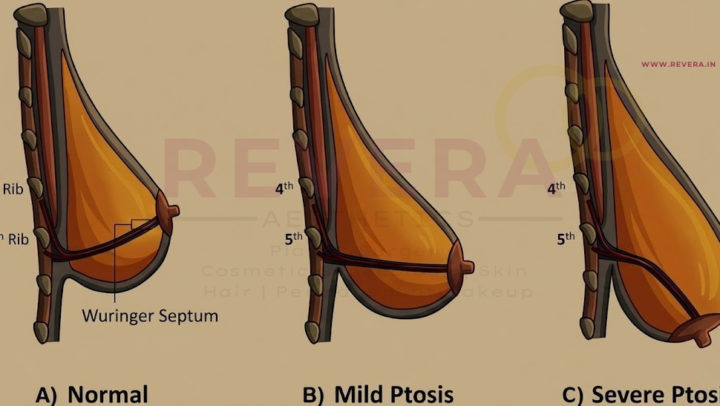

Image showing Würinger’s Septum in various grades of Breast Ptosis

The “Safety Net” Pedicle: Using Würinger’s Septum to Prevent Nipple Loss in Breast Reduction Surgery

4 Jan 2026


The Study: A Solution from South Africa


In September 2010, plastic surgeons from the University of Stellenbosch (Bellville, South Africa) published a landmark study in Plastic and Reconstructive Surgery. Their goal was to address one of the most feared complications in breast surgery: nipple necrosis (tissue death).


After analyzing 106 consecutive patients (211 breasts) between 2001 and 2009, they proposed a technique that relies on a specific "anatomical highway" to keep the nipple safe.


The Anatomy: What is Würinger’s Septum?


To understand why this technique works, you must understand the anatomy of the breast.


  • Würinger’s Septum: This is a horizontal band of connective tissue that runs through the breast.It acts like a "shelf" or a hammock supporting the breast tissue.


  • The Highway: More importantly, this septum carries the nerves and blood vessels from the chest wall directly to the nipple.


Most traditional techniques cut through parts of this supply. The authors of this study argued that by preserving this specific ligament, surgeons can maintain a "dual" blood supply that is nearly bulletproof.


Würinger’s Septum to prevent Nipple Loss in Breast Reduction Surgery.


The Technique: The "Posteroinferomedial" Pedicle


The authors developed a pedicle (the bridge of tissue carrying the nipple) that captures blood from two distinct sources, making it exceptionally reliable.


1. The Medial Source (Internal Thoracic Artery)


By keeping the medial vertical ligament intact, the surgeon preserves the large perforating arteries (2nd, 3rd, and 4th) coming from the center of the chest.


2. The Inferior Source (Anterior Intercostal Arteries)


By keeping the horizontal septum intact, the surgeon captures the inferior mammary branches coming from the ribs.


This "Posteroinferomedial" approach ensures that even if one blood supply is weak, the other takes over, dramatically reducing the risk of the nipple dying.


Results: Versatility and Safety


The study showed that this technique is not only safe but also highly versatile.


  • Shape: It provided good nipple projection and upper breast fullness.


  • Flexibility: It can be used with almost any skin incision—whether "donut" (periareolar), "lollipop" (vertical), or "anchor" (inverted-T).


  • Learning Curve: The authors noted that the technique is easy to learn for surgeons familiar with breast anatomy.


Conclusion


For patients with risk factors like smoking or very large breasts, blood supply is everything. The Posteroinferomedial Pedicle offers a surgical "insurance policy" by utilizing Würinger’s septum to double the blood flow to the nipple.


Ask yourself “Who is the Best Plastic Surgeon Near Me?”.


Revera Clinic caters with the Best Plastic Surgeon in Hyderabad!


Breast Reduction Surgery Cost varies between individuals!


Contact us to know if you are a suitable candidate for Breast Reduction Surgery!


Frequently Asked Questions (FAQ)


Q: Does this technique preserve nipple sensation?


A: Yes. Because Würinger’s septum carries the main nerves to the nipple alongside the arteries, preserving it typically results in excellent sensation retention.


Q: Is this technique used for breast lifts (mastopexy) too?


A: Yes. The study confirmed its safety for both reduction mammaplasty and mastopexy (lifts).


Q: Why is "dual blood supply" better?


A: Human anatomy varies.18 Some people have strong medial arteries, while others have strong inferior ones. Capturing both ensures the nipple survives regardless of your specific anatomy.


References


The Anti-Gravity Lift: Why Vertical Breast Reduction Surgeries Don’t “Bottom Out”

4 Jan 2026


The Fear of the "Droop"


One of the biggest concerns patients have about breast reduction is: "Will they just sag again in a few years?"


In traditional Anchor (Wise Pattern) reductions, a phenomenon called pseudoptosis (or "bottoming out") is common. This happens when the breast tissue slides down the chest wall, stretching the lower skin and leaving the nipple looking too high.


However, a landmark study published in Plastic and Reconstructive Surgery confirms that the Vertical Scar (Lollipop) technique behaves very differently. In fact, it seems to defy gravity. It was conducted at USA and Canada. The Study was published in 2007.


The Anti Gravity Lift with Vertical Breast Reduction Surgery


The Study: 4 Years of "Settling"


Dr. Lista and Dr. Ahmad analyzed 49 women who underwent Vertical Scar Reduction Mammaplasty. They measured the breast position before surgery, 5 days after, and again 4 years later.


They wanted to answer two questions:


  1. Does the bottom of the breast stretch out?


  2. Does the nipple stay where we put it?


Discovery 1: The "Shrinking" Bottom


Contrary to the "bottoming out" seen in other techniques, the researchers found that the bottom of the breast (the inferior pole) actually tightened over time.


  • The Data: The distance from the breast crease (inframammary fold) to the bottom of the nipple decreased by 0.4 cm over four years.


  • The Result: Instead of sagging, the vertical technique relies on skin retraction that maintains a tight, perky lower breast shape for years.


Discovery 2: The Rising Nipple


This was the most surprising finding. In most surgeries, surgeons expect gravity to pull everything down. In the Vertical reduction, the nipple actually moved up.


  • Post-Op Day 5: The nipple was found 1.3 cm higher than where it was marked on the skin before surgery.


  • 4 Years Later: It remained 1.0 cm higher than the original markings.


This "upward migration" is unique to the way the vertical technique reshapes the internal tissue (coning), pushing the breast mound upward.


The Surgeon's Secret: "Marking High"


Because of this study, Dr. Lista changed the way he marks patients. To ensure the nipple lands in the perfect "sweet spot," he anticipates this upward movement.


  • The Old Way: Marking the center of the nipple at the breast crease.


  • The New Rule: Marking the superior border (top edge) of the nipple at the level of the breast crease.


By placing the nipple lower initially, it naturally rises into the perfect position as the breast heals and settles.


Conclusion


If you are looking for long-term projection and want to avoid the "bottomed out" look, the Vertical Scar technique has the data to back it up. Unlike other methods where gravity wins, this technique uses the skin's own elasticity to keep the breast lifted and compact for years after surgery.


Ask yourself “Who is the Best Plastic Surgeon Near Me?”.


Revera Clinic caters with the Best Plastic Surgeon in Hyderabad!


Breast Reduction Surgery Cost varies between individuals!


Contact us to know if you are a suitable candidate for Breast Reduction Surgery!


Frequently Asked Questions (FAQ)


Q: What is "Pseudoptosis"?


A: It is a condition where the breast tissue sags below the nipple, while the nipple itself remains high on the chest. It creates a "snoopy nose" deformity. This study proved that pseudoptosis does not occur with the vertical technique.


Q: Why does the vertical scar technique heal differently?


A: It relies on "coning" the tissue and allowing the skin to retract (shrink-wrap) around the new shape, rather than just cutting away skin and stitching it tight.


Q: Will my nipples look too low right after surgery?


A: They might! Because your surgeon knows the nipple will migrate upward by about 1 cm, they may intentionally place it slightly lower during the operation.


References


The Science of Prediction: How Heavy Are Your Breasts for Breast Reduction Surgery?

4 Jan 2026


The Quest for a Simple Formula


Researchers analyzed data from 263 women to find a reliable way to estimate breast weight before Breast Reduction surgery. They looked at several factors:


  • Age, height, and weight.


  • The distance from the sternal notch (the "V" at the base of your throat) to the nipple.


  • The distance from the sternal notch to the inframammary crease (the fold under the breast).


The "Magic Number": Sternal Notch to Nipple


The study found that one measurement was more powerful than all others: The distance from the sternal notch to the nipple. This single measurement accounted for almost all the predictable variance in breast weight. The researchers discovered a strong correlation (0.80) between this distance and the final weight of the tissue removed.


Key Benchmarks for Insurance Coverage:


Many insurance plans require at least 500 grams per side. The study found the following:


  • $\ge 28.5$ cm: If your notch-to-nipple distance is 28.5 cm or more, there is an 80% chance the resection weight will be over 500 grams.


  • 25.5 to 28 cm: In this "critical range," the predicted weight falls between 400 and 600 grams. There is only a 50% chance of hitting that 500-gram insurance mark.


The Human Element: Experience vs. Math


While the researchers developed a mathematical equation, they found a surprising result: The experienced surgeon was still more accurate than the formula.


In that tricky 400g to 600g "gray zone," the senior surgeon was able to predict weights over 500g with 94% accuracy. This is because seasoned surgeons use "practiced spatial relationship skills"—essentially, they can "see" the volume and density of the breast in a way a ruler cannot.


Modern Context: AI and 3D Imaging


Since this study was published, technology has advanced significantly. While the notch-to-nipple measurement remains a "gold standard" in the office, many modern clinics now use 3D Surface Imaging (like Crisalix or Vectra).


Recent research published in Plastic and Reconstructive Surgery shows that 3D imaging and artificial intelligence can now predict resection weights with even higher precision than manual measurements alone, helping to reduce the risk of insurance denials.


Ask yourself “Who is the Best Plastic Surgeon Near Me?”.


Revera Clinic caters with the Best Plastic Surgeon in Hyderabad!


Breast Reduction Surgery Cost varies between individuals!


Contact us to know if you are a suitable candidate for Breast Reduction Surgery!


Frequently Asked Questions (FAQ)


Q: Why does the insurance company care about the weight?


A: Insurers use weight as a proxy for "medical necessity." They believe that if a surgeon removes a large enough amount of tissue, the surgery is treating a physical condition (like back pain) rather than being purely cosmetic.


Q: What if I am just short of the 500g requirement?


A: This is the "critical range" mentioned in the study. In these cases, your surgeon’s clinical notes about your symptoms (shoulder grooving, rashes, neck pain) become even more vital for your insurance appeal.


Q: Does breast density affect the weight?


A: Yes. Glandular tissue is heavier than fatty tissue. This is one reason why the notch-to-nipple measurement isn't 100% perfect—it measures length, not density.


References


The “Owl” Incision: A Smarter Way to Shape the Breast in Breast Reduction Surgery

4 Jan 2026


The Evolution of the Scar


For decades, the "Wise Pattern" (the Anchor scar) was the gold standard for breast reduction. However, many patients and surgeons were frustrated by the results: the breasts could look "boxy," lacked projection (perkiness), and left very long scars.


While the "Lollipop" (vertical) and "Round Block" (donut) techniques emerged as alternatives, each had limitations. Dr. Oscar Ramirez combined the best features of both to create the "Owl" Incision.


What is the "Owl" Technique?


The technique gets its name from the shape of the preoperative markings, which resemble the eyes and beak of an owl. It is designed to maximize shape while minimizing the footprint of the scar.


Key Features of the "Owl" Method:


  • Heart-Shaped Resection: Instead of removing tissue from the bottom, the surgeon performs a heart-shaped resection of the internal tissue.


  • Supero-Central Pedicle: The nipple is kept on a central pillar of tissue. This ensures a robust blood supply and preserves nerve sensation.


  • No Undermining: Unlike traditional surgery, the skin is not separated from the underlying tissue. This means no drains are needed and healing is much faster.


  • The "Vertical Pillar" Move: The internal tissue is folded toward the center of the breast. This creates "excellent projection"—essentially building a natural internal bra to make the breasts look perkier.


Small Scars, Big Capacity


One of the biggest myths in plastic surgery is that you need a large scar for a large reduction. Dr. Ramirez's study of 94 patients over seven years proved otherwise:


  • Massive Reductions: He successfully removed up to 1,900 grams (over 4 lbs) per breast using the Owl technique.


  • Outpatient Safety: Nearly 90% of patients had their surgery as outpatients, going home the same day.


  • No "Dog Ears": By adding a very short horizontal line at the bottom, the technique eliminates the bunching of skin (dog ears) often seen in other vertical methods.


The Benefits Beyond Aesthetics


Because the "Owl" technique avoids aggressive undermining and preserves the central tissue, it offers functional benefits that traditional "Anchor" reductions might not:


  • Preserved Sensation: The nerves leading to the nipple are better protected.


  • Breastfeeding Support: Because the central tissue and milk ducts are largely left intact, the ability to lactate is often preserved.


  • Immediate Results: Unlike other vertical techniques that look "pleated" or gathered for months, the Owl technique provides excellent shape immediately on the operating table.


Conclusion


The Owl incision represents a "best of all worlds" approach. It offers the perkiness of a vertical reduction with the safety and volume capacity of a traditional one, all while keeping the scars to a minimum. If you are looking for a technique that prioritizes breast projection and sensation, the Owl method is a proven, reliable choice.


Ask yourself “Who is the Best Plastic Surgeon Near Me?”.


Revera Clinic caters with the Best Plastic Surgeon in Hyderabad!


Breast Reduction Surgery Cost varies between individuals!


Contact us to know if you are a suitable candidate for Breast Reduction Surgery!


Frequently Asked Questions (FAQ)


Q: Will I have a scar underneath the breast?


A: With the Owl technique, the horizontal scar is either completely eliminated or made very short, making it much less visible than a traditional "Anchor" scar.


Q: Why don't I need drains with this technique?


A: Drains are typically used when skin is separated (undermined) from the tissue. Since this technique avoids that separation, there is no space for fluid to collect, making drains unnecessary.


Q: Is this technique good for "droopy" breasts (ptosis)?


A: Yes. The study specifically noted that it is excellent for correcting severe ptosis while maintaining high vascular safety for the nipple.


Reference


Your Post-Breast Reduction Surgery Mammogram: What Has Changed?

4 Jan 2026

The New "Baseline"


If you have a breast reduction, your breasts undergo significant internal changes. It is not just the outside that is reshaped; the internal glandular tissue is moved, stitched, and sometimes combined with liposuction.


Because of this, your mammograms will look different for the rest of your life. Dr. Joan Robertson conducted a study on 50 patients to document these "constant and significant" changes.


Why Does the Image Change?


The surgery involves moving the "nipple-areola complex" and the underlying tissue. This shifting creates specific features that a radiologist (a doctor who reads X-rays) must recognize so they don't mistake them for something more serious.


1. Internal Scarring (Fibrosis)


As the breast heals, internal "scar tissue" forms where the incisions were made. On a mammogram, this can appear as thickened areas or shadows.


2. Oil Cysts and Calcifications


Sometimes, small areas of fat tissue lose their blood supply during surgery. This is called fat necrosis. While harmless, it can turn into "oil cysts" or tiny calcium deposits (calcifications) that show up clearly on an X-ray.


3. The "Mediolateral" Shift


Interestingly, Dr. Robertson found that these changes are often most visible on the mediolateral view (the side-to-side view) rather than the cranio-caudad (top-down) view.


Safety First: The Hidden Findings


As we discussed in the Emory University study, surgeons always send the removed tissue to a lab to check for hidden abnormalities.


  • The Benefit: This routine check catches hidden findings in 1.8% of general patients.


  • The Protocol: Having a "normal" mammogram before surgery is standard, but the lab test after surgery is an extra layer of safety.


Tips for Your Future Mammograms


  1. Wait for the Settling: Most surgeons recommend waiting 3 to 6 months after surgery before getting a new "baseline" mammogram.


  2. Inform the Tech: Always tell the mammogram technician that you have had a breast reduction. They will place specialized "scar markers" (tiny stickers) on your skin so the radiologist knows where the surgical lines are.


  3. Provide Old Films: If possible, give your radiologist your mammograms from before the surgery. Comparing the "old" breast to the "new" breast helps them identify which changes are purely surgical.


Conclusion


A breast reduction does not make it harder to detect cancer, but it does change the "landscape" of your breast tissue. By understanding these changes and communicating with your medical team, you can continue your routine screenings with confidence and peace of mind.


Ask yourself “Who is the Best Plastic Surgeon Near Me?”.


Revera Clinic caters with the Best Plastic Surgeon in Hyderabad!


Breast Reduction Surgery Cost varies between individuals!


Contact us to know if you are a suitable candidate for Breast Reduction Surgery!


Frequently Asked Questions (FAQ)


Q: Does breast reduction increase the risk of breast cancer?


A: No. In fact, some studies suggest that because you have less breast tissue after surgery, the overall risk may slightly decrease.


Q: What if my mammogram shows "calcifications"?


A: Post-surgical calcifications are very common. Radiologists can usually tell the difference between "benign" (harmless) surgical calcifications and those that require further testing.


Q: Should I get a mammogram right before my surgery?


A: Yes. The ASPS Guidelines recommend a preoperative mammogram for most women over the age of 35 or those with a family history of breast cancer.


References


Why Do Nipples Sometimes “Shift” After Breast Reduction Surgery?

3 Jan 2026


The Mystery of the Moving Nipple


One of the most frustrating issues after a successful breast reduction is seeing the nipple position change months after the surgery. A patient may leave the operating room with perfect symmetry, only to find that 3 to 6 months later, the nipples appear to be "riding high" on the breast mound.


Surgeons Dr. Melvyn Dinner and Dr. Lawrence Chait studied this phenomenon in 50 patients who underwent the McKissock vertical dermal pedicle technique. While the technique was excellent for nipple health and sensation, they discovered a consistently recurring problem: the "high-riding nipple".


The Cause: Gravity and the "Skin Brassiere"


The study revealed that the nipple doesn't actually move up; rather, the breast tissue moves down.


  • The Slump: Over the first few months, the breast tissue settles and "slumps" due to gravity.


  • The Stretch: The "skin brassiere" (the skin holding the breast) naturally stretches under the weight of the remaining breast tissue.


  • The Scar: In some cases, the vertical scar itself can stretch significantly—sometimes by as much as 2 cm.


As the bottom of the breast drops and the skin stretches, the nipple—which is anchored higher up—appears to "ride" too high in relation to the new breast mound.


Proven Success: Safety is Still High


Despite this aesthetic challenge, the McKissock technique proved to be incredibly safe in this series of 100 breasts:


  • 100% Nipple Viability: There was no nipple loss or even minor skin peeling.


  • Full Sensation: Every patient maintained nipple sensation to light touch.


  • High Satisfaction: Patients were generally satisfied with the shape and the resulting scars.


How Surgeons Prevent the "High Ride" Today


To avoid this long-term shift, modern surgeons have refined how they plan the surgery:


  1. Lower Initial Placement: Some surgeons intentionally place the nipple-areola complex slightly lower than the "ideal" spot during surgery, anticipating that the breast will settle into a perfect position later.


  2. Internal Support: Using techniques like the "Internal Bra" or specialized suturing helps anchor the breast tissue so it doesn't slump as much.


  3. Accurate Marking: Preoperative markings are done with the patient standing up to account for the natural pull of gravity on the tissue.


Conclusion


If your nipples look slightly "low" immediately after a reduction, don't worry—your surgeon may have planned it that way. Understanding that the "skin brassiere" will stretch over the first six months allows surgeons to compensate for gravity and ensure your nipples stay in the perfect spot for years to come.


———————–


Ask yourself “Who is the Best Plastic Surgeon Near Me?”.


Revera Clinic caters with the Best Plastic Surgeon in Hyderabad!


Breast Reduction Surgery Cost varies between individuals!


Contact us to know if you are a suitable candidate for Breast Reduction Surgery!


Frequently Asked Questions (FAQ)


Q: Is a high-riding nipple dangerous?


A: No, it is purely an aesthetic concern. It does not affect the health of the breast or the success of the surgery in terms of pain relief.


Q: How long does it take for the breast to "settle" into its final shape?


A: Most of the stretching and slumping occurs between 3 to 6 months after the procedure.


Q: Can a high-riding nipple be fixed?


A: Yes. If the nipple position is significantly off after the breast has fully settled, a minor revision can often be performed to adjust the placement.


Reference


The Nipple Safety Test: How Surgeons Use “Fluorescence” to Prevent Complications in Breast Reduction Surgery

31 Dec 2025


The Surgical Anxiety: The "Dusky" Nipple


At the very end of a breast reduction procedure, one of the most stressful moments for a plastic surgeon is seeing a "dusky" or blue-looking nipple-areola complex. This discoloration can indicate poor blood flow, which may lead to a "slough" or the death of the tissue.


Historically, the response was to apply dressings and hope for the best the following morning. However, researchers in La Jolla, California, pioneered a more scientific approach: the Intravenous Fluorescein Test.


What is the Fluorescein Test?


Fluorescein is a special dye (resorcinolphthalein) that has been used in medicine since 1881. When injected into the bloodstream, it travels through the vessels and into the skin.


How the Test Works During Surgery


  1. The Injection: Before the final stitches are placed, the surgeon injects a specific dose of fluorescein intravenously.


  2. The UV Light: Fifteen minutes later, the room is darkened, and the breast is examined under an ultraviolet (UV) light.


  3. The Glow: Healthy, viable skin will glow a bright chartreuse (yellow-green) color under the light.


  4. The Warning: Any areas that remain dark blue or do not glow are at high risk for tissue loss.


The Study: Saving the Nipple in Real-Time


In a series of 35 patients undergoing McKissock-type reductions, surgeons used this test to predict and avoid disasters.


  • The Reassurance: In 31 patients, the tissue glowed perfectly, confirming that everything was healthy.


  • The "False Alarm": In one patient, the nipple looked blue to the eye, but the fluorescein test showed it was glowing. The surgeon left it alone, and the tissue survived perfectly.


  • The Life-Saving Intervention: In another patient, the test revealed no glow. The surgeon opened the incision and found that the internal tissue "pedicle" was kinked and folded too tightly. After correcting the position, the nipple glowed, and the tissue was saved.


Why This Matters for Your Safety


While this specific test was pioneered in the early 1980s, the principle remains a cornerstone of modern plastic surgery: Objective Safety Monitoring.


Today, surgeons may use similar fluorescence technology (like ICG-Angiography) to check blood flow during complex reconstructions. This "safety check" allows your surgeon to:


  • Predict tissue survival with high accuracy.


  • Correct internal issues (like kinked blood vessels) while you are still in the operating room.


  • Avoid the "disaster" of nipple tissue loss.


Conclusion


Your safety during a breast reduction isn't left to "prayer and hope". Advanced techniques like fluorescein testing give surgeons a "window" into your blood circulation, ensuring that your results are not only beautiful but also medically sound.


-----------------------


Ask yourself “Who is the Best Plastic Surgeon Near Me?”.


Revera Clinic caters with the Best Plastic Surgeon in Hyderabad!


Breast Reduction Surgery Cost varies between individuals!


Contact us to know if you are a suitable candidate for Breast Reduction Surgery!


Frequently Asked Questions (FAQ)


Q: Is the fluorescein dye safe?


A: Yes, it has been used safely in ophthalmology and surgery for over a century. The body typically clears the dye within 24 hours.


Q: Does every surgeon use a UV light test?


A: Not every surgeon uses this specific test for every patient. However, most will use clinical signs (like "capillary refill") or modern infrared imaging if they have any concerns about blood flow during your procedure.


Q: Can a "dusky" nipple still survive?


A: Yes. As the study showed, sometimes a nipple looks dusky due to temporary bruising or vein congestion, but is actually healthy. The fluorescein test helps the surgeon tell the difference.


References


Small Scars, Large Results: The Integrated “Vertical” Technique for Breast Reduction Surgery

30 Dec 2025


The Best of Both Worlds


When considering breast reduction, many patients are caught between two desires. They want a significant reduction in size, but they also want to avoid the long horizontal scar of a traditional "Anchor" reduction.


The Lejour Vertical Technique is famous for reducing scars, but some believe it is only for small procedures. However, surgeons in Charleston have developed a way to integrate the Central Mound technique with vertical skin removal to handle larger cases safely.


How the Integrated Technique Works


This approach is unique because it combines internal tissue shaping with external skin management.


  • Vertical Skin Resection: This limits the scar to a "lollipop" shape, significantly decreasing visible scarring.


  • Central Mound Reduction: By removing tissue from the central and superior (upper) part of the breast, surgeons can remove 400 to 1000 grams per side while preserving the blood supply and feeling in the nipple.


  • Internal Support: Unlike other methods, the tissue at the bottom (inferior pedicle) is folded on itself. This acts like an internal bra, providing better support and projection.


The Role of Liposuction


A major part of this technique is the use of extensive liposuction in the lateral breast and underarm (axilla) areas.


  • Efficiency: Up to two-thirds of the breast tissue can sometimes be removed using liposuction alone if the breast is composed mostly of fat.


  • Safety First: Surgeons carefully avoid liposuction in the center of the breast to protect the blood supply to the nipple.


Is This Technique Right for You?


This integrated approach is ideal for candidates who need a moderate to large reduction (up to 1000g per side) but prioritize a smaller scar.


Important Considerations:


  1. Nipple Placement: If your nipple needs to be moved more than 8 cm vertically, a different procedure may be safer.


  2. Patience is Key: It can take up to 6 months for the final shape of the breast to settle and develop.


  3. Smoking Status: Smoking significantly reduces the safety of this procedure and the distance a nipple can be moved.


Conclusion


By integrating the central mound with the vertical scar technique, surgeons can offer "superior shaped" results through much smaller incisions. It is a powerful option for achieving significant relief from heavy breasts without the traditional "Anchor" scar.


-----------------------


Ask yourself “Who is the Best Plastic Surgeon Near Me?”.
Contact us to know if you are a suitable candidate for Breast Reduction.


Revera Clinic caters with the Best Plastic Surgeon in Hyderabad!


Contact us to know if you are a suitable candidate for Vertical Small Scar Breast Reduction Surgery!


Frequently Asked Questions (FAQ)


Q: Will I lose sensation in my nipples?


A: This specific combination of techniques is designed to preserve the innervation (nerve supply) to the nipple-areola complex even during large reductions.


Q: What is "tumescent fluid"?


A: It is a solution injected into the breast before surgery that helps with liposuction and reduces bleeding.


Q: Do I need a mammogram first?


A: According to the study's protocol, mammograms are routinely obtained for patients over 35 or those with a family history of breast cancer.


Reference


Preventing the “Sag”: How to Keep Your Breast Shape After Breast Reduction Surgery

29 Dec 2025


The Problem: The "Bottoming Out" Effect


Many patients are thrilled with their breast reduction results immediately after surgery. However, a common long-term concern is "pseudoptosis," better known as bottoming out.


This happens when the breast tissue sinks toward the bottom of the breast over time. It can leave the nipple looking too high and the lower part of the breast looking overly heavy or stretched.


Is this inevitable? According to a study published in Plastic and Reconstructive Surgery, the answer depends on the surgical technique used – Which could help Preventing Sagging After Breast Reduction Surgery!


The Solution: The Medial Pedicle Technique


Researchers in New York analyzed 88 consecutive patients who underwent a specific type of surgery: the Medial Pedicle with a Wise Pattern resection.


  • Medial Pedicle: This refers to the "bridge" of tissue that keeps the blood supply to the nipple coming from the middle of the chest.


  • Wise Pattern: This is the traditional "Anchor" shaped incision pattern.


By combining these two, surgeons found they could create a more stable internal structure that resists gravity better than older methods.


The Results: Stability Over Time


The study followed patients for a minimum of one year to see how their shape changed. They measured the distance from the nipple to the crease under the breast (inframammary fold).


The Findings:


  • Minimal Stretching: For moderate reductions (500g to 1200g per side), the distance increased by only 11% after a year.


  • Handling Massive Weight: Even in very large reductions (>1200g per side), the technique remained effective at preventing significant sagging.


  • Efficiency: The average operative time was fast—just 104.5 minutes.


  • Safety: The complication rate was low at 6.8%.


Conclusion: A Reliable Way to Lasting Results


If you are considering a breast reduction, you want a result that looks as good in five years as it does in five months.


The authors concluded that the medial pedicle approach is an effective and reliable way to treat a wide range of breast sizes. It offers a short operative time, a low risk of complications, and—most importantly—less "bottoming out" over the long term.


——————————-


Ask yourself “Who is the Best Plastic Surgeon Near Me?”.
Contact us to know if you are a suitable candidate for Breast Reduction.


Revera Clinic caters with the Best Plastic Surgeon in Hyderabad!


Frequently Asked Questions (FAQ)


Q: What exactly is "pseudoptosis"?


A: It is the medical term for the appearance of sagging where the breast tissue falls below the crease, but the nipple remains relatively in place.


Q: Is this technique suitable for very large breasts?


A: Yes. The study included patients with severe hypertrophy and found the medial pedicle to be highly reliable even for massive reductions.


Q: Does a shorter surgery time mean it's less safe?


A: Not at all. In this study, the short operative time was combined with a very low complication rate of only 6.8%.


Reference


Based on the research from Manhattan Eye Ear and Throat Hospital, here is a checklist of high-value questions you can ask during your consultation to see if the medial pedicle technique is the right approach for your surgery.


Consultation Checklist: Discussing Technique and Longevity


  • "What 'pedicle' do you typically use for my size of reduction?"

    • Why ask: While many surgeons use an inferior pedicle, the medial pedicle has been shown to be exceptionally reliable for both severe hypertrophy and aesthetic shaping.


  • "How do you address the risk of 'bottoming out' or pseudoptosis over time?"

    • Why ask: Research indicates that the medial pedicle technique results in significantly less long-term sagging—an average increase of only 11% in the lower breast length for standard reductions.


  • "Is the medial pedicle safe for the amount of tissue I need removed?"

    • Why ask: This technique is proven to be effective and safe even for massive reductions (over 1200g per side).


  • "What is your typical operative time for this procedure?"

    • Why ask: The medial pedicle with a Wise pattern is known for being an efficient procedure, averaging around 104 minutes, which can mean less time under anesthesia.


  • "Can I see 'long-term' before and after photos (at least 1 year post-op)?"

    • Why ask: Since "bottoming out" occurs over time, looking at results from patients followed for a year or more is the best way to judge the stability of the surgeon's technique.