
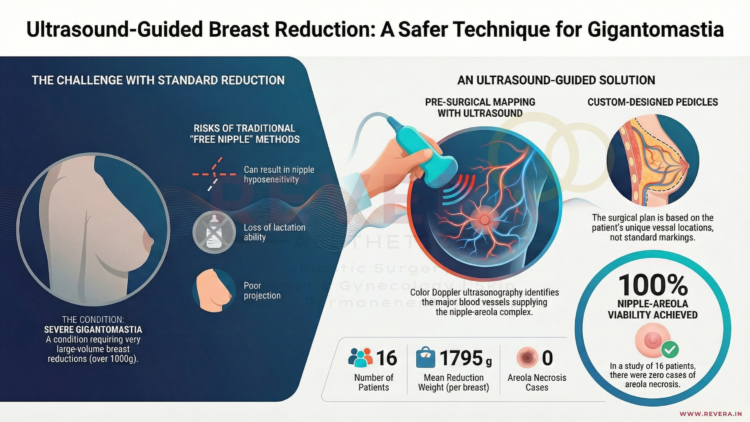
Massive Breast Reduction: How Ultrasound Can Save Your Nipple Sensation
The Fear of the “Free Nipple Graft”
Women with extremely large breasts (Severe Gigantomastia) often face a difficult choice. They want relief from the heavy weight. However, surgeons often tell them they need a “Free Nipple Graft.”
This technique involves completely removing the nipple and sewing it back on as a skin graft. It is safe, but the trade-off is steep. Patients often lose nipple sensation, nipple projection, and the ability to breastfeed.
Why Is This Usually Necessary?
In standard breast reductions, surgeons rely on general anatomical rules to keep the nipple alive. We assume we know where the blood vessels are.
But in severe gigantomastia, the anatomy is stretched. The nipple sits very far away from the chest wall. Guessing the location of the blood vessels becomes risky. If the surgeon guesses wrong, the nipple could die. Therefore, many choose the Free Nipple Graft to be safe.
The Solution: Seeing Inside with Ultrasound
A study published in Plastic and Reconstructive Surgery offers a smarter, technology-driven alternative.
Researchers from Istanbul Medical Faculty decided not to guess. Instead, they used Color Doppler Ultrasonography before surgery to map out the breast.
How It Works
- The Scan: Before the operation, the surgeon uses an ultrasound probe to scan the breast.
- The Map: They identify exactly which blood vessels (perforators) are feeding the nipple-areola complex.
- The Design: The surgeon designs a custom tissue bridge (“pedicle”) specifically for that patient. It protects those specific vessels.
Customizing the Surgery
The study showed that every woman is different.
- Some patients had strong blood supply from the inner breast (Internal Mammary artery).
- Others relied on the outer breast (Lateral Thoracic artery).
By using ultrasound, the surgeons could tailor the cut to the patient. They used superomedial, superolateral, or mediolateral designs depending on what the scan showed.
The Results: Safety Without Sacrifice
The study followed 16 patients with severe gigantomastia (average age 41).
- Massive Reduction: The average weight removed was nearly 1.8 kg (about 4 lbs) per breast.
- Perfect Survival: Zero patients suffered nipple necrosis (tissue death).
- No Free Graft: None of the patients required a Free Nipple Graft.
What This Means for You
Having massive breasts does not mean you must sacrifice nipple sensation or shape. Technology can act as a “guide” for your surgeon.
If you are considering a significant reduction, ask your surgeon about preservation techniques. A personalized approach, guided by ultrasound, can offer the safety of a Free Nipple Graft without the downsides.
Reference
Başaran, Karaca M.D.; Ucar, Adem M.D.; Guven, Erdem M.D.; Arinci, Atilla M.D.; Yazar, Memet M.D.; Kuvat, Samet Vasfi M.D. “Ultrasonographically Determined Pedicled Breast Reduction in Severe Gigantomastia.” Plastic and Reconstructive Surgery 128(4):p 252e-259e, October 2011.