
Written by revera-admin

The Science of Prediction: How Heavy Are Your Breasts for Breast Reduction Surgery?

The Quest for a Simple Formula

Researchers analyzed data from 263 women to find a reliable way to estimate breast weight before Breast Reduction surgery. They looked at several factors:

  • Age, height, and weight.
  • The distance from the sternal notch (the “V” at the base of your throat) to the nipple.
  • The distance from the sternal notch to the inframammary crease (the fold under the breast).

The “Magic Number”: Sternal Notch to Nipple

The study found that one measurement was more powerful than all others: The distance from the sternal notch to the nipple. This single measurement accounted for almost all the predictable variance in breast weight. The researchers discovered a strong correlation (0.80) between this distance and the final weight of the tissue removed.

Key Benchmarks for Insurance Coverage:

Many insurance plans require at least 500 grams per side. The study found the following:

  • $\ge 28.5$ cm: If your notch-to-nipple distance is 28.5 cm or more, there is an 80% chance the resection weight will be over 500 grams.
  • 25.5 to 28 cm: In this “critical range,” the predicted weight falls between 400 and 600 grams. There is only a 50% chance of hitting that 500-gram insurance mark.

The Human Element: Experience vs. Math

While the researchers developed a mathematical equation, they found a surprising result: The experienced surgeon was still more accurate than the formula.

In that tricky 400g to 600g “gray zone,” the senior surgeon was able to predict weights over 500g with 94% accuracy. This is because seasoned surgeons use “practiced spatial relationship skills”—essentially, they can “see” the volume and density of the breast in a way a ruler cannot.

Modern Context: AI and 3D Imaging

Since this study was published, technology has advanced significantly. While the notch-to-nipple measurement remains a “gold standard” in the office, many modern clinics now use 3D Surface Imaging (like Crisalix or Vectra).

Recent research published in Plastic and Reconstructive Surgery shows that 3D imaging and artificial intelligence can now predict resection weights with even higher precision than manual measurements alone, helping to reduce the risk of insurance denials.


Ask yourself “Who is the Best Plastic Surgeon Near Me?”.

Revera Clinic caters with the Best Plastic Surgeon in Hyderabad!

Breast Reduction Surgery Cost varies between individuals!

Contact us to know if you are a suitable candidate for Breast Reduction Surgery!


Frequently Asked Questions (FAQ)

Q: Why does the insurance company care about the weight?

A: Insurers use weight as a proxy for “medical necessity.” They believe that if a surgeon removes a large enough amount of tissue, the surgery is treating a physical condition (like back pain) rather than being purely cosmetic.

Q: What if I am just short of the 500g requirement?

A: This is the “critical range” mentioned in the study. In these cases, your surgeon’s clinical notes about your symptoms (shoulder grooving, rashes, neck pain) become even more vital for your insurance appeal.

Q: Does breast density affect the weight?

A: Yes. Glandular tissue is heavier than fatty tissue. This is one reason why the notch-to-nipple measurement isn’t 100% perfect—it measures length, not density.


References

Written by revera-admin

Your Post-Breast Reduction Surgery Mammogram: What Has Changed?

The New “Baseline”

If you have a breast reduction, your breasts undergo significant internal changes. It is not just the outside that is reshaped; the internal glandular tissue is moved, stitched, and sometimes combined with liposuction.

Because of this, your mammograms will look different for the rest of your life. Dr. Joan Robertson conducted a study on 50 patients to document these “constant and significant” changes.

Why Does the Image Change?

The surgery involves moving the “nipple-areola complex” and the underlying tissue. This shifting creates specific features that a radiologist (a doctor who reads X-rays) must recognize so they don’t mistake them for something more serious.

1. Internal Scarring (Fibrosis)

As the breast heals, internal “scar tissue” forms where the incisions were made. On a mammogram, this can appear as thickened areas or shadows.

2. Oil Cysts and Calcifications

Sometimes, small areas of fat tissue lose their blood supply during surgery. This is called fat necrosis. While harmless, it can turn into “oil cysts” or tiny calcium deposits (calcifications) that show up clearly on an X-ray.

3. The “Mediolateral” Shift

Interestingly, Dr. Robertson found that these changes are often most visible on the mediolateral view (the side-to-side view) rather than the cranio-caudad (top-down) view.

Safety First: The Hidden Findings

As we discussed in the Emory University study, surgeons always send the removed tissue to a lab to check for hidden abnormalities.

  • The Benefit: This routine check catches hidden findings in 1.8% of general patients.
  • The Protocol: Having a “normal” mammogram before surgery is standard, but the lab test after surgery is an extra layer of safety.

Tips for Your Future Mammograms

  1. Wait for the Settling: Most surgeons recommend waiting 3 to 6 months after surgery before getting a new “baseline” mammogram.
  2. Inform the Tech: Always tell the mammogram technician that you have had a breast reduction. They will place specialized “scar markers” (tiny stickers) on your skin so the radiologist knows where the surgical lines are.
  3. Provide Old Films: If possible, give your radiologist your mammograms from before the surgery. Comparing the “old” breast to the “new” breast helps them identify which changes are purely surgical.

Conclusion

A breast reduction does not make it harder to detect cancer, but it does change the “landscape” of your breast tissue. By understanding these changes and communicating with your medical team, you can continue your routine screenings with confidence and peace of mind.


Ask yourself “Who is the Best Plastic Surgeon Near Me?”.

Revera Clinic caters with the Best Plastic Surgeon in Hyderabad!

Breast Reduction Surgery Cost varies between individuals!

Contact us to know if you are a suitable candidate for Breast Reduction Surgery!


Frequently Asked Questions (FAQ)

Q: Does breast reduction increase the risk of breast cancer?

A: No. In fact, some studies suggest that because you have less breast tissue after surgery, the overall risk may slightly decrease.

Q: What if my mammogram shows “calcifications”?

A: Post-surgical calcifications are very common. Radiologists can usually tell the difference between “benign” (harmless) surgical calcifications and those that require further testing.

Q: Should I get a mammogram right before my surgery?

A: Yes. The ASPS Guidelines recommend a preoperative mammogram for most women over the age of 35 or those with a family history of breast cancer.


References

Written by revera-admin

More Than Just Shape: Restoring Feeling After Breast Reconstruction

The “Numb” Reality of Mastectomy

For millions of women undergoing mastectomy (breast removal) for cancer treatment or prevention, the primary focus is survival. The secondary focus is often reconstruction—restoring the physical appearance of the breast.

However, there is a “silent” side effect that is rarely discussed but deeply felt: Numbness.

During a mastectomy, the sensory nerves that provide feeling to the breast skin and nipple are often cut.

A Little Background on Anatomy

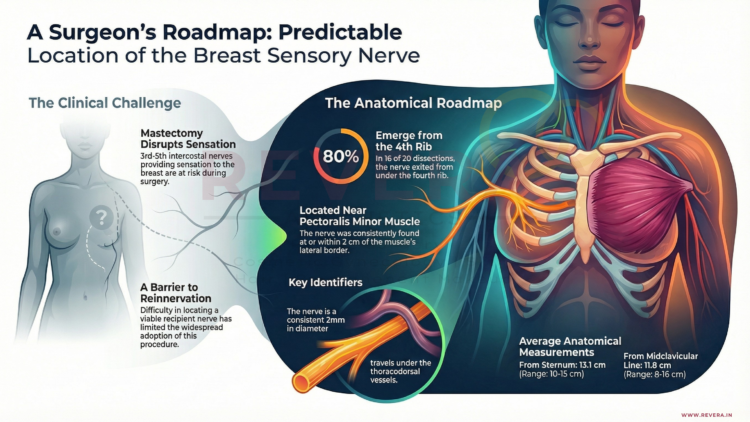
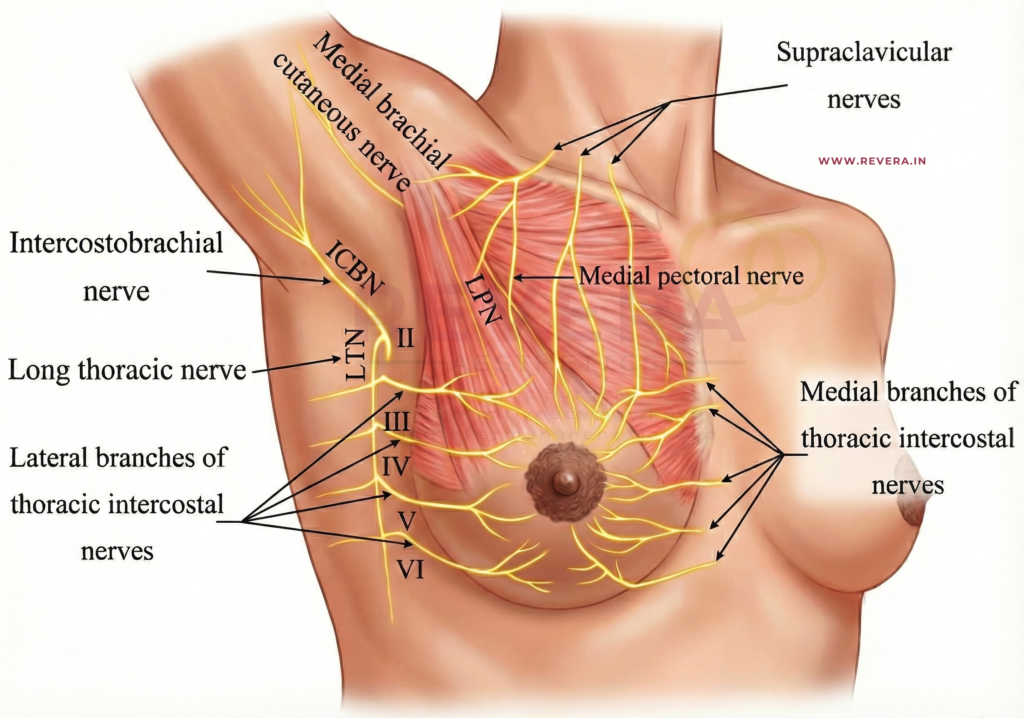
To understand why numbness occurs, we must look at how the breast receives feeling. The sensory innervation to the breast originates from the medial and lateral cutaneous branches of the third to fifth intercostal nerves.Image of thoracic dermatomes and intercostal nerve distribution

Shutterstock

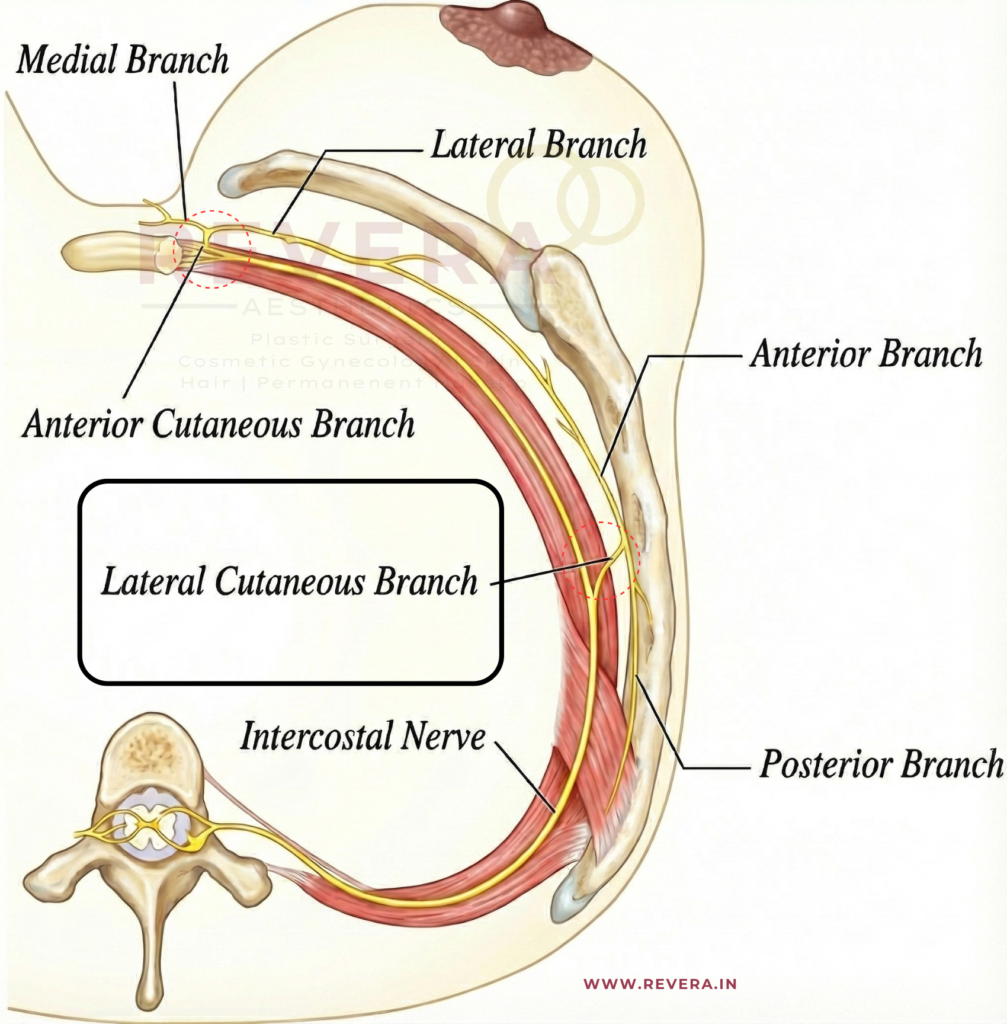
  • The Path of the Nerves: The third, fourth, and fifth intercostal nerves give off lateral cutaneous branches that pierce the chest wall (near the mid-axillary line, or the side of your rib cage). These branches divide into anterior and posterior parts, supplying the skin of the side and front of the chest.
  • The Anterior Branches: The anterior cutaneous branches (the terminal parts of these nerves) supply the skin on the chest wall toward the center (sternum).
    • The 3rd nerve covers the upper-mid chest.
    • The 4th nerve covers the central chest and the medial (inner) breast area – The Nipple Line.
    • The 5th nerve covers the lower-mid chest and the inframammary fold (where the breast meets the ribs).

These nerves provide sensory innervation (known as dermatomes) to specific chest and abdominal areas and are crucial for sensation and pain management (such as nerve blocks).

For years, women have accepted that their reconstructed breasts, while looking beautiful, would permanently feel numb—like “wearing a bra made of your own skin.”

Restoring sensation (Resensation) is possible. Surgeons can perform a “nerve transfer,” connecting a nerve from your chest wall to the nerves in the reconstructed breast.

So, why isn’t this done all the time?

One major hurdle has been the difficulty of finding the right donor nerve. The human body is complex, and searching for a tiny nerve (often only 2 millimeters wide) during a long surgery can be like finding a needle in a haystack.

The Breakthrough: A Roadmap for Sensation

A pivotal study published in Plastic and Reconstructive Surgery has provided surgeons with a reliable “treasure map” to find these elusive nerves.

Research conducted by Dr. Rebecca Knackstedt and Dr. Risal Djohan (along with their team in Cleveland and Toledo, Ohio), utilized precise anatomical studies to identify the exact hiding place of the nerve responsible for breast sensation.

What They Found

The researchers discovered that the Lateral Intercostal Branch (the nerve key to breast feeling) is located in a highly predictable spot:

  • It almost always exits from under the 4th Rib.
  • It sits consistently near the edge of the Pectoralis Minor muscle.
  • It travels safely underneath the thoracodorsal vessels (major blood vessels in the armpit area).

Why This Matters for Your Surgery

This study transforms a “search mission” into a precise procedure. Because surgeons now know exactly where to look, we can locate the nerve with much greater accuracy. The study identified the nerve’s location as:

  • 10 to 15 cm from the sternum (breastbone).
  • 8 to 16 cm from the mid-clavicular line.
  • Near the lateral border of the armpit muscle (Pectoralis minor) or within 2 cm from it.

By using these precise coordinates, surgeons can:

  1. Locate the nerve quickly, reducing surgery time.
  2. Preserve the nerve more effectively.
  3. Perform Nerve Allografts: Connect this sensation-carrying nerve to your reconstructed breast tissue using a nerve graft.

Moving Beyond “Looking Normal”

We believe that feeling whole means more than just looking in the mirror; it’s about feeling a hug, noticing a change in temperature, and reclaiming your body’s sensation.

Thanks to anatomical breakthroughs like this study from Ohio, Breast Neurotization (nerve repair) is becoming a more standard and successful part of breast reconstruction.


Frequently Asked Questions (FAQ)

Q: If I have this procedure, will my sensation be 100% normal?

A: “Normal” is a strong word. Nerve regeneration is slow and complex. Most patients do not regain perfect, pre-surgery sensitivity. However, the goal is to transition from “numbness” to “protective sensation” (feeling touch and pressure) and, in many cases, erogenous sensation. It is a vast improvement over having no feeling at all.

Q: Does this add time to the surgery?

A: Yes, nerve repair does add some time to the reconstruction surgery. However, thanks to the “mapping” provided by this research, the time taken to find the nerve is significantly reduced, making the addition of nerve repair much more feasible.

Q: Can this be done if I had a mastectomy years ago?

A: Breast reinnervation is most successful when performed at the same time as the mastectomy (Immediate Reconstruction). Doing it years later is much more difficult because the nerve endings may have scar tissue or have become dormant. However, it is always worth discussing with your surgeon.

Q: Is this only for implant reconstruction or flap reconstruction?

A: Nerve grafts can be used in both. In DIEP Flap (using your own tissue), surgeons connect the chest nerve to the nerve in the tummy tissue. In Implant reconstruction, the nerve is connected to the remaining skin or nipple nerves.


Reference

Knackstedt, Rebecca M.D., Ph.D.; Gatherwright, James M.D.; Cakmakoglu, Cagri M.D.; Djohan, Michelle M.S.; Djohan, Risal M.D. “Predictable Location of Breast Sensory Nerves for Breast Reinnervation.” Plastic and Reconstructive Surgery. February 2019. Cleveland Clinic & University of Toledo, Ohio.

Written by revera-admin

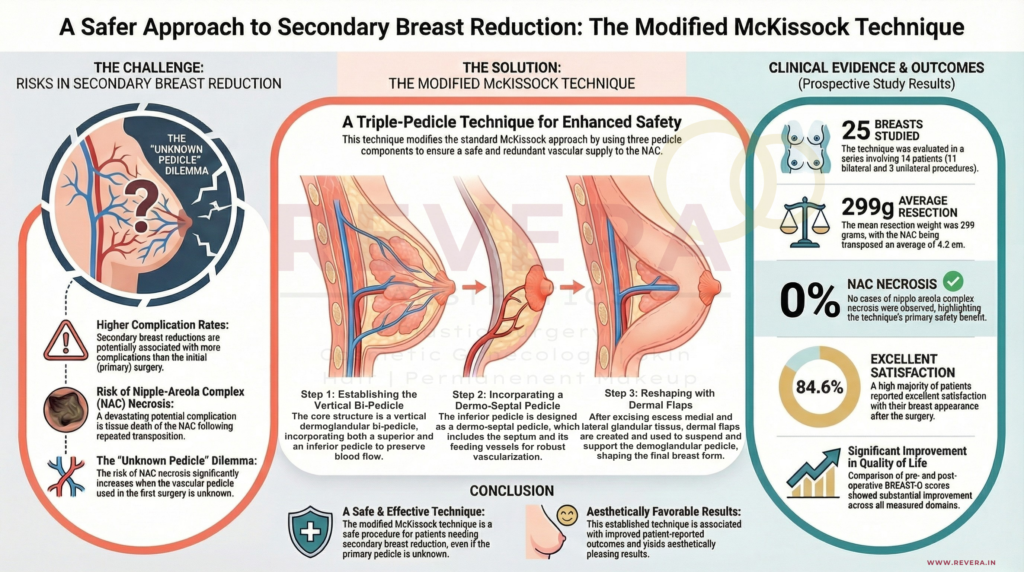
Thinking About a Second Breast Reduction? New Research Makes “Revisions” Safer Than Ever

When One Surgery Isn’t Enough

Breast reduction surgery typically has one of the highest satisfaction rates in cosmetic medicine. However, bodies change. Due to weight fluctuations, hormonal shifts, or pregnancy, breast tissue can sometimes regrow, or gravity may cause sagging to return years after the initial procedure.

Many women find themselves wanting a Secondary Breast Reduction (a revision surgery) but hesitate due to safety concerns.

Historically, performing a reduction on a breast that has already been operated on was considered risky. The main fear? Compromising the blood supply to the nipple.

The “Unknown Pedicle” Problem

In a primary breast reduction, the surgeon creates a “pedicle”—a bridge of tissue that keeps the nipple and areola attached to their blood and nerve supply while the surrounding tissue is removed.

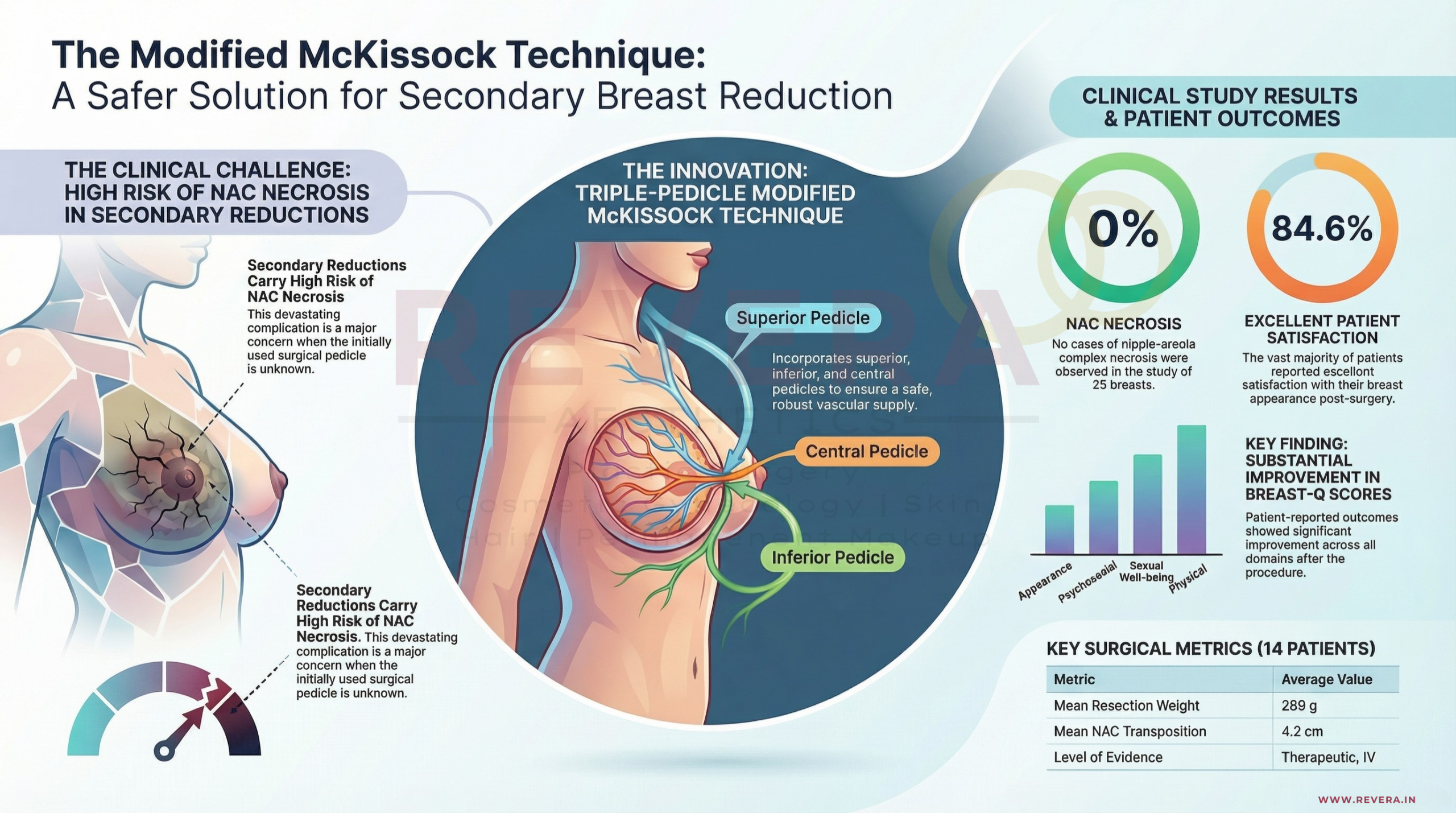
The challenge with revision surgery is that the new surgeon often doesn’t know which technique the previous surgeon used. If they cut into the old “lifeline” by mistake, it can lead to Nipple-Areola Complex (NAC) Necrosis (loss of the nipple tissue).

The Austrian Solution: A Triple-Safety Technique

A new prospective study published in April 2025 in the Plastic and Reconstructive Surgery journal offers a reassuring solution.

A team of researchers from Linz and Innsbruck, Austria, led by Dr. Sandra Feldler and Dr. Manfred Schmidt, has developed a “Modified McKissock Technique” specifically designed for these complex revision cases.

How It Works

The classic “McKissock” technique uses a vertical bipedicle (a bridge with a top and bottom attachment) to supply blood to the nipple.

The Austrian team modified this by adding a third component: a Central Pedicle.

  • Superior Pedicle (Top)
  • Inferior Pedicle (Bottom)
  • Central Pedicle (Middle)

Think of it as adding an extra emergency power line. Even if the surgeon doesn’t know exactly how the first surgery was performed, this “triple-threat” approach ensures the nipple retains a robust blood supply from multiple directions.

The Results: 100% Safety Record

The study followed 25 breast revisions using this new technique. The results were remarkably positive:

  • Zero Necrosis: There were no cases of nipple loss or tissue death.
  • Significant Reduction: The average patient had roughly 300g of tissue removed per breast.
  • High Satisfaction: 84.6% of patients rated their aesthetic appearance as “excellent” after the surgery.

Why This Matters For You

If you have been told that a second breast reduction is “too risky” or that you aren’t a candidate because your previous surgical records are lost, this research changes the conversation.

This modified technique allows surgeons to navigate the “unknowns” of your previous surgery with a safety net, ensuring you can achieve the smaller, lifted shape you desire without compromising your safety.


Frequently Asked Questions (FAQ)

Q: Why do breasts get big again after a reduction?

A: While the fat and glandular tissue removed during surgery is gone forever, the remaining cells can expand. Weight gain, pregnancy, menopause, and certain hormonal medications can stimulate the remaining breast tissue to grow.

Q: Is a revision recovery harder than the first time?

A: Surprisingly, many patients find the recovery similar or even slightly easier, as less tissue is usually removed compared to the first massive reduction. However, strict adherence to post-op care is vital to protect the blood supply.

Q: Does this technique leave more scars?

A: This technique generally utilizes the “inverted-T” or “anchor” scar pattern. Since most primary breast reductions also use this pattern, the surgeon simply goes through the old scar lines, meaning you likely won’t have new scars, just refreshed ones.

Q: Can I breastfeed after a secondary reduction?

A: Breastfeeding after a primary reduction is already difficult (about 50% success rate). A secondary reduction involves further manipulation of the milk ducts. While the nipple is kept alive and sensitive, the ability to breastfeed is unlikely after a second procedure.


Reference

Feldler, Sandra MD; Zaussinger, Maximilian MD; Ehebruster, Gudrun MD; Bachleitner, Kathrin MD; Steinkellner, Theresia MD; Schmidt, Manfred MD. “Modified McKissock Technique for Secondary Breast Reduction: A Prospective Study on Safety and Surgical and Aesthetic Outcomes.” Plastic and Reconstructive Surgery. April 2025. Linz and Innsbruck, Austria.