High-Tech vs. The Standard: Is the “Harmonic Scalpel” Better for Breast Reduction?
The Allure of New Gadgets
We all love the latest technology. Whether it is a new iPhone or a high-tech kitchen appliance, we often assume “newer” means “better.” In plastic surgery, medical companies frequently market expensive new devices that promise faster recovery and less pain.
One such device is the Harmonic Scalpel. It claims to cut tissue and stop bleeding using ultrasonic vibrations rather than heat. But is it actually better than the standard tool surgeons have used for decades? A study from Dartmouth-Hitchcock Medical Center put this technology to the test.
The Tools: Electric vs. Ultrasonic
To understand the study, you must understand the tools:
- Electrocautery (The Standard): This tool uses electricity to heat tissue. It cuts and seals blood vessels simultaneously. It is the gold standard for breast reduction.
- Harmonic Scalpel (The Challenger): This device uses ultrasonic energy. It vibrates at high speeds to cut and coagulate tissue. It is often used in general surgery for procedures like thyroid removal.
The Experiment: A Side-by-Side Comparison
The researchers designed a clever study to remove outside factors like individual healing rates. They recruited 31 patients for bilateral breast reduction.
Here is the twist: They used both tools on the same patient.
One breast was operated on using the standard Electrocautery. The other breast was operated on using the Harmonic Scalpel. The assignment was random and blinded, meaning neither the patient nor the initial plan dictated which side got which tool.
The Results: Does Money Buy Better Results?
The study looked at three main things: speed, drainage (fluid buildup), and pain. The results might surprise you.
1. Speed (Operative Time)
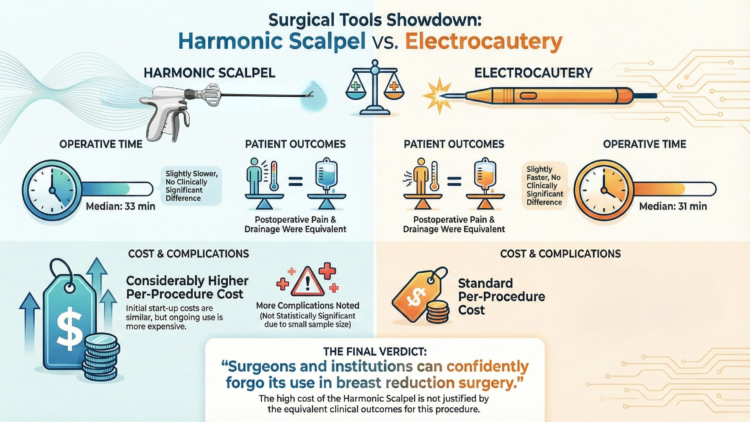
The manufacturer claims the Harmonic Scalpel is more efficient. However, the study found the opposite. The median time for the Harmonic Scalpel was 33 minutes, compared to 31 minutes for standard electrocautery. While this difference was statistically significant, it is practically negligible. Basically, the fancy tool did not save time.
2. Pain and Drainage
Did the ultrasonic technology reduce pain or fluid buildup? No.
The researchers found no statistical difference in drainage volume or postoperative pain scores between the two sides. Patients felt the same, regardless of the tool used.
3. The Cost
This is the biggest difference. While the start-up costs for the machines were comparable, the per-procedure cost for the Harmonic Scalpel was considerably higher.
Expert Opinion: Why It Didn’t Work
In the accompanying discussion, Dr. Melissa Crosby from M.D. Anderson Cancer Center explains why this high-tech tool fell short.
The Harmonic Scalpel is excellent for surgeries like thyroidectomies because it replaces slow manual techniques like tying knots or using clips. However, in breast reduction, surgeons already use electrocautery for speed and sealing. Therefore, swapping it for the Harmonic device does not add efficiency; it just adds cost.
Dr. Crosby also noted that in an era of cost-effective medicine, we must critically appraise expensive gadgets to ensure they actually benefit the patient.
The Verdict
The study concludes that the Harmonic Scalpel is roughly equivalent to standard electrocautery—but it costs much more.
For patients, this is good news. You do not need to seek out a surgeon who uses this specific “high-tech” device to get a great result. The standard method is efficient, safe, and just as comfortable.
Frequently Asked Questions (FAQ)
Q: Does the Harmonic Scalpel reduce scarring?
A: This study did not find any advantage in terms of healing complications or drainage that would suggest better scarring. In fact, there were slightly more complications on the Harmonic side, though the number was too small to be certain.
Q: Why do some surgeons use it?
A: Some surgeons may prefer it for other types of surgery (like general surgery) and carry that preference over. However, evidence shows no specific benefit for breast reduction.
Q: Is Electrocautery safe?
A: Yes. It has been the standard in surgery for many years. It is effective at stopping bleeding (hemostasis) while cutting, which keeps the surgery safe and quick.
References
- [1] Burdette, Todd E. M.D.; Kerrigan, Carolyn L. M.D.; Homa, Karen A. Ph.D. “Harmonic Scalpel versus Electrocautery in Breast Reduction Surgery: A Randomized Controlled Trial.” Plastic and Reconstructive Surgery 128(4):p 243e-249e, October 2011.
- [2] Crosby, Melissa A. M.D. “Discussion: Harmonic Scalpel versus Electrocautery in Breast Reduction Surgery: A Randomized Controlled Trial.” Plastic and Reconstructive Surgery 128(4):p 250e-251e, October 2011.