

Finally, a Solution for Nipple Reshaping Without the Visible Scars
The Hidden Insecurity
While breast augmentation and lifts are commonly discussed, many patients struggle silently with insecurities regarding the nipple-areola complex. Whether due to genetics, hormonal changes, or the aftermath of breastfeeding, common complaints include:
- Large Areolae: An areola that feels disproportionately large for the breast.
- Undefined Contours: A lack of crisp definition between the nipple and the surrounding skin.
- Herniated Tissue: Often called “puffy nipples,” where glandular tissue pushes out, creating a dome-like appearance.
For years, patients have hesitated to fix these issues for one main reason: The fear of scarring.
Usual Scars
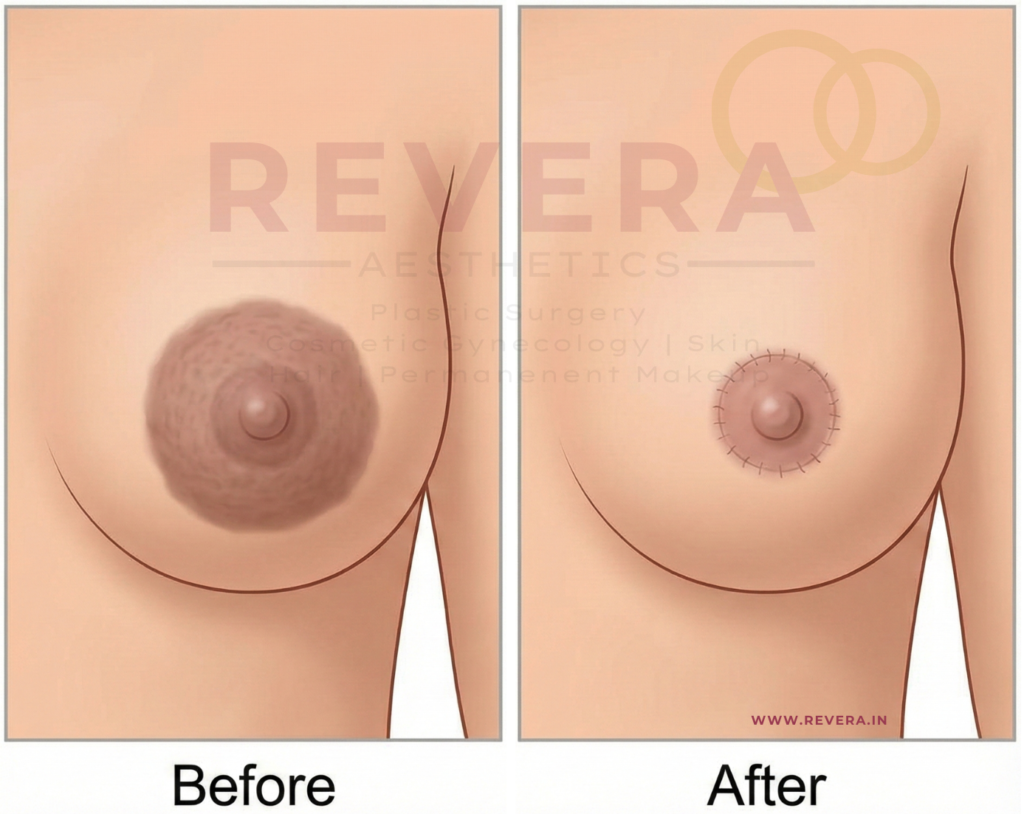
The Old Trade-Off: Shape vs. Scars
Historically, correcting the shape of the nipple or reducing the size of the areola came with a compromise. Previous techniques, such as the “petal pattern method,” were effective at contouring but often limited in how much they could reduce the areola size.
More importantly, these older methods frequently resulted in visible scars from the front. For a patient seeking aesthetic improvement, trading a shape issue for a visible scar was often a difficult choice.
The Innovation: The “Crown-Shape” Method
A breakthrough study published in Plastic and Reconstructive Surgery (June 2025) introduces a refined solution: the Crown-Shape Debulking Method.
Developed by Dr. Ju Young Go and Dr. Won Lee from leading clinics in Seoul and Anyang, South Korea, this technique is a “single-stage” procedure designed to reshape the nipple without leaving obvious marks.
How It Works
The “Crown-Shape” technique is an advanced evolution of previous methods. It involves:
- Debulking: Removing the herniated or excess glandular tissue that causes puffiness.
- Structuring: Using a specific “crown” pattern to tighten the skin and define the nipple.
- Hiding the Evidence: The key innovation is that it allows for significant reduction and reshaping “without visible scars in the frontal areolar area”.
Why This Is a Game-Changer
This new Korean technique addresses the limitations of the past. It offers greater control during surgery to ensure the new shape is aesthetically pleasing while minimizing the risk of the problem recurring (recurrence).
Key Benefits:
- Scar-Free Frontal View: No distracting scar lines on the face of the areola.
- Effective Reduction: Can handle larger reductions than previous methods.
- Better Definition: Creates a distinct, attractive nipple contour.
Is This Right for You?
If you have been bothered by “puffy” nipples or large areolas but have avoided surgery because you didn’t want scars, the Crown-Shape Debulking method might be the answer. This technique allows for a natural look that stands up to close inspection.
Frequently Asked Questions (FAQ)
Q: What specific problems does this fix?
A: This technique is designed for patients with large areolae, undefined nipple contours, or herniation of glandular tissue (bulging/puffy nipples) around the areola.
Q: How is this different from the “Petal Pattern” method?
A: The “Petal Pattern” was a previous technique that was good for contouring but had limitations in how much it could reduce the areola size. Furthermore, the Petal Pattern often left visible scars when viewed from the front. The Crown-Shape method improves upon this by allowing for better reduction without the visible frontal scars.
Q: Is there really no scar?
A: All surgery involves incisions, but this technique is described as “scar-free” in the frontal areolar area. This means the incisions are strategically placed and hidden so that when looking at the breast directly, there are no obvious surgical markings.
Reference
Go, Ju Young MD, PhD; Lee, Won MD, PhD. “Scar-Free Nipple and Areola Contouring: A Crown-shape Debulking Method for Enhanced Aesthetic Outcomes.” Plastic and Reconstructive Surgery. June 20, 2025. Seoul and Anyang, Korea.