
Written by revera-admin

Breast Reduction: Surgery vs. No Surgery? A Quality of Life Study

The Decision to Wait

Many women seek a consultation for breast reduction to address the physical and emotional burden of large breasts (macromastia). However, for various reasons, some patients choose not to proceed with the surgery.

Is “waiting and seeing” a viable strategy? Or does the quality of life continue to decline without intervention? Researchers at the University of Pennsylvania aimed to quantify exactly how much the surgery helps compared to those who do not undergo the procedure.

The Study: A Fair Comparison

To ensure an accurate comparison, the researchers used propensity score matching. This means they matched patients in the surgical group with patients in the non-surgical group who had similar ages, body mass index (BMI), and breast measurements.

  • Participants: 100 matched patients were identified.
  • Average Age: 39.5 years.
  • Average BMI: 31.1 $kg/m^2$.
  • Method: Both groups were surveyed using the BREAST-Q, a validated tool that measures patient-reported quality of life.

The Results: A Widening Gap

The data showed a stark difference between those who had the surgery and those who remained in the non-operative group.

1. The Surgery Group (Operative)

For the patients who underwent breast reduction, the researchers observed significant improvements in every single category.

  • Physical Well-being: Patients felt less pain and physical restriction.
  • Psychosocial Well-being: Confidence and social comfort increased.
  • Sexual Well-being: Patients felt more positive about intimacy and their bodies.
  • Satisfaction with Breasts: Satisfaction with their appearance improved drastically.

2. The Non-Surgery Group (Non-operative)

For the women who chose not to have surgery, the results were much different.

  • No Improvement: These patients realized no benefit or improvement in their quality of life over time.
  • Deterioration: Across two of the four domains, their quality of life scores actually showed a downward trend.
  • The Takeaway: Large breasts are a progressive issue. Without surgery, the physical and emotional burden often gets worse rather than better.

Why This Matters for You

This study provides strong evidence that breast reduction is not just a “cosmetic” change. It is a highly effective treatment for a condition that impacts your entire well-being.

As the authors concluded, patients who undergo the surgery see statistically significant improvements in all aspects of life. Meanwhile, those who wait or rely on non-surgical methods realize no benefit with time.

If you are struggling with the symptoms of macromastia, this research confirms that surgery is the definitive path toward a better quality of life.


Reference

Written by revera-admin

The Hall-Findlay Technique: Simplifying the “Lollipop” Breast Reduction

Why Vertical Breast Reduction Used to Be Hard

For many years, the Vertical Reduction Mammaplasty (often called the “Lollipop” reduction) struggled to gain popularity in North America. Surgeons worried that the technique was too difficult to learn. Many also believed it only worked for small breast reductions.

Dr. Elizabeth Hall-Findlay changed this perspective. In her influential study published in Plastic and Reconstructive Surgery, she introduced modifications that made the procedure simpler, safer, and more reliable for all sizes.

Four Key Modifications That Simplified Everything

Dr. Hall-Findlay identified several steps in the traditional “Lejour” technique that made it complicated. She simplified the surgery by focusing on these four changes:

1. The Medial (or Lateral) Pedicle

Instead of using a complex central blood supply, she used a medial or lateral dermoglandular pedicle. This tissue bridge safely carries the blood supply to the nipple. This change makes the move (transposition) of the nipple much more predictable for the surgeon.

2. No Skin Undermining

Traditional methods often involved “undermining” or separating the skin from the underlying breast tissue. Dr. Hall-Findlay removed this step. By keeping the skin attached, the breast retains better blood flow and heals more reliably.

3. Minimal Use of Liposuction

While some techniques rely heavily on liposuction to reduce breast volume, Dr. Hall-Findlay found it was rarely necessary. She preferred direct surgical removal to ensure a more precise and stable breast shape.

4. No Pectoralis Fascia Sutures

She eliminated the need to stitch the breast tissue to the chest muscle (pectoralis fascia). This streamlined the operation and reduced internal complexity.

Proven Results: 400 Successful Cases

Dr. Hall-Findlay tested these modifications in a series of 400 vertical breast reductions. The results proved that the “Lollipop” method isn’t just for small breasts.

  • Broad Application: The average reduction was 525g per breast, but she successfully removed up to 1425g using this technique.
  • Reduced Scarring: By using a vertical pattern, she effectively eliminated the long horizontal scar found in traditional “Anchor” reductions.
  • Ease of Use: The study concluded that these modifications made the technique much easier for other surgeons to learn and apply.

The Takeaway for Patients

If you want a breast reduction with less scarring, you no longer have to worry if your breasts are “too large” for a vertical technique. Thanks to these refinements, surgeons can offer the “Lollipop” reduction with high safety and excellent, long-lasting results.


Frequently Asked Questions

Q: Is the vertical technique safe for very large breasts?

A: Yes. Dr. Hall-Findlay’s research showed it is effective for reductions involving over 1400g of tissue per breast.

Q: What is the main benefit of the medial pedicle?

A: It provides a very reliable blood supply to the nipple and areola, which reduces the risk of healing complications.

Q: Will the “Lollipop” shape hold up over time?

A: Because this technique uses internal tissue shaping rather than just skin tightening, the results tend to be very stable.


Reference

[1] Hall-Findlay, Elizabeth J. M.D., F.R.C.S.(C). “A Simplified Vertical Reduction Mammaplasty: Shortening the Learning Curve.Plastic and Reconstructive Surgery 104(3):p 748-759, September 1999.

Written by revera-admin

High-Tech vs. The Standard: Is the “Harmonic Scalpel” Better for Breast Reduction?

The Allure of New Gadgets

We all love the latest technology. Whether it is a new iPhone or a high-tech kitchen appliance, we often assume “newer” means “better.” In plastic surgery, medical companies frequently market expensive new devices that promise faster recovery and less pain.

One such device is the Harmonic Scalpel. It claims to cut tissue and stop bleeding using ultrasonic vibrations rather than heat. But is it actually better than the standard tool surgeons have used for decades? A study from Dartmouth-Hitchcock Medical Center put this technology to the test.

The Tools: Electric vs. Ultrasonic

To understand the study, you must understand the tools:

  1. Electrocautery (The Standard): This tool uses electricity to heat tissue. It cuts and seals blood vessels simultaneously. It is the gold standard for breast reduction.
  2. Harmonic Scalpel (The Challenger): This device uses ultrasonic energy. It vibrates at high speeds to cut and coagulate tissue. It is often used in general surgery for procedures like thyroid removal.

The Experiment: A Side-by-Side Comparison

The researchers designed a clever study to remove outside factors like individual healing rates. They recruited 31 patients for bilateral breast reduction.

Here is the twist: They used both tools on the same patient.

One breast was operated on using the standard Electrocautery. The other breast was operated on using the Harmonic Scalpel. The assignment was random and blinded, meaning neither the patient nor the initial plan dictated which side got which tool.

The Results: Does Money Buy Better Results?

The study looked at three main things: speed, drainage (fluid buildup), and pain. The results might surprise you.

1. Speed (Operative Time)

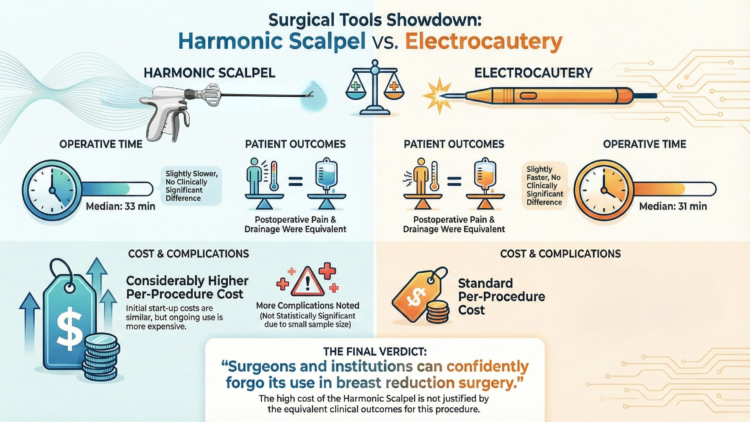
The manufacturer claims the Harmonic Scalpel is more efficient. However, the study found the opposite. The median time for the Harmonic Scalpel was 33 minutes, compared to 31 minutes for standard electrocautery. While this difference was statistically significant, it is practically negligible. Basically, the fancy tool did not save time.

2. Pain and Drainage

Did the ultrasonic technology reduce pain or fluid buildup? No.

The researchers found no statistical difference in drainage volume or postoperative pain scores between the two sides. Patients felt the same, regardless of the tool used.

3. The Cost

This is the biggest difference. While the start-up costs for the machines were comparable, the per-procedure cost for the Harmonic Scalpel was considerably higher.

Expert Opinion: Why It Didn’t Work

In the accompanying discussion, Dr. Melissa Crosby from M.D. Anderson Cancer Center explains why this high-tech tool fell short.

The Harmonic Scalpel is excellent for surgeries like thyroidectomies because it replaces slow manual techniques like tying knots or using clips. However, in breast reduction, surgeons already use electrocautery for speed and sealing. Therefore, swapping it for the Harmonic device does not add efficiency; it just adds cost.

Dr. Crosby also noted that in an era of cost-effective medicine, we must critically appraise expensive gadgets to ensure they actually benefit the patient.

The Verdict

The study concludes that the Harmonic Scalpel is roughly equivalent to standard electrocautery—but it costs much more.

For patients, this is good news. You do not need to seek out a surgeon who uses this specific “high-tech” device to get a great result. The standard method is efficient, safe, and just as comfortable.


Frequently Asked Questions (FAQ)

Q: Does the Harmonic Scalpel reduce scarring?

A: This study did not find any advantage in terms of healing complications or drainage that would suggest better scarring. In fact, there were slightly more complications on the Harmonic side, though the number was too small to be certain.

Q: Why do some surgeons use it?

A: Some surgeons may prefer it for other types of surgery (like general surgery) and carry that preference over. However, evidence shows no specific benefit for breast reduction.

Q: Is Electrocautery safe?

A: Yes. It has been the standard in surgery for many years. It is effective at stopping bleeding (hemostasis) while cutting, which keeps the surgery safe and quick.


References