Woman in a Grey Shirt Giving a Thumbs up and holding a measuring tape in another hand. Dr. John Tebbetts Vertical Skin Excess measurement for Breast Reduction and Breast Lift Surgery
Written by revera-admin

Math Over Art: How Quantifying Your Skin Prevents Surgical Errors in Breast Reduction and Breast Lift!

The Problem: The “Artistic” Guess

For a long time, breast reduction and lift (mastopexy) planning relied heavily on the surgeon’s “artistic eye.” A surgeon would pinch the skin, draw some markings, and estimate how much tissue to remove.

While often successful, this subjective approach has a flaw: Imprecision. “Eyeballing” the skin excision can lead to nipples that are too high, scars that stretch, or breasts that “bottom out” because the skin envelope was left too loose.

The Solution: The Tebbetts Process

In March 2014, Dr. John Tebbetts published a landmark study from his practice in Dallas, Texas, detailing a strictly mathematical approach to planning these surgeries.

This paper represents a major shift from surgery as an “art” to surgery as an “objective science”.

Instead of guessing, he developed a process to quantify the skin envelope—measuring exactly how much excess skin exists down to the millimeter. He applied this rigorous measuring process to 124 mastopexy and 122 breast reduction patients.

1. Measuring “Vertical Skin Excess” (VSE)

The core of this technique is measuring Vertical Skin Excess. This is the specific amount of skin between the nipple and the breast crease that needs to be removed to lift the breast correctly.

Dr. Tebbetts found that this number—not a guess—should dictate which incision pattern is used:

Simple Formula:

VSE=Actual Nipple-to-IMF DistanceDesired Nipple-to-IMF Distance (typically 8-10 cm)cap V cap S cap E equals Actual Nipple-to-IMF Distance minus Desired Nipple-to-IMF Distance (typically 8-10 cm)

Quantified approach (More Detailed Calculation):

VSE=Existing Nipple-to-IMF Dimension(Desired Nipple-to-IMF Distance+Areola Diameter2)cap V cap S cap E equals Existing Nipple-to-IMF Dimension minus open paren Desired Nipple-to-IMF Distance plus the fraction with numerator Areola Diameter and denominator 2 end-fraction close paren

Illustration showing Nipple to IMF distance (Inframammary Fold)

2. Designing the “New” Envelope

Once the excess is measured, the surgeon calculates exactly where the new nipple position should be. In Dr. Tebbetts’ study, the planning was so precise that 0% of the 246 patients required nipple repositioning after surgery.

The Results: Why Math Wins

The study followed patients for an average of 4.6 years, providing long-term data on how these “quantified” breasts aged.

  • High Accuracy: As mentioned, no patient needed their nipples moved again.
  • Low Complications: “Bottoming out” (excessive lower pole stretch) occurred in only 4% of cases.
  • Learning Curve: Interestingly, the reoperation rate dropped from 6.5% in the first five years of using this method to just 1.6% in the later years, proving that once a surgeon masters the math, the results are incredibly consistent.

What This Means for You

If you are considering a breast reduction or lift, you want a surgeon who plans, not one who guesses.

This “Quantified Dimensions” approach ensures that the surgery is tailored to your specific skin elasticity and measurements. It removes the “surprise” factor, ensuring that the incision chosen is exactly the right one to handle your specific amount of excess skin.


Ask yourself “Who is the Best Plastic Surgeon Near Me?”.

Revera Clinic caters with the Best Plastic Surgeon in Hyderabad!

Breast Reduction Surgery Cost varies between individuals!

Contact us to know if you are a suitable candidate for Breast Reduction Surgery!


Frequently Asked Questions (FAQ)

Q: Does “quantifying” mean I get a cookie-cutter breast?

A: No, it means the opposite. Because the measurements are specific to your body, the surgical plan is customized to your exact anatomy rather than a generic template.

Q: Can this method prevent all stretching?

A: No surgery can stop gravity completely. However, this study showed that “excessive restretch” was rare (4%), meaning the results are stable for years.

Q: Is this technique used for implants too?

A: Dr. Tebbetts is famous for applying similar mathematical principles (“High Five” system) to breast augmentation, ensuring that implants fit the patient’s footprint perfectly.


References


woman wearing a T shirt showing hanging bridges.
Written by revera-admin

The “Internal Bra” Effect: How SFS Suspension Prevents Bad Scars On Breast after Breast Reduction Surgery

Home » Mastopexy

The Problem: Skin Cannot Hold Weight

Estimated reading time: 3 minutes

For decades, standard breast reductions relied on “dermal suspension.” Essentially, surgeons used the skin itself to hold up the weight of the reshaped breast.

The problem? Skin is elastic—it stretches. When you use skin to support weight, it creates high tension on the incision lines.

  • The Consequence: High tension leads to “hypertrophic” (thick, raised) scars. In traditional methods, these bad scars occurred in 50% to 55% of patients within 6 months.
  • The Droop: Because the skin stretches, the lift often fails over time, leading to a recurrence of sagging.

The Solution: The Superficial Fascial System (SFS)

In April 1999, Dr. Ted Lockwood published a study in Plastic and Reconstructive Surgery introducing a powerful alternative. He argued that surgeons should anchor the breast not to the skin, but to the Superficial Fascial System (SFS).

What is the SFS?

The SFS is a distinct layer of connective tissue that lies just beneath the skin but is much stronger than the skin itself. It is the body’s natural “casing.”

The Lockwood Technique

Instead of sewing the skin tight, Dr. Lockwood used permanent (non-absorbable) sutures to lock the SFS layers together.

  1. Internal Locking: The weight of the breast is supported by the fascia.
  2. Tension-Free Skin: Because the fascia is holding the weight, the skin can be draped gently over the top without any tension.

The Results: A Massive Drop in Scarring

The study analyzed 109 patients (218 breasts) operated on in Kansas between 1993 and 1996. The results were dramatic:

  • Traditional Methods: 50–55% rate of hypertrophic scarring.
  • Lockwood SFS Technique: 3% rate of hypertrophic scarring.

By taking the tension off the skin, the scars remained thin, flat, and faint. Additionally, the “internal bra” created by the SFS suspension resulted in “longer-lasting contour results” that didn’t bottom out as quickly as dermal suspension.

Conclusion

If you are worried about ugly scars or your breasts drooping again after surgery, the “fascial suspension” technique addresses the root cause of both. By using the body’s own connective tissue strength rather than relying on stretchy skin, surgeons can deliver results that are stable, secure, and beautifully healed.


Ask yourself “Who is the Best Plastic Surgeon Near Me?”.

Revera Clinic caters with the Best Plastic Surgeon in Hyderabad!

Breast Reduction Surgery Cost varies between individuals!

Contact us to know if you are a suitable candidate for Breast Reduction Surgery!


Frequently Asked Questions (FAQ)

Q: Are permanent sutures dangerous inside the breast?

A: Generally, no. Permanent sutures in the SFS layer are standard in many body contouring procedures (like tummy tucks). They provide the long-term strength needed to resist gravity.

Q: Does this technique take longer to perform?

A: It may take slightly longer than a standard reduction because the surgeon must carefully identify and suture the specific fascial layers, but the long-term scar benefits are significant.

Q: Is this the same as an “Internal Bra” mesh?

A: Not exactly. “Internal Bra” mesh uses a foreign material (like GalaFLEX) to support the breast. The Lockwood technique uses your body’s own natural tissue (fascia) to create that support, avoiding the risks of foreign objects.


Reference


Image showing Würinger’s Septum in various grades of Breast Ptosis
Written by revera-admin

The “Safety Net” Pedicle: Using Würinger’s Septum to Prevent Nipple Loss in Breast Reduction Surgery

The Study: A Solution from South Africa

In September 2010, plastic surgeons from the University of Stellenbosch (Bellville, South Africa) published a landmark study in Plastic and Reconstructive Surgery. Their goal was to address one of the most feared complications in breast surgery: nipple necrosis (tissue death).

After analyzing 106 consecutive patients (211 breasts) between 2001 and 2009, they proposed a technique that relies on a specific “anatomical highway” to keep the nipple safe.

The Anatomy: What is Würinger’s Septum?

To understand why this technique works, you must understand the anatomy of the breast.

  • Würinger’s Septum: This is a horizontal band of connective tissue that runs through the breast.It acts like a “shelf” or a hammock supporting the breast tissue.
  • The Highway: More importantly, this septum carries the nerves and blood vessels from the chest wall directly to the nipple.

Most traditional techniques cut through parts of this supply. The authors of this study argued that by preserving this specific ligament, surgeons can maintain a “dual” blood supply that is nearly bulletproof.

Würinger’s Septum to prevent Nipple Loss in Breast Reduction Surgery.

The Technique: The “Posteroinferomedial” Pedicle

The authors developed a pedicle (the bridge of tissue carrying the nipple) that captures blood from two distinct sources, making it exceptionally reliable.

1. The Medial Source (Internal Thoracic Artery)

By keeping the medial vertical ligament intact, the surgeon preserves the large perforating arteries (2nd, 3rd, and 4th) coming from the center of the chest.

2. The Inferior Source (Anterior Intercostal Arteries)

By keeping the horizontal septum intact, the surgeon captures the inferior mammary branches coming from the ribs.

This “Posteroinferomedial” approach ensures that even if one blood supply is weak, the other takes over, dramatically reducing the risk of the nipple dying.

Results: Versatility and Safety

The study showed that this technique is not only safe but also highly versatile.

  • Shape: It provided good nipple projection and upper breast fullness.
  • Flexibility: It can be used with almost any skin incision—whether “donut” (periareolar), “lollipop” (vertical), or “anchor” (inverted-T).
  • Learning Curve: The authors noted that the technique is easy to learn for surgeons familiar with breast anatomy.

Conclusion

For patients with risk factors like smoking or very large breasts, blood supply is everything. The Posteroinferomedial Pedicle offers a surgical “insurance policy” by utilizing Würinger’s septum to double the blood flow to the nipple.


Ask yourself “Who is the Best Plastic Surgeon Near Me?”.

Revera Clinic caters with the Best Plastic Surgeon in Hyderabad!

Breast Reduction Surgery Cost varies between individuals!

Contact us to know if you are a suitable candidate for Breast Reduction Surgery!


Frequently Asked Questions (FAQ)

Q: Does this technique preserve nipple sensation?

A: Yes. Because Würinger’s septum carries the main nerves to the nipple alongside the arteries, preserving it typically results in excellent sensation retention.

Q: Is this technique used for breast lifts (mastopexy) too?

A: Yes. The study confirmed its safety for both reduction mammaplasty and mastopexy (lifts).

Q: Why is “dual blood supply” better?

A: Human anatomy varies.18 Some people have strong medial arteries, while others have strong inferior ones. Capturing both ensures the nipple survives regardless of your specific anatomy.


References

Written by revera-admin

Natural Volume Without Implants: A New Brazilian Technique for Restoring Breast Volume in Breast Lift & Breast Reduction

The Quest for the Perfect Profile

For many women considering a Mastopexy (Breast Lift) or Reduction Mammoplasty, the goal is simple: a lifted, youthful shape and a more manageable size.

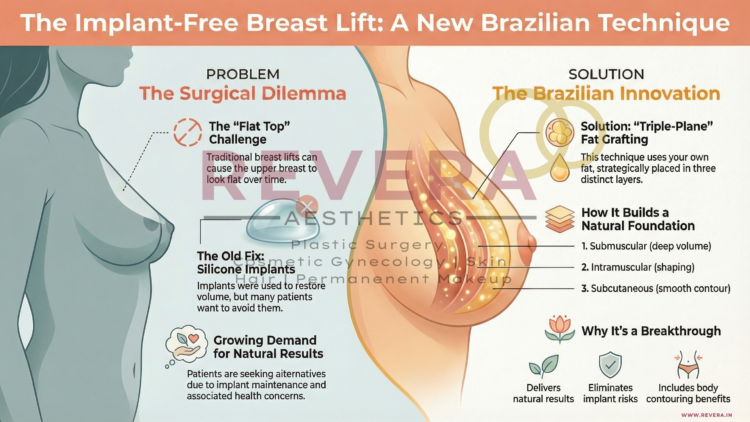
However, there has always been a surgical dilemma. Traditional lifts are excellent at removing excess skin and reshaping the breast, but they often struggle to maintain “upper pole projection”—that desirable fullness at the top of the breast (the décolletage). Over time, gravity can cause the breast tissue to settle, sometimes leaving the upper breast looking flat.

Historically, the solution to this was using silicone implants to fill that upper volume. But what if you don’t want implants?

The “Implant-Free” Movement

While implants remain a popular choice, many of our patients are seeking natural alternatives. Some wish to avoid the maintenance of implants, while others are concerned about rare but documented risks associated with silicone, such as Breast Implant-Associated Anaplastic Large-Cell Lymphoma (BIA-ALCL) or autoimmune symptoms.

If you desire fullness and lift but want to stay 100% natural, a groundbreaking new technique known as Triple-Plane Autologous Fat Grafting might be the answer.

Innovative Research from Brazil

We pride ourselves on staying up-to-date with global advancements in aesthetic medicine. This specific technique comes from a cutting-edge study titled “Breast codes: triple plane autologous fat grafting,” published in August 2025 in the prestigious Plastic and Reconstructive Surgery journal.

The study was conducted by Dr. Ricardo T. Nóra, a plastic surgeon based in Sinop, Mato Grosso, Brazil, in collaboration with Dr. Lydia M. Ferreira from the Division of Plastic Surgery at the Federal University of São Paulo, Brazil.

Brazil has long been recognized as a world leader in cosmetic surgery innovation. In this study, Dr. Nóra and Dr. Ferreira standardized a method to enhance breast shape without foreign bodies, addressing the limitations of previous techniques.

What is the “Triple-Plane” Technique?

Autologous Fat Grafting involves taking fat from an area where you have a little extra (like the abdomen or thighs) and transferring it to the breasts.

The innovation introduced by Dr. Nóra and Dr. Ferreira is the “Triple-Plane” approach. Instead of randomly injecting fat, this technique systematically places fat in three specific layers (planes) to build a lasting structural foundation:

  1. Submuscular: Deep placement under the muscle for foundational volume.
  2. Intramuscular: Placement within the muscle for dynamic shaping.
  3. Subcutaneous: Placement just under the skin for smooth contouring and softness.

Why This Matters for You

This innovative approach addresses the “flat top” issue without requiring a foreign object in your body. By strategically layering the fat according to these new “Breast Codes,” surgeons can now create that coveted upper-breast fullness during a lift or reduction.

Key Benefits:

  • Natural Results: Uses your own tissue, so the look and feel are entirely you.
  • Safety: Eliminates the risks associated with long-term silicone implants.
  • Body Contouring: You get the added benefit of liposuction in the donor area.
  • Scientifically Backed: Based on rigorous surgical protocols developed by leading experts in Brazil.

Experience the Future of Breast Surgery

If you are looking for a natural, long-lasting enhancement, let’s discuss if this technique is right for your body goals. Contact our clinic today at +919866224871 to schedule a consultation. Chat with us on WhatsApp.

We are located in Hyderabad – Himayatnagar and Gachibowli – Kondapur.


Reference

Nóra, Ricardo T. M.D., MSc; Ferreira, Lydia M. M.D., PhD. “Breast codes: triple plane autologous fat grafting in mastopexies and reduction mammoplasties without implants.” Plastic and Reconstructive Surgery. August 13, 2025.