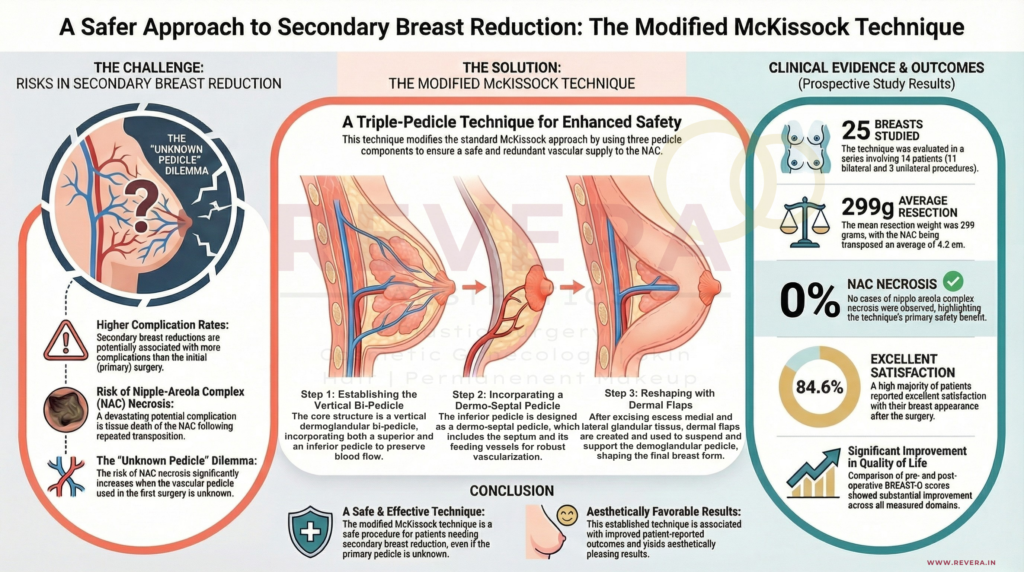
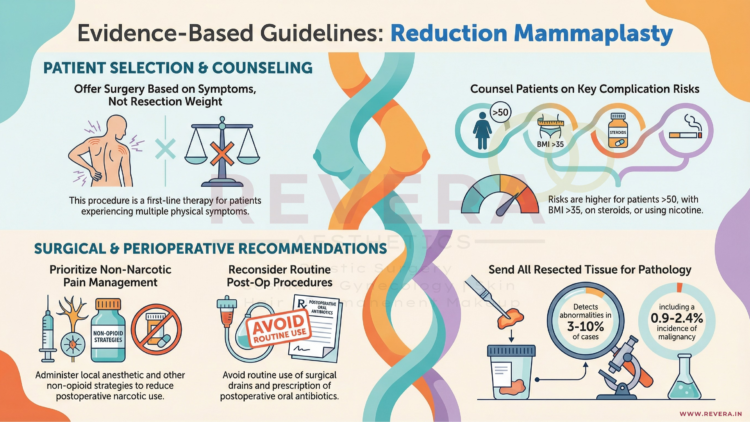
Infographic on 2022 Evidence Based Safety Guidelines on Reduction Mammaplasty
Written by revera-admin

The New Gold Standard: What the Latest Guidelines (2022) Say About Breast Reduction

Setting the Standard for Safety and Results

Breast reduction surgery (reduction mammaplasty) is one of the most life-changing procedures in plastic surgery, performed on over 100,000 patients annually. To ensure patients receive the safest and most effective care, the American Society of Plastic Surgeons (ASPS) convened a multidisciplinary work group to update their clinical practice guidelines.

Published in 2022, these guidelines reviewed thousands of studies to determine what truly works. Here is what the new evidence means for you as a patient.

1. It Is About Your Symptoms, Not the Scale

For years, insurance companies often demanded a specific weight of tissue be removed (e.g., 500g or 1000g) to qualify for coverage. The new guidelines challenge this outdated metric.

The ASPS now strongly recommends that surgery be offered as first-line therapy based on symptoms, not resection weight.

  • The Evidence: Studies show that relief from back pain, neck pain, and bra strap grooving is not correlated with the amount of tissue removed.
  • The Takeaway: If you have multiple physical symptoms (pain, rashes, grooving) that aren’t fixed by non-surgical methods, you are a candidate for surgery, regardless of whether you need a “small” or “large” reduction6666.

2. Drains Are No Longer Routine

One of the most dreaded parts of recovery for many patients is the use of surgical drains (tubes sticking out of the incision to collect fluid).

The guidelines bring good news: Plastic surgeons should not routinely use intraoperative drains for breast reduction patients.

  • Why? High-quality evidence shows no significant difference in complication rates (like hematomas) between patients with drains and those without.
  • The Benefit: avoiding drains means less discomfort during removal, lower costs, and less scarring.

3. Pain Management Has Evolved (Less Narcotics)

The modern approach to breast reduction focuses on multimodal pain management to reduce the need for strong opioids (narcotics).

  • Local Anesthesia: The guidelines strongly recommend administering local anesthetic (numbing medication like lidocaine or bupivacaine) at the surgical site. This significantly improves pain scores immediately after surgery and reduces the time spent in the recovery room.
  • Non-Narcotic Strategies: Surgeons are encouraged to use non-opioid medications (such as Acetaminophen or NSAIDs) to manage pain safely.

4. Technique: The Pedicle Choice

The “pedicle” is the bridge of tissue that keeps your nipple alive and sensitive during the lift and reduction. The guidelines reviewed the two most common techniques:

  1. Inferior Pedicle: The most commonly used, reliable for preserving blood supply.
  2. Superomedial Pedicle: Preserves upper-pole fullness and avoids a long transverse scar.

The verdict? Both techniques are acceptable and effective. There is no significant difference in major complications between them, so your surgeon can choose the method best suited to your specific anatomy.

5. Important Risk Factors

To ensure safety, the guidelines identified specific factors that may increase the risk of complications. Patients should be counseled if they:

  • Are older than 50 years.
  • Have a Body Mass Index (BMI) greater than 35.
  • Use chronic corticosteroids.

Additionally, there is a strong recommendation regarding Nicotine: Patients identified as nicotine users should be referred to cessation programs and encouraged to stop smoking before surgery. Smoking significantly increases the risk of wound healing problems and infection.

6. Antibiotics and Pathology

  • Antibiotics: Extended courses of antibiotics after you go home are generally not recommended. A single dose given before surgery (within 1 hour of incision) is sufficient to prevent infection without causing antibiotic resistance.
  • Pathology: It is recommended that all breast tissue removed during the surgery be sent to the lab for evaluation to check for any hidden abnormal cells or high-risk lesions.

Frequently Asked Questions (FAQ)

Q: Do I have to try physical therapy before surgery?

A: The guidelines state that reduction mammaplasty should be offered as first-line therapy over non-operative treatments. There is no evidence that non-operative management (like special bras or therapy) provides effective long-term relief for breast hypertrophy.

Q: Will I have drains?

A: According to the 2022 guidelines, routine use of drains is not supported by evidence. However, exceptions may be made for specific high-risk cases or if liposuction is also performed.

Q: Does the “Pedicle” technique affect breastfeeding?

A: The guidelines noted that techniques preserving the subareolar parenchyma (the tissue under the nipple) increase the likelihood of breastfeeding success, but more research is needed to compare specific techniques directly.

Reference

Perdikis, Galen M.D.; Dillingham, Claire D.O.; et al. “Evidence-Based Clinical Practice Guideline: Revision: Reduction Mammaplasty.” Plastic and Reconstructive Surgery 149(3):p 392e-409e, March 2022.

Infographic showing Fully Awake Breast Surgery
Written by revera-admin

Awake Breast Reduction: Is General Anesthesia Necessary?

A Revolutionary Approach to Breast Surgery

For many women considering breast reduction surgery, the fear is not necessarily of the procedure itself, but of “going under.” General anesthesia, while generally safe, comes with side effects like nausea, grogginess, and a longer recovery time.

However, a study published in Plastic and Reconstructive Surgery presents a compelling alternative: Fully Awake Breast Reduction.

Authors Dr. Simon Filson, Dr. Danielle Yarhi, and Dr. Yitzhak Ramon from Haifa, Israel, successfully performed breast reductions on 25 patients who were awake, communicative, and able to move during the surgery—all without feeling pain.

How Is It Possible?

The secret lies in Thoracic Epidural Anesthesia.

Unlike general anesthesia, which puts the entire body to sleep and requires a breathing tube, a thoracic epidural numbs only the specific area of the body being operated on (the chest). The patient breathes on their own and remains conscious.

The “Awake” Cocktail: Anesthetics and Sedatives Used

To ensure the patient was comfortable, relaxed, and pain-free, the surgical team utilized a specific combination of oral medications and local anesthetics.

According to the study and the accompanying discussion by Dr. Donald Lalonde, the specific protocol included:

1. The “Sedative Cocktail”

Before the procedure began, patients were given these agents to induce relaxation and prevent pain or nausea:

  • Oxazepam : A benzodiazepine used to reduce anxiety.
  • Dipyrone : A strong analgesic (pain reliever).
  • Promethazine : An antihistamine that provides sedation and prevents nausea.

2. The Anesthetic Block (The Numbing Agents)

To perform the epidural block itself, the anesthesiologist used:

  • Lidocaine: Injected under the skin to numb the needle entry point.
  • Ropivacaine : Injected into the epidural space to provide the actual sensory block for the surgery.

Why Being Awake Changes Everything

The benefits of this technique went far beyond just avoiding general anesthesia. Because the patients were awake, they could actively cooperate during the surgery.

  • The “Sit-Up” Test: Patients could sit up on the operating table, allowing the surgeon to check the symmetry and shape of the breasts against gravity in real-time. The patient could even look and give their opinion before the surgery was finished!.
  • Faster Recovery: Patients were able to get off the operating table and walk to the recovery room immediately after surgery.
  • No “Hangover”: There were zero reports of nausea or vomiting, a common side effect of general anesthesia.

Expert Debate: “Sedated” vs. “Wide Awake”

This technique has sparked interesting conversations among experts. Dr. Donald Lalonde, a Canadian expert in “Wide-Awake Surgery,” applauded the move away from general anesthesia but noted that because sedatives (Oxazepam and Promethazine) were used, the patients were technically “sedated” rather than “wide awake”.

Dr. Lalonde suggested that in the future, surgeons might be able to skip the sedatives entirely and use Lidocaine with Epinephrine for the block, making the procedure truly “wide awake” and eliminating the risks associated with sedatives.

The Future of Surgery

Whether using mild sedation or pure local anesthesia, the trend is clear: surgery is becoming safer, lighter, and more patient-focused. If you are considering breast reduction but fear general anesthesia, this study proves that effective, comfortable alternatives exist.


Reference

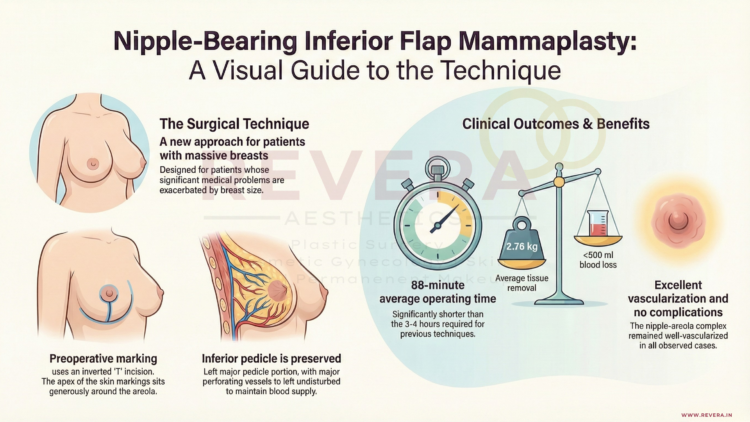
Image depicts infographic of Nipple Sparing Inferior Flap Mammaplasty, the time taken, amount of tissue removed and Blood loss
Written by revera-admin

Relief for Massive Breasts: A Safer, Faster Technique for High-Risk Patients

When Breast Reduction is a Medical Necessity

For many women, breast reduction is about comfort and confidence. But for women with Gigantomastia (massive breasts), the condition is a severe medical burden.

Patients with massive breasts often suffer from debilitating back pain, skin infections, and significant mobility issues. Even more concerning, the sheer weight of the tissue can exacerbate pre-existing cardiac (heart) and respiratory (lung) problems.

For these patients, surgery is not a luxury—it is a necessity. However, because these patients often battle obesity or heart conditions, undergoing a long surgical procedure can be risky.

The Challenge: The 4-Hour Marathon

The most popular traditional methods for breast reduction (such as the McKissock or Robbins techniques) rely on complex internal sculpting. While effective, these surgeries typically require 3 to 4 hours of operative time.

For a patient with heart or lung issues, being under general anesthesia for four hours can be dangerous. Consequently, some women feel forced to consider a Total Mastectomy (complete removal of the breast) just to get relief, or they avoid surgery altogether.

The Solution: Nipple-Bearing Inferior Flap Mammaplasty

A technique published in Plastic and Reconstructive Surgery offers a powerful solution specifically designed for massive weight reduction with maximum safety.

Developed by a surgical team in Preston, England, this technique focuses on speed and blood supply safety.

How It Works

Unlike complex sculpting methods that require separating the breast tissue from the chest wall (“undermining”), this technique leaves the base of the breast undisturbed.

  1. Wide Base: The surgeon creates a wide, supportive base of tissue (the “inferior flap”) that keeps the nipple attached to its natural blood supply.
  2. No Grafting Needed: Unlike some rapid reduction techniques that cut the nipple off and sew it back on as a skin graft, this method keeps the nipple connected, preserving its vitality.
  3. Efficient Removal: A wedge of tissue is removed down to the pectoral fascia, and the remaining flaps are brought together securely.

The Results: Faster and Safer

The study followed patients with massive breasts and significant medical problems who underwent this specific procedure. The results were transformative:

  • Drastically Reduced Surgery Time: The average operation took only 88 minutes (compared to the standard 3–4 hours).
  • Massive Weight Loss: The average tissue removal was 2.76 kg (over 6 lbs) per patient.
  • Safety: There was minimal blood loss (less than 500 mL on average).
  • Nipple Survival: Because the nipple was carried on a wide, robust flap, it remained well-vascularized with no complications in the study group.

Is This Right For You?

This technique is ideal for women who:

  • Have extremely large breasts causing medical distress.
  • Have been told they are “high risk” for long surgeries due to obesity or heart/lung conditions.
  • Want significant size reduction without resorting to a total mastectomy.

We believe that health and mobility should never be out of reach. If you are suffering from the weight of massive breasts, contact us to discuss if this rapid-reduction technique is an option for you.


Frequently Asked Questions (FAQ)

Q: Will I lose my nipple sensation? A: This technique is a “Nipple-Bearing” procedure. Unlike a “Free Nipple Graft” (where the nipple is completely detached), this method maintains a wide bridge of tissue connecting the nipple to the body’s blood and nerve supply, which helps preserve the nipple-areola complex.

Q: How are the scars placed? A: The incision design usually results in an inverted-U or inverted-L shape on the lower breast. While scarring is inevitable in reduction surgery, the primary goal of this specific technique is massive volume reduction to improve heart and lung health.

Q: Why is a shorter surgery better? A: For patients with pre-existing medical conditions (like high blood pressure, asthma, or obesity), prolonged anesthesia increases the risk of complications such as clots (DVT) or respiratory distress. Reducing the time from 4 hours to roughly 90 minutes significantly lowers this risk.


Reference

Alvi, R. F.R.C.S.I.; Jaffe, W. F.R.C.S.; Laitung, J. K. G. Ch.M., F.R.C.S.Ed.. “Nipple-Bearing Inferior Flap Mammaplasty: A New Technique for Reducing Massive Breasts.” Plastic and Reconstructive Surgery 101(1):p 174-176, January 1998.

Written by revera-admin

Thinking About a Second Breast Reduction? New Research Makes “Revisions” Safer Than Ever

When One Surgery Isn’t Enough

Breast reduction surgery typically has one of the highest satisfaction rates in cosmetic medicine. However, bodies change. Due to weight fluctuations, hormonal shifts, or pregnancy, breast tissue can sometimes regrow, or gravity may cause sagging to return years after the initial procedure.

Many women find themselves wanting a Secondary Breast Reduction (a revision surgery) but hesitate due to safety concerns.

Historically, performing a reduction on a breast that has already been operated on was considered risky. The main fear? Compromising the blood supply to the nipple.

The “Unknown Pedicle” Problem

In a primary breast reduction, the surgeon creates a “pedicle”—a bridge of tissue that keeps the nipple and areola attached to their blood and nerve supply while the surrounding tissue is removed.

The challenge with revision surgery is that the new surgeon often doesn’t know which technique the previous surgeon used. If they cut into the old “lifeline” by mistake, it can lead to Nipple-Areola Complex (NAC) Necrosis (loss of the nipple tissue).

The Austrian Solution: A Triple-Safety Technique

A new prospective study published in April 2025 in the Plastic and Reconstructive Surgery journal offers a reassuring solution.

A team of researchers from Linz and Innsbruck, Austria, led by Dr. Sandra Feldler and Dr. Manfred Schmidt, has developed a “Modified McKissock Technique” specifically designed for these complex revision cases.

How It Works

The classic “McKissock” technique uses a vertical bipedicle (a bridge with a top and bottom attachment) to supply blood to the nipple.

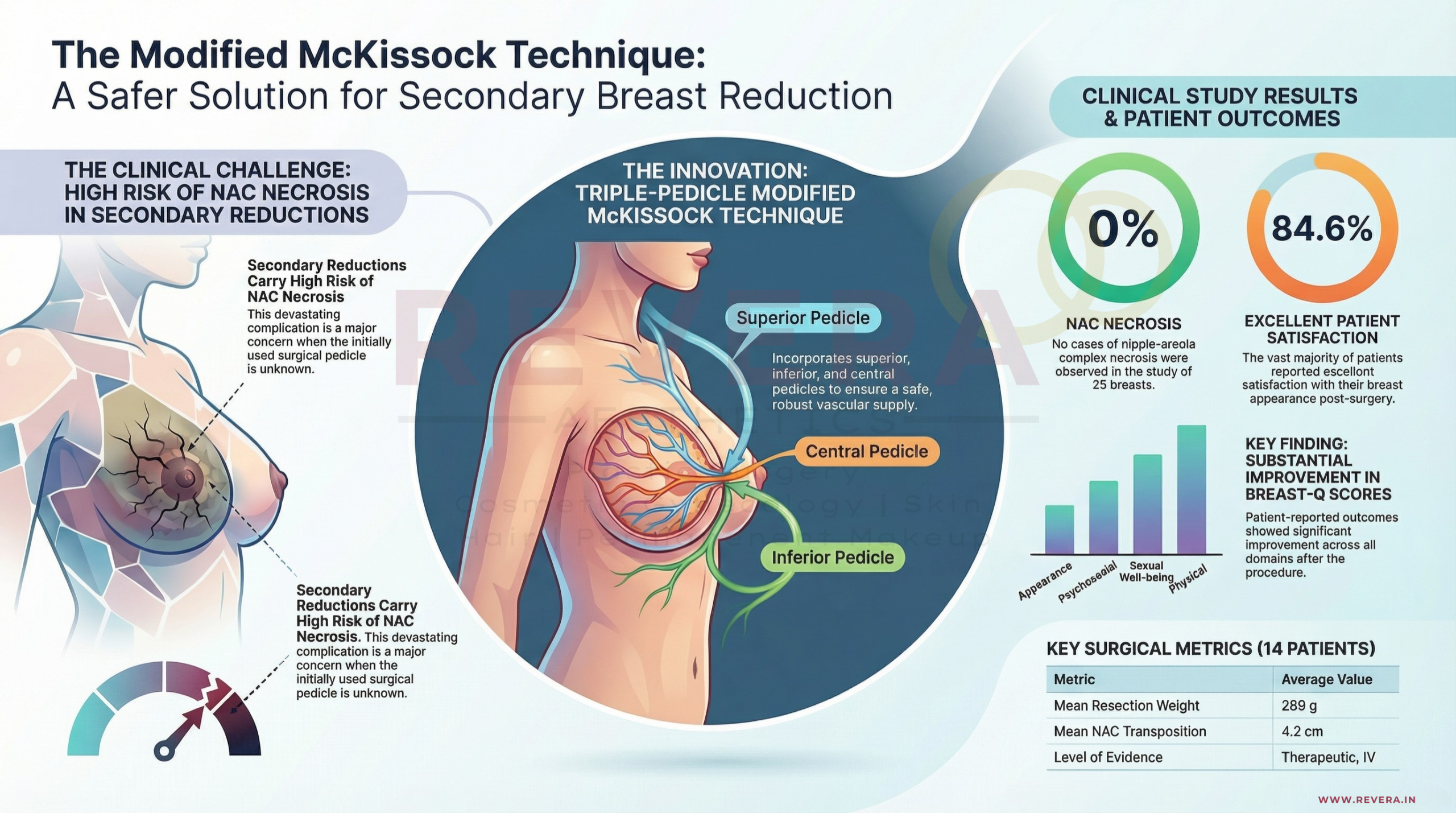
The Austrian team modified this by adding a third component: a Central Pedicle.

  • Superior Pedicle (Top)
  • Inferior Pedicle (Bottom)
  • Central Pedicle (Middle)

Think of it as adding an extra emergency power line. Even if the surgeon doesn’t know exactly how the first surgery was performed, this “triple-threat” approach ensures the nipple retains a robust blood supply from multiple directions.

The Results: 100% Safety Record

The study followed 25 breast revisions using this new technique. The results were remarkably positive:

  • Zero Necrosis: There were no cases of nipple loss or tissue death.
  • Significant Reduction: The average patient had roughly 300g of tissue removed per breast.
  • High Satisfaction: 84.6% of patients rated their aesthetic appearance as “excellent” after the surgery.

Why This Matters For You

If you have been told that a second breast reduction is “too risky” or that you aren’t a candidate because your previous surgical records are lost, this research changes the conversation.

This modified technique allows surgeons to navigate the “unknowns” of your previous surgery with a safety net, ensuring you can achieve the smaller, lifted shape you desire without compromising your safety.


Frequently Asked Questions (FAQ)

Q: Why do breasts get big again after a reduction?

A: While the fat and glandular tissue removed during surgery is gone forever, the remaining cells can expand. Weight gain, pregnancy, menopause, and certain hormonal medications can stimulate the remaining breast tissue to grow.

Q: Is a revision recovery harder than the first time?

A: Surprisingly, many patients find the recovery similar or even slightly easier, as less tissue is usually removed compared to the first massive reduction. However, strict adherence to post-op care is vital to protect the blood supply.

Q: Does this technique leave more scars?

A: This technique generally utilizes the “inverted-T” or “anchor” scar pattern. Since most primary breast reductions also use this pattern, the surgeon simply goes through the old scar lines, meaning you likely won’t have new scars, just refreshed ones.

Q: Can I breastfeed after a secondary reduction?

A: Breastfeeding after a primary reduction is already difficult (about 50% success rate). A secondary reduction involves further manipulation of the milk ducts. While the nipple is kept alive and sensitive, the ability to breastfeed is unlikely after a second procedure.


Reference

Feldler, Sandra MD; Zaussinger, Maximilian MD; Ehebruster, Gudrun MD; Bachleitner, Kathrin MD; Steinkellner, Theresia MD; Schmidt, Manfred MD. “Modified McKissock Technique for Secondary Breast Reduction: A Prospective Study on Safety and Surgical and Aesthetic Outcomes.” Plastic and Reconstructive Surgery. April 2025. Linz and Innsbruck, Austria.


1 2