
Written by revera-admin

More Than Just Back Pain: Measuring Happiness After Breast Reduction

Is It Just About Pain Relief?

Most women seek breast reduction surgery to relieve physical pain. Heavy breasts cause backaches, neck strain, and deep grooves from bra straps.

But what about the emotional side? Does the surgery actually make you feel better about yourself? Does it improve your confidence or intimacy?

For a long time, surgeons relied on anecdotal evidence (“My patients seem happier”). However, a study from The Ohio State University used a powerful scientific tool to prove it.

The “Gold Standard” of Surveys: The BREAST-Q

To measure something as vague as “satisfaction,” you need a precise ruler.

In this study, researchers used the BREAST-Q. This is a specific questionnaire developed to meet strict international standards. It does not just ask “Are you happy?” It breaks down satisfaction into specific categories.

The Study: Tracking Real Changes

The researchers followed 49 women undergoing breast reduction by a single surgeon. They asked these patients to fill out the BREAST-Q twice:

  1. Before surgery (Pre-operative).
  2. Six weeks after surgery (Post-operative).

They then compared the scores to see exactly what changed.

The Results: 4 Areas of Major Improvement

The findings confirmed that breast reduction changes lives on multiple levels. The study found statistically significant improvements in four distinct areas:

  1. Physical Well-being: As expected, the physical pain (back, neck, shoulders) decreased significantly.
  2. Psychosocial Well-being: Patients felt more confident and socially comfortable.
  3. Sexual Well-being: Patients reported feeling better about intimacy and their bodies.
  4. Satisfaction with Breasts: Patients were far happier with how their breasts looked.

The Surprise Finding: Looks Matter Most

Here is the most interesting part of the study.

You might assume that pain relief is the main driver of happiness. However, the data showed something else. Overall patient satisfaction was most strongly correlated with satisfaction with breast appearance.

This means that while getting rid of the pain is wonderful, loving the new shape of your breasts is what truly makes you happy with the surgery.

What This Means for You

It is okay to want your breasts to look good.

Sometimes, patients feel guilty for caring about the aesthetic result. They say, “I just want the pain gone.” But this study validates the cosmetic side of the procedure.

A good breast reduction should do both. It should relieve the weight and create a beautiful shape. According to the research, that aesthetic improvement is the key to your overall satisfaction.


Frequently Asked Questions (FAQ)

Q: What is the BREAST-Q?

A: It is a scientifically validated survey used by surgeons to measure patient satisfaction and quality of life outcomes. It is considered the gold standard for breast surgery research.

Q: Will this surgery help my self-esteem?

A: Yes. This study showed statistically significant improvements in “psychosocial well-being,” which relates to confidence and social interaction.

Q: Does insurance cover this if it improves “sexual well-being”?

A: Generally, insurance covers breast reduction based on physical symptoms (medical necessity), not psychological or sexual improvements. However, these are proven secondary benefits of the surgery.


Reference

[1] Coriddi, Michelle M.D.; Nadeau, Meghan M.D.; Taghizadeh, Maakan M.D.; Taylor, Anne M.D. “Analysis of Satisfaction and Well-Being following Breast Reduction Using a Validated Survey Instrument: The BREAST-Q.” Plastic and Reconstructive Surgery 132(2):p 285-290, August 2013.
Written by revera-admin

Can a “Heavy Chest” Actually Hurt Your Lungs?

The Weight on Your Chest

Women with macromastia (excessively large breasts) often complain of a “heavy” feeling on their chest. They may feel short of breath during exercise or even while resting.

Is this just a sensation? Or does the weight of the breasts actually restrict the lungs from filling with air?

A Randomized Controlled Trial from the University of Hull in the United Kingdom sought to answer this medical question.

The Study: Testing Lung Capacity

The researchers wanted to see if removing the breast weight improved lung function physically. They conducted a high-quality study (Randomized Controlled Trial) with 73 women.

  • Group 1 (Surgery): These women had breast reduction surgery immediately (within 6 weeks).
  • Group 2 (Control): These women waited 6 months before having surgery.

The doctors used spirometry (lung function tests) to measure how much air the women could inhale and exhale. They compared the results between the two groups.

The Findings: Weight Matters

The results revealed an interesting connection between breast size and breathing.

When they looked at the groups as a whole, the difference wasn’t immediately obvious. However, when they looked closer at the surgery group, they found a clear pattern.

  • The Correlation: There was a positive correlation between the weight of the tissue removed and the improvement in lung function.
  • The Takeaway: The more weight the surgeon removed, the better the patient’s lung test scores (like Peak Expiratory Flow) became.
  • Significant Improvement: Specifically, the study showed a significant improvement in Forced Vital Capacity (FVC). This measures the total amount of air you can forcibly exhale from your lungs.

Why Does This Happen?

Large breasts can act like a physical weight on the chest wall. This external weight may prevent the ribcage from expanding fully when you take a deep breath.

By performing a reduction mammaplasty, the surgeon removes this restriction. This allows the chest wall to move more freely, helping the lungs expand to their full predicted capacity.

Conclusion

If you have massive breasts and struggle to catch your breath, it might not just be “in your head.” It could be a mechanical restriction.

This study confirms that for women with heavy breasts, reduction surgery does more than relieve back pain. It correlates with a measurable improvement in pulmonary (lung) function.


Reference

[1] Iwuagwu, Obi C. F.R.C.S.; et al. “Does Reduction Mammaplasty Improve Lung Function Test in Women with Macromastia? Results of a Randomized Controlled Trial.Plastic and Reconstructive Surgery 118(1):p 1-6, July 2006.

Written by revera-admin

Am I Too “Heavy” or “Old” for Breast Reduction? New Data.

The Two Big Questions

When women consider breast reduction surgery, they often hesitate for two reasons. First, they worry about their weight (Body Mass Index or BMI). Second, they worry about their age.

Surgeons often struggle with these questions too. Is it safe to operate on someone with a high BMI? Does getting older mean more complications?

A study from Baylor Scott & White Medical Center in Texas provides some clear answers.

The Study: 277 Women Analyzed

The researchers reviewed 277 breast reduction surgeries performed over a four-year period. They specifically looked at how age, weight, and the amount of tissue removed impacted the recovery process.

Here is what they found.

The Weight Factor: Slow Healing, Not Disaster

Patients often fear that a high BMI guarantees a surgical disaster. The data suggests otherwise.

  • The Good News: BMI was not associated with higher rates of major complications (like dangerous infections or blood clots).
  • The Reality: However, weight does matter for speed. The study found that women with a higher BMI were significantly more likely to require more than 2 months to heal.

Basically, heavier patients are safe, but they need more patience. The wounds may take longer to close completely.

The Age Factor: Minor Annoyances

Does age make surgery risky? Not exactly, but it does change the skin’s ability to bounce back.

The study found that greater age was linked to a higher rate of minor complications. These are usually superficial wound healing issues, like small scabs or separations along the incision line. They are annoying, but rarely dangerous.

Minor vs. Major Complications

It is important to understand what “complication” means in this context.

  • Minor Complications: These were common (49.1% of patients) and mostly involved superficial wounds. These heal with dressing changes and time.
  • Major Complications: These were rare (only 4.31%). No specific factor (age or weight) seemed to increase this risk.

The Bottom Line

This study offers reassurance. While having a higher BMI means you might need longer to heal, it does not necessarily rule you out for surgery.

As the authors conclude, the benefits of breast reduction—relief from back pain and improved quality of life—often outweigh the risks, even for selected patients with higher BMI.


Reference

[1] Payton, Jesse I. MD; et al. “Impact of Age, Body Mass Index, and Resection Weight on Postoperative Complications in Reduction Mammaplasty.Plastic and Reconstructive Surgery 151(4):p 727-735, April 2023.

Written by revera-admin

A Safer Breast Reduction for Smokers? The “Three Flap” TechniqueThe Risk: Why Surgeons Turn Smokers Away

The Risk: Why Surgeons Turn Smokers Away

If you smoke or have a higher Body Mass Index (BMI), finding a surgeon for breast reduction can be difficult. Many surgeons hesitate to operate on these “high-risk” patients.

The reason is simple: Blood Supply.

Nicotine shrinks blood vessels. This limits the oxygen reaching the healing tissue. In breast reduction surgery, this increases the risk of serious complications, specifically nipple necrosis (where the nipple tissue dies) or wound breakdown.

However, a study published in Plastic and Reconstructive Surgery presents a specialized technique designed to overcome these odds.

The Solution: The Three Dermoglandular Flap Technique

Surgeons from the University of Bari, Italy, developed a method specifically for challenging cases. They call it the Three Dermoglandular Flap technique.

How It Works

Standard reductions often rely on skin to hold the breast shape. Over time, skin stretches, and the breast droops again (recurrence).

This Italian technique uses a different approach:

  1. Inferior-Central Pedicle: The surgeon keeps the nipple attached to a robust central bridge of tissue to ensure maximum blood flow.
  2. Internal Support: They create three separate flaps of dermis (deep skin) and gland tissue.
  3. The “Internal Bra”: These flaps are stitched together inside the breast. This creates a strong internal structure that supports the weight of the breast, independent of the skin.

The Test: Operating on “High-Risk” Patients

The researchers tested this method on the hardest-to-treat group. They selected 47 women who met strict criteria:

  • They were all smokers.
  • They had massive breasts (volume >1000 cc).
  • They had severe sagging (Grade 3 Ptosis).
  • They were overweight (Average BMI of 31.2).

The Results: Zero Nipple Loss

Given the high risks, the results were remarkable.

  • Safety: There were zero cases of partial or complete nipple necrosis.
  • Healing: There were zero cases of major wound breakdown.
  • Aesthetics: The technique produced a good cone shape with fullness in the upper breast.
  • Longevity: The results remained stable over time (up to 4 years of follow-up), proving the “internal support” worked.

What This Means for You

If you have been told you are “too high risk” for surgery due to smoking or weight, do not lose hope. While quitting smoking is always the best option for your health, surgical techniques exist that can handle challenging anatomy safely.

The Three Dermoglandular Flap technique offers a “safe and practical approach” for heavy, pendulous breasts. It prioritizes blood supply and structural support, ensuring you get the relief you need without the complications you fear.


Reference

[1] Pascone, Michele M.D.; Di Candia, Michele M.D.; Pascone, Christian M.D. “The Three Dermoglandular Flap Support in Reduction Mammaplasty.Plastic and Reconstructive Surgery 130(1):p 1e-10e, July 2012.


Social Media Hashtags

#BreastReduction #PlasticSurgerySafety #SmokersSurgery #HighBMISurgery #BreastLift #MedicalResearch #SurgicalInnovation #MassiveWeightLoss #ReconstructiveSurgery #PatientEducation

Written by revera-admin

High-Tech vs. The Standard: Is the “Harmonic Scalpel” Better for Breast Reduction?

The Allure of New Gadgets

We all love the latest technology. Whether it is a new iPhone or a high-tech kitchen appliance, we often assume “newer” means “better.” In plastic surgery, medical companies frequently market expensive new devices that promise faster recovery and less pain.

One such device is the Harmonic Scalpel. It claims to cut tissue and stop bleeding using ultrasonic vibrations rather than heat. But is it actually better than the standard tool surgeons have used for decades? A study from Dartmouth-Hitchcock Medical Center put this technology to the test.

The Tools: Electric vs. Ultrasonic

To understand the study, you must understand the tools:

  1. Electrocautery (The Standard): This tool uses electricity to heat tissue. It cuts and seals blood vessels simultaneously. It is the gold standard for breast reduction.
  2. Harmonic Scalpel (The Challenger): This device uses ultrasonic energy. It vibrates at high speeds to cut and coagulate tissue. It is often used in general surgery for procedures like thyroid removal.

The Experiment: A Side-by-Side Comparison

The researchers designed a clever study to remove outside factors like individual healing rates. They recruited 31 patients for bilateral breast reduction.

Here is the twist: They used both tools on the same patient.

One breast was operated on using the standard Electrocautery. The other breast was operated on using the Harmonic Scalpel. The assignment was random and blinded, meaning neither the patient nor the initial plan dictated which side got which tool.

The Results: Does Money Buy Better Results?

The study looked at three main things: speed, drainage (fluid buildup), and pain. The results might surprise you.

1. Speed (Operative Time)

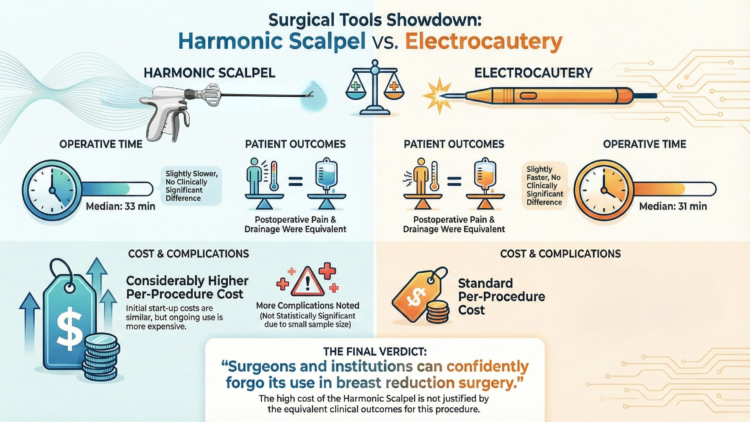
The manufacturer claims the Harmonic Scalpel is more efficient. However, the study found the opposite. The median time for the Harmonic Scalpel was 33 minutes, compared to 31 minutes for standard electrocautery. While this difference was statistically significant, it is practically negligible. Basically, the fancy tool did not save time.

2. Pain and Drainage

Did the ultrasonic technology reduce pain or fluid buildup? No.

The researchers found no statistical difference in drainage volume or postoperative pain scores between the two sides. Patients felt the same, regardless of the tool used.

3. The Cost

This is the biggest difference. While the start-up costs for the machines were comparable, the per-procedure cost for the Harmonic Scalpel was considerably higher.

Expert Opinion: Why It Didn’t Work

In the accompanying discussion, Dr. Melissa Crosby from M.D. Anderson Cancer Center explains why this high-tech tool fell short.

The Harmonic Scalpel is excellent for surgeries like thyroidectomies because it replaces slow manual techniques like tying knots or using clips. However, in breast reduction, surgeons already use electrocautery for speed and sealing. Therefore, swapping it for the Harmonic device does not add efficiency; it just adds cost.

Dr. Crosby also noted that in an era of cost-effective medicine, we must critically appraise expensive gadgets to ensure they actually benefit the patient.

The Verdict

The study concludes that the Harmonic Scalpel is roughly equivalent to standard electrocautery—but it costs much more.

For patients, this is good news. You do not need to seek out a surgeon who uses this specific “high-tech” device to get a great result. The standard method is efficient, safe, and just as comfortable.


Frequently Asked Questions (FAQ)

Q: Does the Harmonic Scalpel reduce scarring?

A: This study did not find any advantage in terms of healing complications or drainage that would suggest better scarring. In fact, there were slightly more complications on the Harmonic side, though the number was too small to be certain.

Q: Why do some surgeons use it?

A: Some surgeons may prefer it for other types of surgery (like general surgery) and carry that preference over. However, evidence shows no specific benefit for breast reduction.

Q: Is Electrocautery safe?

A: Yes. It has been the standard in surgery for many years. It is effective at stopping bleeding (hemostasis) while cutting, which keeps the surgery safe and quick.


References

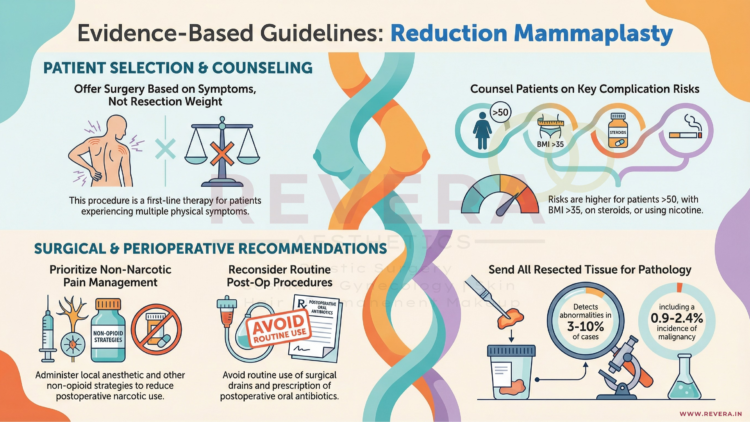
Infographic on 2022 Evidence Based Safety Guidelines on Reduction Mammaplasty
Written by revera-admin

The New Gold Standard: What the Latest Guidelines (2022) Say About Breast Reduction

Setting the Standard for Safety and Results

Breast reduction surgery (reduction mammaplasty) is one of the most life-changing procedures in plastic surgery, performed on over 100,000 patients annually. To ensure patients receive the safest and most effective care, the American Society of Plastic Surgeons (ASPS) convened a multidisciplinary work group to update their clinical practice guidelines.

Published in 2022, these guidelines reviewed thousands of studies to determine what truly works. Here is what the new evidence means for you as a patient.

1. It Is About Your Symptoms, Not the Scale

For years, insurance companies often demanded a specific weight of tissue be removed (e.g., 500g or 1000g) to qualify for coverage. The new guidelines challenge this outdated metric.

The ASPS now strongly recommends that surgery be offered as first-line therapy based on symptoms, not resection weight.

  • The Evidence: Studies show that relief from back pain, neck pain, and bra strap grooving is not correlated with the amount of tissue removed.
  • The Takeaway: If you have multiple physical symptoms (pain, rashes, grooving) that aren’t fixed by non-surgical methods, you are a candidate for surgery, regardless of whether you need a “small” or “large” reduction6666.

2. Drains Are No Longer Routine

One of the most dreaded parts of recovery for many patients is the use of surgical drains (tubes sticking out of the incision to collect fluid).

The guidelines bring good news: Plastic surgeons should not routinely use intraoperative drains for breast reduction patients.

  • Why? High-quality evidence shows no significant difference in complication rates (like hematomas) between patients with drains and those without.
  • The Benefit: avoiding drains means less discomfort during removal, lower costs, and less scarring.

3. Pain Management Has Evolved (Less Narcotics)

The modern approach to breast reduction focuses on multimodal pain management to reduce the need for strong opioids (narcotics).

  • Local Anesthesia: The guidelines strongly recommend administering local anesthetic (numbing medication like lidocaine or bupivacaine) at the surgical site. This significantly improves pain scores immediately after surgery and reduces the time spent in the recovery room.
  • Non-Narcotic Strategies: Surgeons are encouraged to use non-opioid medications (such as Acetaminophen or NSAIDs) to manage pain safely.

4. Technique: The Pedicle Choice

The “pedicle” is the bridge of tissue that keeps your nipple alive and sensitive during the lift and reduction. The guidelines reviewed the two most common techniques:

  1. Inferior Pedicle: The most commonly used, reliable for preserving blood supply.
  2. Superomedial Pedicle: Preserves upper-pole fullness and avoids a long transverse scar.

The verdict? Both techniques are acceptable and effective. There is no significant difference in major complications between them, so your surgeon can choose the method best suited to your specific anatomy.

5. Important Risk Factors

To ensure safety, the guidelines identified specific factors that may increase the risk of complications. Patients should be counseled if they:

  • Are older than 50 years.
  • Have a Body Mass Index (BMI) greater than 35.
  • Use chronic corticosteroids.

Additionally, there is a strong recommendation regarding Nicotine: Patients identified as nicotine users should be referred to cessation programs and encouraged to stop smoking before surgery. Smoking significantly increases the risk of wound healing problems and infection.

6. Antibiotics and Pathology

  • Antibiotics: Extended courses of antibiotics after you go home are generally not recommended. A single dose given before surgery (within 1 hour of incision) is sufficient to prevent infection without causing antibiotic resistance.
  • Pathology: It is recommended that all breast tissue removed during the surgery be sent to the lab for evaluation to check for any hidden abnormal cells or high-risk lesions.

Frequently Asked Questions (FAQ)

Q: Do I have to try physical therapy before surgery?

A: The guidelines state that reduction mammaplasty should be offered as first-line therapy over non-operative treatments. There is no evidence that non-operative management (like special bras or therapy) provides effective long-term relief for breast hypertrophy.

Q: Will I have drains?

A: According to the 2022 guidelines, routine use of drains is not supported by evidence. However, exceptions may be made for specific high-risk cases or if liposuction is also performed.

Q: Does the “Pedicle” technique affect breastfeeding?

A: The guidelines noted that techniques preserving the subareolar parenchyma (the tissue under the nipple) increase the likelihood of breastfeeding success, but more research is needed to compare specific techniques directly.


Reference

Perdikis, Galen M.D.; Dillingham, Claire D.O.; et al. “Evidence-Based Clinical Practice Guideline: Revision: Reduction Mammaplasty.” Plastic and Reconstructive Surgery 149(3):p 392e-409e, March 2022.

Written by revera-admin

More Than Just Shape: Restoring Feeling After Breast Reconstruction

The “Numb” Reality of Mastectomy

For millions of women undergoing mastectomy (breast removal) for cancer treatment or prevention, the primary focus is survival. The secondary focus is often reconstruction—restoring the physical appearance of the breast.

However, there is a “silent” side effect that is rarely discussed but deeply felt: Numbness.

During a mastectomy, the sensory nerves that provide feeling to the breast skin and nipple are often cut.

A Little Background on Anatomy

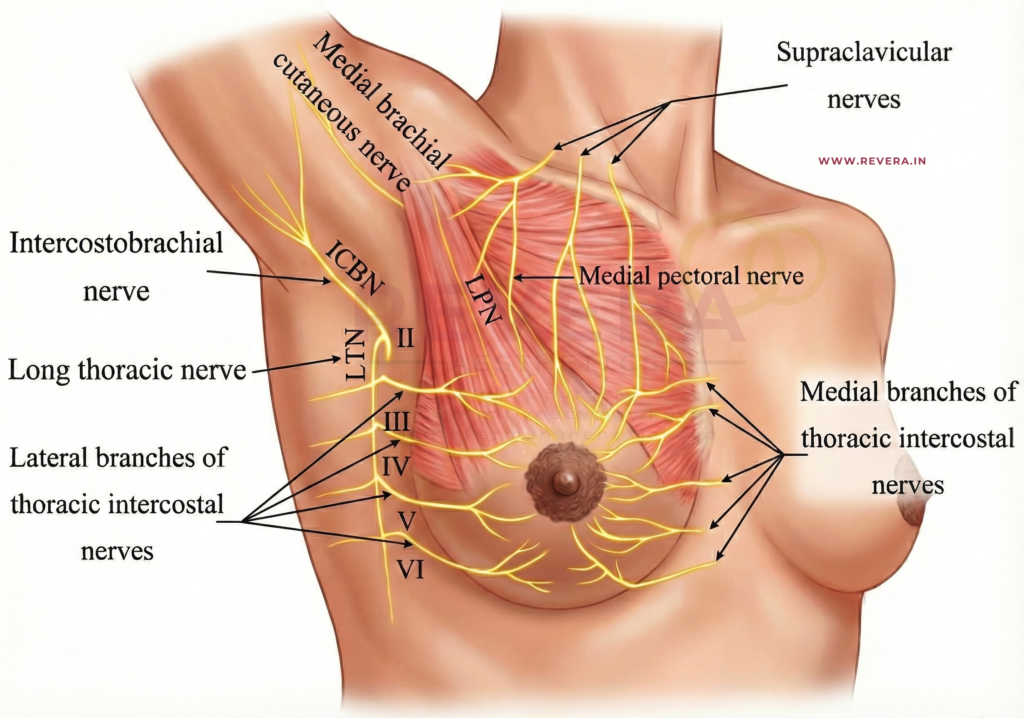
To understand why numbness occurs, we must look at how the breast receives feeling. The sensory innervation to the breast originates from the medial and lateral cutaneous branches of the third to fifth intercostal nerves.Image of thoracic dermatomes and intercostal nerve distribution

Shutterstock

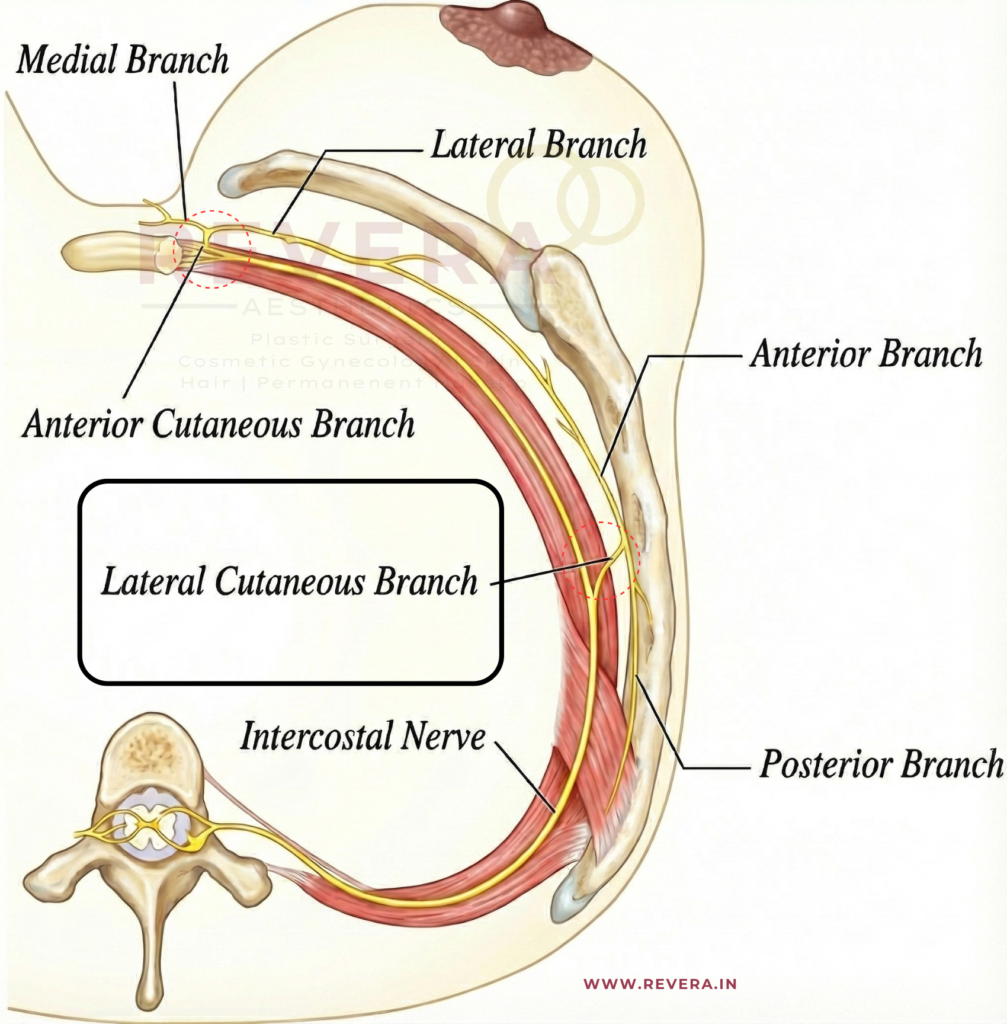
  • The Path of the Nerves: The third, fourth, and fifth intercostal nerves give off lateral cutaneous branches that pierce the chest wall (near the mid-axillary line, or the side of your rib cage). These branches divide into anterior and posterior parts, supplying the skin of the side and front of the chest.
  • The Anterior Branches: The anterior cutaneous branches (the terminal parts of these nerves) supply the skin on the chest wall toward the center (sternum).
    • The 3rd nerve covers the upper-mid chest.
    • The 4th nerve covers the central chest and the medial (inner) breast area – The Nipple Line.
    • The 5th nerve covers the lower-mid chest and the inframammary fold (where the breast meets the ribs).

These nerves provide sensory innervation (known as dermatomes) to specific chest and abdominal areas and are crucial for sensation and pain management (such as nerve blocks).

For years, women have accepted that their reconstructed breasts, while looking beautiful, would permanently feel numb—like “wearing a bra made of your own skin.”

Restoring sensation (Resensation) is possible. Surgeons can perform a “nerve transfer,” connecting a nerve from your chest wall to the nerves in the reconstructed breast.

So, why isn’t this done all the time?

One major hurdle has been the difficulty of finding the right donor nerve. The human body is complex, and searching for a tiny nerve (often only 2 millimeters wide) during a long surgery can be like finding a needle in a haystack.

The Breakthrough: A Roadmap for Sensation

A pivotal study published in Plastic and Reconstructive Surgery has provided surgeons with a reliable “treasure map” to find these elusive nerves.

Research conducted by Dr. Rebecca Knackstedt and Dr. Risal Djohan (along with their team in Cleveland and Toledo, Ohio), utilized precise anatomical studies to identify the exact hiding place of the nerve responsible for breast sensation.

What They Found

The researchers discovered that the Lateral Intercostal Branch (the nerve key to breast feeling) is located in a highly predictable spot:

  • It almost always exits from under the 4th Rib.
  • It sits consistently near the edge of the Pectoralis Minor muscle.
  • It travels safely underneath the thoracodorsal vessels (major blood vessels in the armpit area).

Why This Matters for Your Surgery

This study transforms a “search mission” into a precise procedure. Because surgeons now know exactly where to look, we can locate the nerve with much greater accuracy. The study identified the nerve’s location as:

  • 10 to 15 cm from the sternum (breastbone).
  • 8 to 16 cm from the mid-clavicular line.
  • Near the lateral border of the armpit muscle (Pectoralis minor) or within 2 cm from it.

By using these precise coordinates, surgeons can:

  1. Locate the nerve quickly, reducing surgery time.
  2. Preserve the nerve more effectively.
  3. Perform Nerve Allografts: Connect this sensation-carrying nerve to your reconstructed breast tissue using a nerve graft.

Moving Beyond “Looking Normal”

We believe that feeling whole means more than just looking in the mirror; it’s about feeling a hug, noticing a change in temperature, and reclaiming your body’s sensation.

Thanks to anatomical breakthroughs like this study from Ohio, Breast Neurotization (nerve repair) is becoming a more standard and successful part of breast reconstruction.


Frequently Asked Questions (FAQ)

Q: If I have this procedure, will my sensation be 100% normal?

A: “Normal” is a strong word. Nerve regeneration is slow and complex. Most patients do not regain perfect, pre-surgery sensitivity. However, the goal is to transition from “numbness” to “protective sensation” (feeling touch and pressure) and, in many cases, erogenous sensation. It is a vast improvement over having no feeling at all.

Q: Does this add time to the surgery?

A: Yes, nerve repair does add some time to the reconstruction surgery. However, thanks to the “mapping” provided by this research, the time taken to find the nerve is significantly reduced, making the addition of nerve repair much more feasible.

Q: Can this be done if I had a mastectomy years ago?

A: Breast reinnervation is most successful when performed at the same time as the mastectomy (Immediate Reconstruction). Doing it years later is much more difficult because the nerve endings may have scar tissue or have become dormant. However, it is always worth discussing with your surgeon.

Q: Is this only for implant reconstruction or flap reconstruction?

A: Nerve grafts can be used in both. In DIEP Flap (using your own tissue), surgeons connect the chest nerve to the nerve in the tummy tissue. In Implant reconstruction, the nerve is connected to the remaining skin or nipple nerves.


Reference

Knackstedt, Rebecca M.D., Ph.D.; Gatherwright, James M.D.; Cakmakoglu, Cagri M.D.; Djohan, Michelle M.S.; Djohan, Risal M.D. “Predictable Location of Breast Sensory Nerves for Breast Reinnervation.” Plastic and Reconstructive Surgery. February 2019. Cleveland Clinic & University of Toledo, Ohio.

Written by revera-admin

Natural Volume Without Implants: A New Brazilian Technique for Restoring Breast Volume in Breast Lift & Breast Reduction

The Quest for the Perfect Profile

For many women considering a Mastopexy (Breast Lift) or Reduction Mammoplasty, the goal is simple: a lifted, youthful shape and a more manageable size.

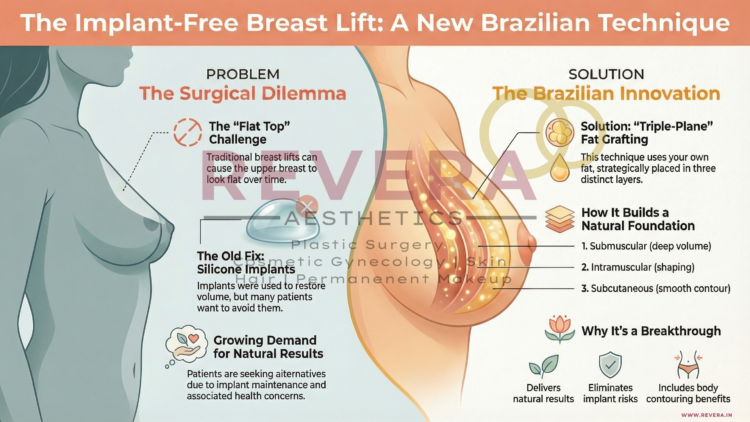
However, there has always been a surgical dilemma. Traditional lifts are excellent at removing excess skin and reshaping the breast, but they often struggle to maintain “upper pole projection”—that desirable fullness at the top of the breast (the décolletage). Over time, gravity can cause the breast tissue to settle, sometimes leaving the upper breast looking flat.

Historically, the solution to this was using silicone implants to fill that upper volume. But what if you don’t want implants?

The “Implant-Free” Movement

While implants remain a popular choice, many of our patients are seeking natural alternatives. Some wish to avoid the maintenance of implants, while others are concerned about rare but documented risks associated with silicone, such as Breast Implant-Associated Anaplastic Large-Cell Lymphoma (BIA-ALCL) or autoimmune symptoms.

If you desire fullness and lift but want to stay 100% natural, a groundbreaking new technique known as Triple-Plane Autologous Fat Grafting might be the answer.

Innovative Research from Brazil

We pride ourselves on staying up-to-date with global advancements in aesthetic medicine. This specific technique comes from a cutting-edge study titled “Breast codes: triple plane autologous fat grafting,” published in August 2025 in the prestigious Plastic and Reconstructive Surgery journal.

The study was conducted by Dr. Ricardo T. Nóra, a plastic surgeon based in Sinop, Mato Grosso, Brazil, in collaboration with Dr. Lydia M. Ferreira from the Division of Plastic Surgery at the Federal University of São Paulo, Brazil.

Brazil has long been recognized as a world leader in cosmetic surgery innovation. In this study, Dr. Nóra and Dr. Ferreira standardized a method to enhance breast shape without foreign bodies, addressing the limitations of previous techniques.

What is the “Triple-Plane” Technique?

Autologous Fat Grafting involves taking fat from an area where you have a little extra (like the abdomen or thighs) and transferring it to the breasts.

The innovation introduced by Dr. Nóra and Dr. Ferreira is the “Triple-Plane” approach. Instead of randomly injecting fat, this technique systematically places fat in three specific layers (planes) to build a lasting structural foundation:

  1. Submuscular: Deep placement under the muscle for foundational volume.
  2. Intramuscular: Placement within the muscle for dynamic shaping.
  3. Subcutaneous: Placement just under the skin for smooth contouring and softness.

Why This Matters for You

This innovative approach addresses the “flat top” issue without requiring a foreign object in your body. By strategically layering the fat according to these new “Breast Codes,” surgeons can now create that coveted upper-breast fullness during a lift or reduction.

Key Benefits:

  • Natural Results: Uses your own tissue, so the look and feel are entirely you.
  • Safety: Eliminates the risks associated with long-term silicone implants.
  • Body Contouring: You get the added benefit of liposuction in the donor area.
  • Scientifically Backed: Based on rigorous surgical protocols developed by leading experts in Brazil.

Experience the Future of Breast Surgery

If you are looking for a natural, long-lasting enhancement, let’s discuss if this technique is right for your body goals. Contact our clinic today at +919866224871 to schedule a consultation. Chat with us on WhatsApp.

We are located in Hyderabad – Himayatnagar and Gachibowli – Kondapur.


Reference

Nóra, Ricardo T. M.D., MSc; Ferreira, Lydia M. M.D., PhD. “Breast codes: triple plane autologous fat grafting in mastopexies and reduction mammoplasties without implants.” Plastic and Reconstructive Surgery. August 13, 2025.