

Written by revera-admin

Breast Reduction: Is It Safe if You are Morbidly Obese?

The Weight Barrier

Many plastic surgeons hesitate to perform breast reductions on patients with a high Body Mass Index (BMI). This is especially true for “morbidly obese” patients (BMI of 40 or higher).

Surgeons often worry about a higher risk of infections and poor wound healing. They also fear the challenges of Gigantomastia. This is when a surgeon must remove more than 2,000 grams of tissue from each breast.

But does the data actually support turning these patients away? A study published in Plastic and Reconstructive Surgery investigated this exact question.

The Study: Analyzing 179 Patients

Researchers in Galveston, Texas, performed a retrospective review of 179 patients. They wanted to see which factors truly caused complications. They looked at:

  • Body Mass Index (BMI).
  • The weight of the tissue removed.
  • The patient’s age.
  • Smoking status.
  • Other health conditions (comorbidities).

The Findings: Safety Across the Scale

The researchers found an overall complication rate of 50%. While this number seems high, it mostly consisted of minor healing issues common in large-volume surgeries.

Crucially, the study found no statistical difference in complications based on:

  1. BMI: Patients with a BMI over 40 were just as safe as those with lower BMIs.
  2. Reduction Size: Removing massive amounts of tissue (>2000g) did not increase the danger.
  3. Age: Older patients did not face more risks than younger ones in this group.

Furthermore, smoking status and other medical conditions did not significantly impact the complication rates in this study.

The Conclusion: A Green Light for Surgery

The study reached a bold conclusion. It is as safe to perform large-volume breast reductions in morbidly obese patients as it is in anyone else.

What This Means for You

If you have a high BMI and suffer from the weight of very large breasts, you may have been told to “lose weight first.” While losing weight is generally healthy, this research proves that you do not have to wait to find relief from physical pain.

Modern guidelines from the American Society of Plastic Surgeons (ASPS) agree. They recommend that surgery be offered based on your symptoms, not just your weight.

If you suffer from back pain, rashes, or shoulder grooving, you deserve a consultation. A skilled surgeon can perform your reduction safely, regardless of your starting weight.

—————

Ask yourself “Who is the Best Plastic Surgeon Near Me?”.
Contact us to know if you are a suitable candidate for Breast Reduction.

Revera Clinic caters with the Best Plastic Surgeon in Hyderabad!


Frequently Asked Questions (FAQ)

Q: Will a high BMI make my recovery longer?

A: Possibly. While major complications are not higher, some studies suggest that patients with a BMI over 35 may take longer than two months to heal completely.

Q: What is “Gigantomastia”?

A: This is a medical term for extremely large breasts. It usually applies when a surgeon needs to remove more than 2,000 grams (about 4.4 lbs) from each breast.

Q: Are certain surgical techniques safer for obese patients?

A: This study looked at various methods, including inferior pedicles and free nipple grafts. It found that the specific surgical method did not change the complication rate.


References

  • [1] Roehl, Kendall M.D.; et al. “Breast Reduction: Safe in the Morbidly Obese?” Plastic and Reconstructive Surgery 122(2):p 370-378, August 2008.
  • [2] Perdikis, Galen M.D.; et al. “Evidence-Based Clinical Practice Guideline: Revision: Reduction Mammaplasty.” Plastic and Reconstructive Surgery 149(3):p 392e-409e, March 2022.
Written by revera-admin

High-Tech vs. The Standard: Is the “Harmonic Scalpel” Better for Breast Reduction?

The Allure of New Gadgets

We all love the latest technology. Whether it is a new iPhone or a high-tech kitchen appliance, we often assume “newer” means “better.” In plastic surgery, medical companies frequently market expensive new devices that promise faster recovery and less pain.

One such device is the Harmonic Scalpel. It claims to cut tissue and stop bleeding using ultrasonic vibrations rather than heat. But is it actually better than the standard tool surgeons have used for decades? A study from Dartmouth-Hitchcock Medical Center put this technology to the test.

The Tools: Electric vs. Ultrasonic

To understand the study, you must understand the tools:

  1. Electrocautery (The Standard): This tool uses electricity to heat tissue. It cuts and seals blood vessels simultaneously. It is the gold standard for breast reduction.
  2. Harmonic Scalpel (The Challenger): This device uses ultrasonic energy. It vibrates at high speeds to cut and coagulate tissue. It is often used in general surgery for procedures like thyroid removal.

The Experiment: A Side-by-Side Comparison

The researchers designed a clever study to remove outside factors like individual healing rates. They recruited 31 patients for bilateral breast reduction.

Here is the twist: They used both tools on the same patient.

One breast was operated on using the standard Electrocautery. The other breast was operated on using the Harmonic Scalpel. The assignment was random and blinded, meaning neither the patient nor the initial plan dictated which side got which tool.

The Results: Does Money Buy Better Results?

The study looked at three main things: speed, drainage (fluid buildup), and pain. The results might surprise you.

1. Speed (Operative Time)

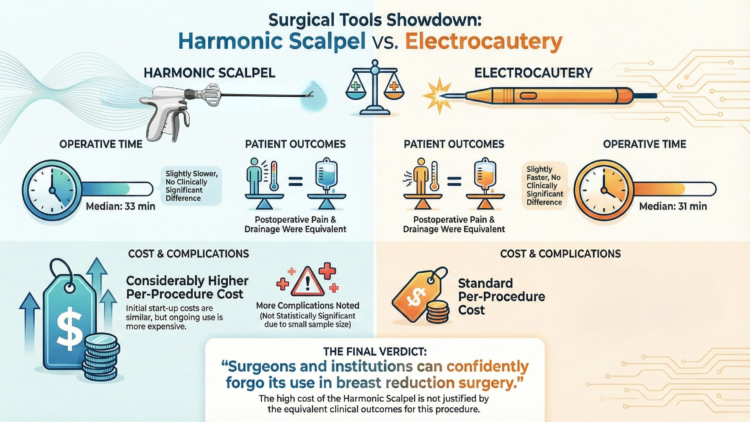
The manufacturer claims the Harmonic Scalpel is more efficient. However, the study found the opposite. The median time for the Harmonic Scalpel was 33 minutes, compared to 31 minutes for standard electrocautery. While this difference was statistically significant, it is practically negligible. Basically, the fancy tool did not save time.

2. Pain and Drainage

Did the ultrasonic technology reduce pain or fluid buildup? No.

The researchers found no statistical difference in drainage volume or postoperative pain scores between the two sides. Patients felt the same, regardless of the tool used.

3. The Cost

This is the biggest difference. While the start-up costs for the machines were comparable, the per-procedure cost for the Harmonic Scalpel was considerably higher.

Expert Opinion: Why It Didn’t Work

In the accompanying discussion, Dr. Melissa Crosby from M.D. Anderson Cancer Center explains why this high-tech tool fell short.

The Harmonic Scalpel is excellent for surgeries like thyroidectomies because it replaces slow manual techniques like tying knots or using clips. However, in breast reduction, surgeons already use electrocautery for speed and sealing. Therefore, swapping it for the Harmonic device does not add efficiency; it just adds cost.

Dr. Crosby also noted that in an era of cost-effective medicine, we must critically appraise expensive gadgets to ensure they actually benefit the patient.

The Verdict

The study concludes that the Harmonic Scalpel is roughly equivalent to standard electrocautery—but it costs much more.

For patients, this is good news. You do not need to seek out a surgeon who uses this specific “high-tech” device to get a great result. The standard method is efficient, safe, and just as comfortable.


Frequently Asked Questions (FAQ)

Q: Does the Harmonic Scalpel reduce scarring?

A: This study did not find any advantage in terms of healing complications or drainage that would suggest better scarring. In fact, there were slightly more complications on the Harmonic side, though the number was too small to be certain.

Q: Why do some surgeons use it?

A: Some surgeons may prefer it for other types of surgery (like general surgery) and carry that preference over. However, evidence shows no specific benefit for breast reduction.

Q: Is Electrocautery safe?

A: Yes. It has been the standard in surgery for many years. It is effective at stopping bleeding (hemostasis) while cutting, which keeps the surgery safe and quick.


References