

Written by revera-admin

The Science of Prediction: How Heavy Are Your Breasts for Breast Reduction Surgery?

The Quest for a Simple Formula

Researchers analyzed data from 263 women to find a reliable way to estimate breast weight before Breast Reduction surgery. They looked at several factors:

  • Age, height, and weight.
  • The distance from the sternal notch (the “V” at the base of your throat) to the nipple.
  • The distance from the sternal notch to the inframammary crease (the fold under the breast).

The “Magic Number”: Sternal Notch to Nipple

The study found that one measurement was more powerful than all others: The distance from the sternal notch to the nipple. This single measurement accounted for almost all the predictable variance in breast weight. The researchers discovered a strong correlation (0.80) between this distance and the final weight of the tissue removed.

Key Benchmarks for Insurance Coverage:

Many insurance plans require at least 500 grams per side. The study found the following:

  • $\ge 28.5$ cm: If your notch-to-nipple distance is 28.5 cm or more, there is an 80% chance the resection weight will be over 500 grams.
  • 25.5 to 28 cm: In this “critical range,” the predicted weight falls between 400 and 600 grams. There is only a 50% chance of hitting that 500-gram insurance mark.

The Human Element: Experience vs. Math

While the researchers developed a mathematical equation, they found a surprising result: The experienced surgeon was still more accurate than the formula.

In that tricky 400g to 600g “gray zone,” the senior surgeon was able to predict weights over 500g with 94% accuracy. This is because seasoned surgeons use “practiced spatial relationship skills”—essentially, they can “see” the volume and density of the breast in a way a ruler cannot.

Modern Context: AI and 3D Imaging

Since this study was published, technology has advanced significantly. While the notch-to-nipple measurement remains a “gold standard” in the office, many modern clinics now use 3D Surface Imaging (like Crisalix or Vectra).

Recent research published in Plastic and Reconstructive Surgery shows that 3D imaging and artificial intelligence can now predict resection weights with even higher precision than manual measurements alone, helping to reduce the risk of insurance denials.


Ask yourself “Who is the Best Plastic Surgeon Near Me?”.

Revera Clinic caters with the Best Plastic Surgeon in Hyderabad!

Breast Reduction Surgery Cost varies between individuals!

Contact us to know if you are a suitable candidate for Breast Reduction Surgery!


Frequently Asked Questions (FAQ)

Q: Why does the insurance company care about the weight?

A: Insurers use weight as a proxy for “medical necessity.” They believe that if a surgeon removes a large enough amount of tissue, the surgery is treating a physical condition (like back pain) rather than being purely cosmetic.

Q: What if I am just short of the 500g requirement?

A: This is the “critical range” mentioned in the study. In these cases, your surgeon’s clinical notes about your symptoms (shoulder grooving, rashes, neck pain) become even more vital for your insurance appeal.

Q: Does breast density affect the weight?

A: Yes. Glandular tissue is heavier than fatty tissue. This is one reason why the notch-to-nipple measurement isn’t 100% perfect—it measures length, not density.


References

Written by revera-admin

Breast Reduction: Is It Safe if You are Morbidly Obese?

The Weight Barrier

Many plastic surgeons hesitate to perform breast reductions on patients with a high Body Mass Index (BMI). This is especially true for “morbidly obese” patients (BMI of 40 or higher).

Surgeons often worry about a higher risk of infections and poor wound healing. They also fear the challenges of Gigantomastia. This is when a surgeon must remove more than 2,000 grams of tissue from each breast.

But does the data actually support turning these patients away? A study published in Plastic and Reconstructive Surgery investigated this exact question.

The Study: Analyzing 179 Patients

Researchers in Galveston, Texas, performed a retrospective review of 179 patients. They wanted to see which factors truly caused complications. They looked at:

  • Body Mass Index (BMI).
  • The weight of the tissue removed.
  • The patient’s age.
  • Smoking status.
  • Other health conditions (comorbidities).

The Findings: Safety Across the Scale

The researchers found an overall complication rate of 50%. While this number seems high, it mostly consisted of minor healing issues common in large-volume surgeries.

Crucially, the study found no statistical difference in complications based on:

  1. BMI: Patients with a BMI over 40 were just as safe as those with lower BMIs.
  2. Reduction Size: Removing massive amounts of tissue (>2000g) did not increase the danger.
  3. Age: Older patients did not face more risks than younger ones in this group.

Furthermore, smoking status and other medical conditions did not significantly impact the complication rates in this study.

The Conclusion: A Green Light for Surgery

The study reached a bold conclusion. It is as safe to perform large-volume breast reductions in morbidly obese patients as it is in anyone else.

What This Means for You

If you have a high BMI and suffer from the weight of very large breasts, you may have been told to “lose weight first.” While losing weight is generally healthy, this research proves that you do not have to wait to find relief from physical pain.

Modern guidelines from the American Society of Plastic Surgeons (ASPS) agree. They recommend that surgery be offered based on your symptoms, not just your weight.

If you suffer from back pain, rashes, or shoulder grooving, you deserve a consultation. A skilled surgeon can perform your reduction safely, regardless of your starting weight.

—————

Ask yourself “Who is the Best Plastic Surgeon Near Me?”.
Contact us to know if you are a suitable candidate for Breast Reduction.

Revera Clinic caters with the Best Plastic Surgeon in Hyderabad!


Frequently Asked Questions (FAQ)

Q: Will a high BMI make my recovery longer?

A: Possibly. While major complications are not higher, some studies suggest that patients with a BMI over 35 may take longer than two months to heal completely.

Q: What is “Gigantomastia”?

A: This is a medical term for extremely large breasts. It usually applies when a surgeon needs to remove more than 2,000 grams (about 4.4 lbs) from each breast.

Q: Are certain surgical techniques safer for obese patients?

A: This study looked at various methods, including inferior pedicles and free nipple grafts. It found that the specific surgical method did not change the complication rate.


References

  • [1] Roehl, Kendall M.D.; et al. “Breast Reduction: Safe in the Morbidly Obese?” Plastic and Reconstructive Surgery 122(2):p 370-378, August 2008.
  • [2] Perdikis, Galen M.D.; et al. “Evidence-Based Clinical Practice Guideline: Revision: Reduction Mammaplasty.” Plastic and Reconstructive Surgery 149(3):p 392e-409e, March 2022.
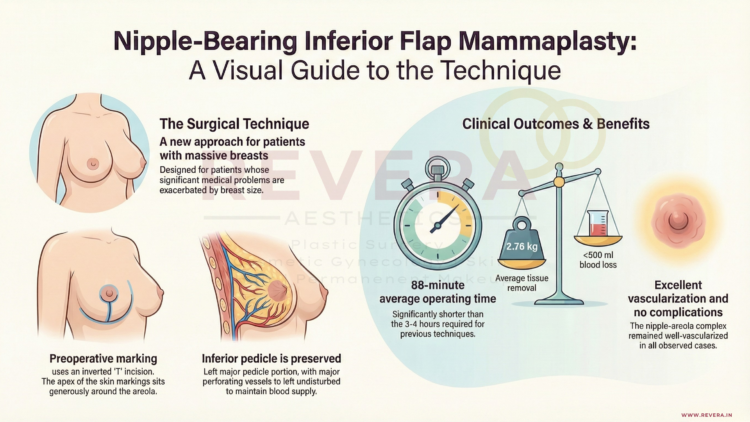
Image depicts infographic of Nipple Sparing Inferior Flap Mammaplasty, the time taken, amount of tissue removed and Blood loss
Written by revera-admin

Relief for Massive Breasts: A Safer, Faster Technique for High-Risk Patients

When Breast Reduction is a Medical Necessity

For many women, breast reduction is about comfort and confidence. But for women with Gigantomastia (massive breasts), the condition is a severe medical burden.

Patients with massive breasts often suffer from debilitating back pain, skin infections, and significant mobility issues. Even more concerning, the sheer weight of the tissue can exacerbate pre-existing cardiac (heart) and respiratory (lung) problems.

For these patients, surgery is not a luxury—it is a necessity. However, because these patients often battle obesity or heart conditions, undergoing a long surgical procedure can be risky.

The Challenge: The 4-Hour Marathon

The most popular traditional methods for breast reduction (such as the McKissock or Robbins techniques) rely on complex internal sculpting. While effective, these surgeries typically require 3 to 4 hours of operative time.

For a patient with heart or lung issues, being under general anesthesia for four hours can be dangerous. Consequently, some women feel forced to consider a Total Mastectomy (complete removal of the breast) just to get relief, or they avoid surgery altogether.

The Solution: Nipple-Bearing Inferior Flap Mammaplasty

A technique published in Plastic and Reconstructive Surgery offers a powerful solution specifically designed for massive weight reduction with maximum safety.

Developed by a surgical team in Preston, England, this technique focuses on speed and blood supply safety.

How It Works

Unlike complex sculpting methods that require separating the breast tissue from the chest wall (“undermining”), this technique leaves the base of the breast undisturbed.

  1. Wide Base: The surgeon creates a wide, supportive base of tissue (the “inferior flap”) that keeps the nipple attached to its natural blood supply.
  2. No Grafting Needed: Unlike some rapid reduction techniques that cut the nipple off and sew it back on as a skin graft, this method keeps the nipple connected, preserving its vitality.
  3. Efficient Removal: A wedge of tissue is removed down to the pectoral fascia, and the remaining flaps are brought together securely.

The Results: Faster and Safer

The study followed patients with massive breasts and significant medical problems who underwent this specific procedure. The results were transformative:

  • Drastically Reduced Surgery Time: The average operation took only 88 minutes (compared to the standard 3–4 hours).
  • Massive Weight Loss: The average tissue removal was 2.76 kg (over 6 lbs) per patient.
  • Safety: There was minimal blood loss (less than 500 mL on average).
  • Nipple Survival: Because the nipple was carried on a wide, robust flap, it remained well-vascularized with no complications in the study group.

Is This Right For You?

This technique is ideal for women who:

  • Have extremely large breasts causing medical distress.
  • Have been told they are “high risk” for long surgeries due to obesity or heart/lung conditions.
  • Want significant size reduction without resorting to a total mastectomy.

We believe that health and mobility should never be out of reach. If you are suffering from the weight of massive breasts, contact us to discuss if this rapid-reduction technique is an option for you.


Frequently Asked Questions (FAQ)

Q: Will I lose my nipple sensation? A: This technique is a “Nipple-Bearing” procedure. Unlike a “Free Nipple Graft” (where the nipple is completely detached), this method maintains a wide bridge of tissue connecting the nipple to the body’s blood and nerve supply, which helps preserve the nipple-areola complex.

Q: How are the scars placed? A: The incision design usually results in an inverted-U or inverted-L shape on the lower breast. While scarring is inevitable in reduction surgery, the primary goal of this specific technique is massive volume reduction to improve heart and lung health.

Q: Why is a shorter surgery better? A: For patients with pre-existing medical conditions (like high blood pressure, asthma, or obesity), prolonged anesthesia increases the risk of complications such as clots (DVT) or respiratory distress. Reducing the time from 4 hours to roughly 90 minutes significantly lowers this risk.


Reference

Alvi, R. F.R.C.S.I.; Jaffe, W. F.R.C.S.; Laitung, J. K. G. Ch.M., F.R.C.S.Ed.. “Nipple-Bearing Inferior Flap Mammaplasty: A New Technique for Reducing Massive Breasts.” Plastic and Reconstructive Surgery 101(1):p 174-176, January 1998.