
Written by revera-admin

Is Laser Hair Removal Safe? The Truth About Side Effects

Estimated reading time: 3 minutes

Home » Patient Safety

The Big Question

Since the late 90s, laser hair removal has exploded in popularity. But for years, patients asked the same question: “What are the risks?”

In 2003, Dr. Sean W. Lanigan published a major prospective study to answer this definitively. By analyzing a large number of patients across multiple centers, he aimed to quantify exactly how often things go wrong—and why.

This is a Multicenter Study on Laser Hair Removal Side Effects.

This research provided some of the first concrete data on exactly how safe laser hair removal is—and which lasers to avoid if you have darker skin.


The Verdict: “Inherently Safe”

The study’s conclusion was reassuring: Laser hair removal is associated with a low incidence of side effects.

When side effects did occur, they were almost always self-limiting, meaning they resolved on their own without needing medical treatment. Common, temporary reactions included:

  • Erythema: Redness of the skin.
  • Perifollicular Edema: Little bumps or swelling around the hair follicles (often considered a good sign that the laser worked).

The “Ruby” Risk for Darker Skin

However, the study identified one major danger zone. The highest rate of side effects occurred in patients with darker skin tones (Fitzpatrick Types IV–VI) who were treated with the Long-Pulsed Ruby Laser.

Why the Ruby Laser Failed

The Ruby laser (694 nm wavelength) is highly absorbed by melanin (pigment).

  • In Fair Skin: The laser ignores the skin and targets the black hair.
  • In Dark Skin: The laser cannot tell the difference between the hair and the melanin in the skin itself. This leads to burns, blistering, and pigmentation changes.

The Solution: Nd:YAG for Darker Skin

Dr. Lanigan’s research established a golden rule that is still followed today: For darker Fitzpatrick skin types, the Nd:YAG laser is safer than the Ruby laser.

The Nd:YAG laser has a longer wavelength (1064 nm). This allows it to bypass the surface pigment of the skin and target the hair follicle deep underneath, significantly reducing the risk of surface burns.

Conclusion

Laser hair removal is safe, but one size does not fit all. The most critical safety factor isn’t just the skill of the operator, but the choice of the laser.

If you have olive, brown, or black skin, this study confirms that you should verify your clinic uses an Nd:YAG or Diode laser, and strictly avoid the older Ruby technology.


Ask yourself Who does the “Best Laser Hair Removal Near Me?”.

Revera Clinic caters with the Best Laser Hair Removal in Hyderabad!

Laser Hair Removal Cost varies between individuals!

Contact us to know if you are a suitable candidate for Laser Hair Removal!


Frequently Asked Questions (FAQ)

Q: Does laser hair removal cause permanent scarring?

A: Scarring is extremely rare. The study found that side effects were mostly temporary (redness or swelling). Permanent scarring usually only happens if the wrong laser (like a Ruby) is used on the wrong skin type.

Q: How do I know my skin type?

A: Clinics use the Fitzpatrick Scale:

  • Type I-III: White/Fair skin that burns easily.
  • Type IV: Olive/Light Brown skin (Mediterranean, Hispanic, Asian).
  • Type V-VI: Dark Brown to Black skin (African, Indian).
  • Note: Types IV-VI require Nd:YAG lasers for maximum safety.

Q: Is the Ruby laser still used today?

A: It is rare. Because of the safety issues highlighted in studies like this one, most modern clinics have switched to Alexandrite (for light skin) and Nd:YAG (for dark skin) lasers.


References

  • [1] Lanigan, Sean W. MD. “Incidence of side effects after laser hair removal.Journal of the American Academy of Dermatology 49(5):p 882-886, November 2003.
  • [2] Gan, Stephanie D. MD; Graber, Emmy M. MD. “Laser Hair Removal: A Review.” Dermatologic Surgery 39(6):p 823-838, June 2013.

Woman in a Grey Shirt Giving a Thumbs up and holding a measuring tape in another hand. Dr. John Tebbetts Vertical Skin Excess measurement for Breast Reduction and Breast Lift Surgery
Written by revera-admin

Math Over Art: How Quantifying Your Skin Prevents Surgical Errors in Breast Reduction and Breast Lift!

The Problem: The “Artistic” Guess

For a long time, breast reduction and lift (mastopexy) planning relied heavily on the surgeon’s “artistic eye.” A surgeon would pinch the skin, draw some markings, and estimate how much tissue to remove.

While often successful, this subjective approach has a flaw: Imprecision. “Eyeballing” the skin excision can lead to nipples that are too high, scars that stretch, or breasts that “bottom out” because the skin envelope was left too loose.

The Solution: The Tebbetts Process

In March 2014, Dr. John Tebbetts published a landmark study from his practice in Dallas, Texas, detailing a strictly mathematical approach to planning these surgeries.

This paper represents a major shift from surgery as an “art” to surgery as an “objective science”.

Instead of guessing, he developed a process to quantify the skin envelope—measuring exactly how much excess skin exists down to the millimeter. He applied this rigorous measuring process to 124 mastopexy and 122 breast reduction patients.

1. Measuring “Vertical Skin Excess” (VSE)

The core of this technique is measuring Vertical Skin Excess. This is the specific amount of skin between the nipple and the breast crease that needs to be removed to lift the breast correctly.

Dr. Tebbetts found that this number—not a guess—should dictate which incision pattern is used:

Simple Formula:

VSE=Actual Nipple-to-IMF DistanceDesired Nipple-to-IMF Distance (typically 8-10 cm)cap V cap S cap E equals Actual Nipple-to-IMF Distance minus Desired Nipple-to-IMF Distance (typically 8-10 cm)

Quantified approach (More Detailed Calculation):

VSE=Existing Nipple-to-IMF Dimension(Desired Nipple-to-IMF Distance+Areola Diameter2)cap V cap S cap E equals Existing Nipple-to-IMF Dimension minus open paren Desired Nipple-to-IMF Distance plus the fraction with numerator Areola Diameter and denominator 2 end-fraction close paren

Illustration showing Nipple to IMF distance (Inframammary Fold)

2. Designing the “New” Envelope

Once the excess is measured, the surgeon calculates exactly where the new nipple position should be. In Dr. Tebbetts’ study, the planning was so precise that 0% of the 246 patients required nipple repositioning after surgery.

The Results: Why Math Wins

The study followed patients for an average of 4.6 years, providing long-term data on how these “quantified” breasts aged.

  • High Accuracy: As mentioned, no patient needed their nipples moved again.
  • Low Complications: “Bottoming out” (excessive lower pole stretch) occurred in only 4% of cases.
  • Learning Curve: Interestingly, the reoperation rate dropped from 6.5% in the first five years of using this method to just 1.6% in the later years, proving that once a surgeon masters the math, the results are incredibly consistent.

What This Means for You

If you are considering a breast reduction or lift, you want a surgeon who plans, not one who guesses.

This “Quantified Dimensions” approach ensures that the surgery is tailored to your specific skin elasticity and measurements. It removes the “surprise” factor, ensuring that the incision chosen is exactly the right one to handle your specific amount of excess skin.


Ask yourself “Who is the Best Plastic Surgeon Near Me?”.

Revera Clinic caters with the Best Plastic Surgeon in Hyderabad!

Breast Reduction Surgery Cost varies between individuals!

Contact us to know if you are a suitable candidate for Breast Reduction Surgery!


Frequently Asked Questions (FAQ)

Q: Does “quantifying” mean I get a cookie-cutter breast?

A: No, it means the opposite. Because the measurements are specific to your body, the surgical plan is customized to your exact anatomy rather than a generic template.

Q: Can this method prevent all stretching?

A: No surgery can stop gravity completely. However, this study showed that “excessive restretch” was rare (4%), meaning the results are stable for years.

Q: Is this technique used for implants too?

A: Dr. Tebbetts is famous for applying similar mathematical principles (“High Five” system) to breast augmentation, ensuring that implants fit the patient’s footprint perfectly.


References


Image showing Würinger’s Septum in various grades of Breast Ptosis
Written by revera-admin

The “Safety Net” Pedicle: Using Würinger’s Septum to Prevent Nipple Loss in Breast Reduction Surgery

The Study: A Solution from South Africa

In September 2010, plastic surgeons from the University of Stellenbosch (Bellville, South Africa) published a landmark study in Plastic and Reconstructive Surgery. Their goal was to address one of the most feared complications in breast surgery: nipple necrosis (tissue death).

After analyzing 106 consecutive patients (211 breasts) between 2001 and 2009, they proposed a technique that relies on a specific “anatomical highway” to keep the nipple safe.

The Anatomy: What is Würinger’s Septum?

To understand why this technique works, you must understand the anatomy of the breast.

  • Würinger’s Septum: This is a horizontal band of connective tissue that runs through the breast.It acts like a “shelf” or a hammock supporting the breast tissue.
  • The Highway: More importantly, this septum carries the nerves and blood vessels from the chest wall directly to the nipple.

Most traditional techniques cut through parts of this supply. The authors of this study argued that by preserving this specific ligament, surgeons can maintain a “dual” blood supply that is nearly bulletproof.

Würinger’s Septum to prevent Nipple Loss in Breast Reduction Surgery.

The Technique: The “Posteroinferomedial” Pedicle

The authors developed a pedicle (the bridge of tissue carrying the nipple) that captures blood from two distinct sources, making it exceptionally reliable.

1. The Medial Source (Internal Thoracic Artery)

By keeping the medial vertical ligament intact, the surgeon preserves the large perforating arteries (2nd, 3rd, and 4th) coming from the center of the chest.

2. The Inferior Source (Anterior Intercostal Arteries)

By keeping the horizontal septum intact, the surgeon captures the inferior mammary branches coming from the ribs.

This “Posteroinferomedial” approach ensures that even if one blood supply is weak, the other takes over, dramatically reducing the risk of the nipple dying.

Results: Versatility and Safety

The study showed that this technique is not only safe but also highly versatile.

  • Shape: It provided good nipple projection and upper breast fullness.
  • Flexibility: It can be used with almost any skin incision—whether “donut” (periareolar), “lollipop” (vertical), or “anchor” (inverted-T).
  • Learning Curve: The authors noted that the technique is easy to learn for surgeons familiar with breast anatomy.

Conclusion

For patients with risk factors like smoking or very large breasts, blood supply is everything. The Posteroinferomedial Pedicle offers a surgical “insurance policy” by utilizing Würinger’s septum to double the blood flow to the nipple.


Ask yourself “Who is the Best Plastic Surgeon Near Me?”.

Revera Clinic caters with the Best Plastic Surgeon in Hyderabad!

Breast Reduction Surgery Cost varies between individuals!

Contact us to know if you are a suitable candidate for Breast Reduction Surgery!


Frequently Asked Questions (FAQ)

Q: Does this technique preserve nipple sensation?

A: Yes. Because Würinger’s septum carries the main nerves to the nipple alongside the arteries, preserving it typically results in excellent sensation retention.

Q: Is this technique used for breast lifts (mastopexy) too?

A: Yes. The study confirmed its safety for both reduction mammaplasty and mastopexy (lifts).

Q: Why is “dual blood supply” better?

A: Human anatomy varies.18 Some people have strong medial arteries, while others have strong inferior ones. Capturing both ensures the nipple survives regardless of your specific anatomy.


References

Written by revera-admin

The Nipple Safety Test: How Surgeons Use “Fluorescence” to Prevent Complications in Breast Reduction Surgery

The Surgical Anxiety: The “Dusky” Nipple

At the very end of a breast reduction procedure, one of the most stressful moments for a plastic surgeon is seeing a “dusky” or blue-looking nipple-areola complex. This discoloration can indicate poor blood flow, which may lead to a “slough” or the death of the tissue.

Historically, the response was to apply dressings and hope for the best the following morning. However, researchers in La Jolla, California, pioneered a more scientific approach: the Intravenous Fluorescein Test.

What is the Fluorescein Test?

Fluorescein is a special dye (resorcinolphthalein) that has been used in medicine since 1881. When injected into the bloodstream, it travels through the vessels and into the skin.

How the Test Works During Surgery

  1. The Injection: Before the final stitches are placed, the surgeon injects a specific dose of fluorescein intravenously.
  2. The UV Light: Fifteen minutes later, the room is darkened, and the breast is examined under an ultraviolet (UV) light.
  3. The Glow: Healthy, viable skin will glow a bright chartreuse (yellow-green) color under the light.
  4. The Warning: Any areas that remain dark blue or do not glow are at high risk for tissue loss.

The Study: Saving the Nipple in Real-Time

In a series of 35 patients undergoing McKissock-type reductions, surgeons used this test to predict and avoid disasters.

  • The Reassurance: In 31 patients, the tissue glowed perfectly, confirming that everything was healthy.
  • The “False Alarm”: In one patient, the nipple looked blue to the eye, but the fluorescein test showed it was glowing. The surgeon left it alone, and the tissue survived perfectly.
  • The Life-Saving Intervention: In another patient, the test revealed no glow. The surgeon opened the incision and found that the internal tissue “pedicle” was kinked and folded too tightly. After correcting the position, the nipple glowed, and the tissue was saved.

Why This Matters for Your Safety

While this specific test was pioneered in the early 1980s, the principle remains a cornerstone of modern plastic surgery: Objective Safety Monitoring.

Today, surgeons may use similar fluorescence technology (like ICG-Angiography) to check blood flow during complex reconstructions. This “safety check” allows your surgeon to:

  • Predict tissue survival with high accuracy.
  • Correct internal issues (like kinked blood vessels) while you are still in the operating room.
  • Avoid the “disaster” of nipple tissue loss.

Conclusion

Your safety during a breast reduction isn’t left to “prayer and hope”. Advanced techniques like fluorescein testing give surgeons a “window” into your blood circulation, ensuring that your results are not only beautiful but also medically sound.

———————–

Ask yourself “Who is the Best Plastic Surgeon Near Me?”.

Revera Clinic caters with the Best Plastic Surgeon in Hyderabad!

Breast Reduction Surgery Cost varies between individuals!

Contact us to know if you are a suitable candidate for Breast Reduction Surgery!


Frequently Asked Questions (FAQ)

Q: Is the fluorescein dye safe?

A: Yes, it has been used safely in ophthalmology and surgery for over a century. The body typically clears the dye within 24 hours.

Q: Does every surgeon use a UV light test?

A: Not every surgeon uses this specific test for every patient. However, most will use clinical signs (like “capillary refill”) or modern infrared imaging if they have any concerns about blood flow during your procedure.

Q: Can a “dusky” nipple still survive?

A: Yes. As the study showed, sometimes a nipple looks dusky due to temporary bruising or vein congestion, but is actually healthy. The fluorescein test helps the surgeon tell the difference.


References


Pain Pump in Breast Reduction Surgery. Shows the schematic with the Infusion Chamber
Written by revera-admin

Less Pain, Faster Home: The Power of “Pain Pumps” in Breast Reduction Surgery

The End of the Hospital “Hangover”

Traditionally, recovering from a breast reduction or reconstruction required a hospital stay. Patients often needed heavy intravenous (IV) narcotics to manage their pain. These medications effectively block pain, but they often cause nausea, grogginess, and constipation.

Researchers at Northwestern Memorial Hospital in Chicago found a better way. By using a continuous “pain pump,” they helped patients go home sooner with significantly less discomfort.

What is a “Pain Pump”?

A pain pump is a small, portable device. It uses a tiny, indwelling catheter to deliver local anesthetic directly to the surgical site. Unlike a one-time injection, the pump provides a continuous infiltration of numbing medication for several days.

The Study: 148 Patients Compared

The study analyzed 74 breast reduction patients and 74 breast reconstruction patients. The researchers compared those who used traditional pain relief to those who used the Pain Pump in Breast Reduction Surgery.

1. Benefits for Pain Pump in Breast Reduction Surgery

The results for breast reduction patients were dramatic.

  • Fewer Hospital Stays: Patients with the pump were significantly less likely to need hospital admission. Many were able to recover comfortably at home.
  • Lower Pain Scores: Patients reported significantly less pain while in the recovery room.
  • Fewer Narcotics: The pump group required much lower amounts of cumulative pain medication.

2. Benefits for Breast Reconstruction

For those undergoing tissue expander reconstruction, the pump also offered clear advantages.

  • Significant Pain Relief: These patients reported much lower average pain scores.
  • Reduced Medication Use: Like the reduction group, these patients used significantly fewer narcotics.
  • Proven Safety: There were zero expander infections related to having the catheter near the implant.

Why This Fits Modern Guidelines

The American Society of Plastic Surgeons (ASPS) now strongly recommends these types of “non-narcotic” strategies. Using local anesthetics like Bupivacaine significantly improves pain scores immediately after surgery. It also helps you get through recovery with fewer side effects.


Medication Overview: What’s in the Pump?

To help you understand your recovery, here is a brief overview of the medications involved in this study.

1. Bupivacaine (Local Anesthetic)

  • Category: Local anesthetic (Amide-type).
  • Mechanism of Action: It blocks sodium channels in the nerve fibers. This stops the nerve from sending pain signals to your brain.
  • Potential Side Effects: While very safe in a pump, potential side effects can include localized numbness or tingling. In very rare cases of accidental systemic absorption, it can affect the heart or central nervous system.

2. Narcotics (Opioids)

  • Category: Opioid analgesics.
  • Mechanism of Action: These bind to specific “opioid receptors” in the brain and spinal cord. They change how your body perceives and responds to pain.
  • Potential Side Effects: Common side effects include nausea, vomiting, dizziness, and constipation. They also carry a risk of respiratory depression and potential dependency with long-term use.

——————————-

Ask yourself “Who is the Best Plastic Surgeon Near Me?”.
Contact us to know if you are a suitable candidate for Breast Reduction.

Revera Clinic caters with the Best Plastic Surgeon in Hyderabad!
Our Anaesthetists are highly accomplished and help in a pain free recovery.


Frequently Asked Questions (FAQ)

Q: Does the pump hurt to remove?

A: No. The catheter is very thin, similar to a piece of fishing line. Removing it is usually quick and painless, often done by the patient or nurse at home.

Q: Will I still need some narcotic pills?

A: Most patients still have a prescription for “breakthrough” pain. However, as this study shows, you will likely need much fewer than if you didn’t have the pump.

Q: Is it safe for breast implants?

A: Yes. The study specifically noted that there were no infections or issues when the pump was used near tissue expanders.


References

Written by revera-admin

Hidden Findings: Why We Test Tissue After Breast Reduction

The Routine Lab Test

When you undergo a breast reduction, your surgeon removes excess fat, skin, and glandular tissue. But what happens to that tissue?

Most patients assume it is simply discarded. However, standard safety protocols require this tissue to be sent to a lab for evaluation. While the goal of surgery is relief from physical pain, this routine step can sometimes uncover “occult” (hidden) medical findings.

The Evidence: The ASPS Recommendation

The American Society of Plastic Surgeons (ASPS) provides clear “Gold Standard” guidelines for this procedure.

  • The Rule: Plastic surgeons should send breast tissue from all patients for pathologic evaluation.
  • The Benefit: This allows for the early detection of cancer or high-risk lesions.
  • The Rationale: Preoperative mammograms are helpful but not perfect. They do not always catch the tiny abnormalities found in surgical specimens.

What the Research Says: The Emory University Study

A major study from Emory University analyzed the records of 1,014 patients who had breast reductions over 20 years. The researchers wanted to know how often hidden (occult) cancer or high-risk cells were found.

They split the patients into two groups:

  • Group A: Women with no history of breast cancer.
  • Group B: Women who had a previous breast cancer diagnosis.

The Incidence of Hidden Findings

The study found that these hidden findings are “not uncommon”.

  1. For General Patients (Group A): High-risk or malignant cells were found in 1.8% of patients.
  2. For Cancer Survivors (Group B): The risk was much higher, 8% of these patients had hidden findings in their reduction specimens.

Who Is at Higher Risk?

The research identified two major “positive predictors” for finding hidden abnormalities during surgery:

  • Increasing Age: As patients get older, the likelihood of a positive finding increases.
  • Personal History: Having a previous breast cancer diagnosis is a significant risk factor.

Why This Matters for Your Safety

Finding these cells early is a major benefit. Identifying high-risk lesions allows your medical team to start early treatment or more frequent screening.

As the authors of the study concluded, it is crucial for surgeons to maintain open communication with the lab. This ensures that if something is found, your follow-up care is precise and effective.


Frequently Asked Questions (FAQ)

Q: If my mammogram was clear, do I still need a lab test?

A: Yes. Research shows that 81% of patients with abnormal findings in their surgery tissue had a “normal” preoperative mammogram. The lab test is a necessary safety net.

Q: Is it common to find cancer during a breast reduction?

A: No, it is rare. In general patients, the risk is about 1.8%. However, “high-risk” cells (which are not cancer but could lead to it) are found slightly more often.

Q: Does insurance cover the cost of the lab test?

A: Generally, because this is a standard-of-care recommendation from the ASPS, it is treated as a necessary part of the medical procedure.


References

  • [1] Razavi, Seyed Amirhossein M.D.; et al. “The Incidence of Occult Malignant and High-Risk Pathologic Findings in Breast Reduction Specimens.” Plastic and Reconstructive Surgery 148(4):p 534e-539e, October 2021.
  • [2] Perdikis, Galen M.D.; et al. “Evidence-Based Clinical Practice Guideline: Revision: Reduction Mammaplasty.” Plastic and Reconstructive Surgery 149(3):p 392e-409e, March 2022.
Written by revera-admin

A Safer Breast Reduction for Smokers? The “Three Flap” TechniqueThe Risk: Why Surgeons Turn Smokers Away

The Risk: Why Surgeons Turn Smokers Away

If you smoke or have a higher Body Mass Index (BMI), finding a surgeon for breast reduction can be difficult. Many surgeons hesitate to operate on these “high-risk” patients.

The reason is simple: Blood Supply.

Nicotine shrinks blood vessels. This limits the oxygen reaching the healing tissue. In breast reduction surgery, this increases the risk of serious complications, specifically nipple necrosis (where the nipple tissue dies) or wound breakdown.

However, a study published in Plastic and Reconstructive Surgery presents a specialized technique designed to overcome these odds.

The Solution: The Three Dermoglandular Flap Technique

Surgeons from the University of Bari, Italy, developed a method specifically for challenging cases. They call it the Three Dermoglandular Flap technique.

How It Works

Standard reductions often rely on skin to hold the breast shape. Over time, skin stretches, and the breast droops again (recurrence).

This Italian technique uses a different approach:

  1. Inferior-Central Pedicle: The surgeon keeps the nipple attached to a robust central bridge of tissue to ensure maximum blood flow.
  2. Internal Support: They create three separate flaps of dermis (deep skin) and gland tissue.
  3. The “Internal Bra”: These flaps are stitched together inside the breast. This creates a strong internal structure that supports the weight of the breast, independent of the skin.

The Test: Operating on “High-Risk” Patients

The researchers tested this method on the hardest-to-treat group. They selected 47 women who met strict criteria:

  • They were all smokers.
  • They had massive breasts (volume >1000 cc).
  • They had severe sagging (Grade 3 Ptosis).
  • They were overweight (Average BMI of 31.2).

The Results: Zero Nipple Loss

Given the high risks, the results were remarkable.

  • Safety: There were zero cases of partial or complete nipple necrosis.
  • Healing: There were zero cases of major wound breakdown.
  • Aesthetics: The technique produced a good cone shape with fullness in the upper breast.
  • Longevity: The results remained stable over time (up to 4 years of follow-up), proving the “internal support” worked.

What This Means for You

If you have been told you are “too high risk” for surgery due to smoking or weight, do not lose hope. While quitting smoking is always the best option for your health, surgical techniques exist that can handle challenging anatomy safely.

The Three Dermoglandular Flap technique offers a “safe and practical approach” for heavy, pendulous breasts. It prioritizes blood supply and structural support, ensuring you get the relief you need without the complications you fear.


Reference

[1] Pascone, Michele M.D.; Di Candia, Michele M.D.; Pascone, Christian M.D. “The Three Dermoglandular Flap Support in Reduction Mammaplasty.Plastic and Reconstructive Surgery 130(1):p 1e-10e, July 2012.


Social Media Hashtags

#BreastReduction #PlasticSurgerySafety #SmokersSurgery #HighBMISurgery #BreastLift #MedicalResearch #SurgicalInnovation #MassiveWeightLoss #ReconstructiveSurgery #PatientEducation

Infographic Comparing Lollipop Scar Vs Anchor shaped scar Breast Reduction
Written by revera-admin

Lollipop vs. Anchor: Which Breast Reduction Technique is Safer?

The Scar Debate: Less is More?

When you consider breast reduction surgery, scarring is often a top concern. Traditionally, surgeons used the Wise-Pattern (or “Anchor”) technique. This leaves a scar around the areola, down the middle, and along the crease underneath the breast.

However, a newer technique called the Vertical Scar (or “Lollipop”) reduction has gained popularity. It eliminates the horizontal scar underneath the breast, leaving only a vertical line.

Patients often ask: Is the “Lollipop” technique just as safe? Can it handle large reductions? A study from the University of Illinois answers these questions.

The Study: Comparing 200 Breasts

Researchers wanted to compare these two popular methods directly. They conducted a “matched cohort study,” meaning they paired patients with similar ages and breast sizes to get a fair comparison.

  • Group A: 100 breasts operated on using the Superomedial Pedicle Vertical technique (“Lollipop”).
  • Group B: 100 breasts operated on using the Traditional Inferior Pedicle Wise-Pattern technique (“Anchor”).

This was a significant study because it looked at outcomes over a 3-year period.

The Results: Equal Safety, Less Scarring

The findings were reassuring for anyone hoping for fewer scars.

  • Large Reductions: The Vertical technique successfully handled large reductions. The average tissue removed was 815g (Vertical) versus 840g (Anchor) per breast.
  • Complications: There was no statistical difference in complications between the two groups. Healing issues and safety profiles were essentially the same.
  • Symptom Relief: 100% of patients in both groups achieved relief from their symptoms (like back and neck pain).

The Verdict: The Vertical “Lollipop” reduction is a safe and effective alternative to the traditional “Anchor” method, even for larger breasts.

A Deeper Dive: It’s All About Blood Supply

In the accompanying discussion, expert surgeon Dr. Elizabeth Hall-Findlay highlights why the “Vertical” technique works so well. It often comes down to the “pedicle”—the bridge of tissue that carries blood to the nipple.

Dr. Hall-Findlay explains that the breast has four major arteries supplying it.

  • Inferior Pedicle (Traditional): Relies on the deep artery from the 4th interspace.
  • Medial/Superomedial Pedicle (Vertical): Relies on strong arteries from the 2nd or 3rd interspace.

She notes that a true Superomedial Pedicle is particularly robust. It incorporates the “very strong descending artery” from the second rib space. This provides a powerful “dual” blood supply, making it a reliable choice for keeping the nipple healthy during surgery.

Which Is Right for You?

This study proves that you do not necessarily need an “Anchor” scar just because you require a large reduction. The “Lollipop” technique offers excellent functional and aesthetic outcomes with a shorter scar.

However, anatomy varies. Your surgeon will choose the “pedicle” and scar pattern that best fits your specific blood supply and body shape.


References

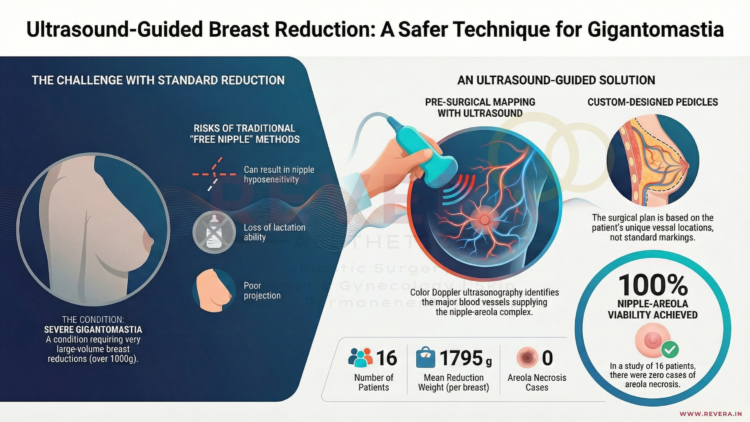
Infographic showing advantages for going for USG mapping of Blood vessels supplying the Breast
Written by revera-admin

Massive Breast Reduction: How Ultrasound Can Save Your Nipple Sensation

The Fear of the “Free Nipple Graft”

Women with extremely large breasts (Severe Gigantomastia) often face a difficult choice. They want relief from the heavy weight. However, surgeons often tell them they need a “Free Nipple Graft.”

This technique involves completely removing the nipple and sewing it back on as a skin graft. It is safe, but the trade-off is steep. Patients often lose nipple sensation, nipple projection, and the ability to breastfeed.

Why Is This Usually Necessary?

In standard breast reductions, surgeons rely on general anatomical rules to keep the nipple alive. We assume we know where the blood vessels are.

But in severe gigantomastia, the anatomy is stretched. The nipple sits very far away from the chest wall. Guessing the location of the blood vessels becomes risky. If the surgeon guesses wrong, the nipple could die. Therefore, many choose the Free Nipple Graft to be safe.

The Solution: Seeing Inside with Ultrasound

A study published in Plastic and Reconstructive Surgery offers a smarter, technology-driven alternative.

Researchers from Istanbul Medical Faculty decided not to guess. Instead, they used Color Doppler Ultrasonography before surgery to map out the breast.

How It Works

  1. The Scan: Before the operation, the surgeon uses an ultrasound probe to scan the breast.
  2. The Map: They identify exactly which blood vessels (perforators) are feeding the nipple-areola complex.
  3. The Design: The surgeon designs a custom tissue bridge (“pedicle”) specifically for that patient. It protects those specific vessels.

Customizing the Surgery

The study showed that every woman is different.

  • Some patients had strong blood supply from the inner breast (Internal Mammary artery).
  • Others relied on the outer breast (Lateral Thoracic artery).

By using ultrasound, the surgeons could tailor the cut to the patient. They used superomedial, superolateral, or mediolateral designs depending on what the scan showed.

The Results: Safety Without Sacrifice

The study followed 16 patients with severe gigantomastia (average age 41).

  • Massive Reduction: The average weight removed was nearly 1.8 kg (about 4 lbs) per breast.
  • Perfect Survival: Zero patients suffered nipple necrosis (tissue death).
  • No Free Graft: None of the patients required a Free Nipple Graft.

What This Means for You

Having massive breasts does not mean you must sacrifice nipple sensation or shape. Technology can act as a “guide” for your surgeon.

If you are considering a significant reduction, ask your surgeon about preservation techniques. A personalized approach, guided by ultrasound, can offer the safety of a Free Nipple Graft without the downsides.


Reference

Başaran, Karaca M.D.; Ucar, Adem M.D.; Guven, Erdem M.D.; Arinci, Atilla M.D.; Yazar, Memet M.D.; Kuvat, Samet Vasfi M.D. “Ultrasonographically Determined Pedicled Breast Reduction in Severe Gigantomastia.” Plastic and Reconstructive Surgery 128(4):p 252e-259e, October 2011.

Infographic comparing two techniques to correct Medially Positioned Nipples
Written by revera-admin

When Nipples “Point In”: A Specialized Technique for Better Positioning

The Challenge of Nipple Position

Breast reduction surgery is not just about making the breast smaller; it is about reshaping it to look proportional and centering the nipple on the new mound.

Most standard breast reduction techniques (like the popular Superomedial Pedicle) assume the nipple is starting from a standard sagging position. But what happens when a patient’s nipples are naturally positioned medially—meaning they sit closer to the cleavage or “point inward”?

In these cases, using standard techniques can be mechanically difficult. Trying to move an inward-facing nipple into a central position can restrict the blood supply or create tension, limiting how perfect the final result can be.

The Solution: The Superolateral Pedicle (SLP)

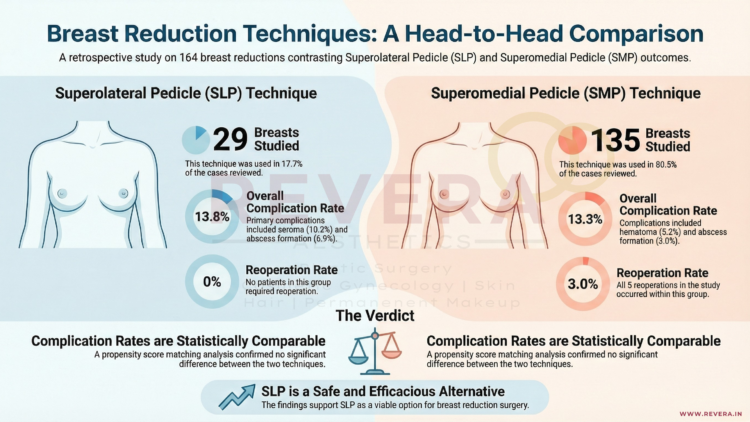
A new study published in Plastic and Reconstructive Surgery (August 2025) highlights a specific surgical approach designed exactly for this anatomy: the Superolateral Pedicle (SLP).

How It Works

In breast reduction, the nipple is kept alive on a “pedicle”—a bridge of tissue that preserves blood vessels and nerves.

  • Standard Way (Superomedial): The tissue bridge is usually kept on the inner/top side.
  • The SLP Way: For patients with medial nipples, the surgeon keeps the tissue bridge on the outer/top side (Superolateral).

By anchoring the nipple from the outside, the surgeon can more easily swing and rotate the nipple into the perfect central position without fighting the breast’s natural tissue resistance.

Is It Safe? The Research Say Yes

Researchers from MedStar Georgetown University Hospital in Washington, DC, reviewed 164 breast reductions to compare the safety of this specialized SLP technique against the standard method.

The Findings:

  • Comparable Safety: The complication rates were nearly identical between the two groups (13.8% for SLP vs. 13.3% for standard), proving that this technique is just as safe as the traditional method.
  • Effective Reduction: The technique worked well for significant reductions, with an average tissue removal of over 700g.
  • No Re-operations: In this specific study group, zero patients in the SLP group required a return to the operating room for complications, compared to 5 cases in the standard group.

Why This Matters For You

Anatomy is unique. If you have noticed that your nipples sit closer to your breastbone or point inward, standard techniques might not offer you the best aesthetic result. This research confirms that your surgeon has a validated, safe “tool in the toolkit” to correct medially positioned nipples and achieve a beautiful, centered look.


Frequently Asked Questions (FAQ)

Q: How do I know if I have “medially positioned” nipples?

A: If your nipples seem to sit closer to your cleavage rather than the center of your breast mound, or if they point inward towards each other, you likely have medial positioning. Your surgeon will assess this during your consultation.

Q: Does this technique leave different scars?

A: generally, no. The Superolateral Pedicle refers to the internal tissue handling. The external scars usually follow the standard “Wise Pattern” (Anchor) or Vertical (Lollipop) shape, just like a regular breast reduction.

Q: Is the recovery harder with this technique?

A: According to the study, complications such as wound healing issues (dehiscence) or fluid collection (seroma) were comparable to the standard technique, suggesting the recovery process is very similar.

Q: Can I still breastfeed with this technique?

A: Like the standard Superomedial technique, the SLP preserves a bridge of tissue carrying blood and nerve supply to the nipple. While breastfeeding can never be guaranteed after reduction surgery, techniques that preserve the pedicle generally offer a better chance than those that do not.


Reference

Lava, Christian X. MS; Li, Karen R. BBA; Episalla, Nicole C. MD; Snee, Isabel A. BS; Bell, Alice C. BA; Fan, Kenneth L. MD; Jabbour, Samer F. MD. “Superolateral Pedicle Breast Reduction for Patients with Medially Positioned Nipple-Areola Complexes.” Plastic and Reconstructive Surgery 156(2):p 174e-182e, August 2025.

1 2