
Written by revera-admin

The Hall-Findlay Technique: Simplifying the “Lollipop” Breast Reduction

Why Vertical Breast Reduction Used to Be Hard

For many years, the Vertical Reduction Mammaplasty (often called the “Lollipop” reduction) struggled to gain popularity in North America. Surgeons worried that the technique was too difficult to learn. Many also believed it only worked for small breast reductions.

Dr. Elizabeth Hall-Findlay changed this perspective. In her influential study published in Plastic and Reconstructive Surgery, she introduced modifications that made the procedure simpler, safer, and more reliable for all sizes.

Four Key Modifications That Simplified Everything

Dr. Hall-Findlay identified several steps in the traditional “Lejour” technique that made it complicated. She simplified the surgery by focusing on these four changes:

1. The Medial (or Lateral) Pedicle

Instead of using a complex central blood supply, she used a medial or lateral dermoglandular pedicle. This tissue bridge safely carries the blood supply to the nipple. This change makes the move (transposition) of the nipple much more predictable for the surgeon.

2. No Skin Undermining

Traditional methods often involved “undermining” or separating the skin from the underlying breast tissue. Dr. Hall-Findlay removed this step. By keeping the skin attached, the breast retains better blood flow and heals more reliably.

3. Minimal Use of Liposuction

While some techniques rely heavily on liposuction to reduce breast volume, Dr. Hall-Findlay found it was rarely necessary. She preferred direct surgical removal to ensure a more precise and stable breast shape.

4. No Pectoralis Fascia Sutures

She eliminated the need to stitch the breast tissue to the chest muscle (pectoralis fascia). This streamlined the operation and reduced internal complexity.

Proven Results: 400 Successful Cases

Dr. Hall-Findlay tested these modifications in a series of 400 vertical breast reductions. The results proved that the “Lollipop” method isn’t just for small breasts.

  • Broad Application: The average reduction was 525g per breast, but she successfully removed up to 1425g using this technique.
  • Reduced Scarring: By using a vertical pattern, she effectively eliminated the long horizontal scar found in traditional “Anchor” reductions.
  • Ease of Use: The study concluded that these modifications made the technique much easier for other surgeons to learn and apply.

The Takeaway for Patients

If you want a breast reduction with less scarring, you no longer have to worry if your breasts are “too large” for a vertical technique. Thanks to these refinements, surgeons can offer the “Lollipop” reduction with high safety and excellent, long-lasting results.


Frequently Asked Questions

Q: Is the vertical technique safe for very large breasts?

A: Yes. Dr. Hall-Findlay’s research showed it is effective for reductions involving over 1400g of tissue per breast.

Q: What is the main benefit of the medial pedicle?

A: It provides a very reliable blood supply to the nipple and areola, which reduces the risk of healing complications.

Q: Will the “Lollipop” shape hold up over time?

A: Because this technique uses internal tissue shaping rather than just skin tightening, the results tend to be very stable.


Reference

[1] Hall-Findlay, Elizabeth J. M.D., F.R.C.S.(C). “A Simplified Vertical Reduction Mammaplasty: Shortening the Learning Curve.Plastic and Reconstructive Surgery 104(3):p 748-759, September 1999.

Written by revera-admin

Avoiding the “Bull’s-Eye”: How to Get a Natural Nipple Scar

The Problem: The “Target” Effect

Breast reduction surgery creates a new shape for your breast. However, it also creates a scar around the nipple.

Traditionally, surgeons cut the nipple in a perfect oval shape. When this heals, it can leave a conspicuous white line. This pale scar contrasts sharply against the darker skin of the areola.

The result is often called a “bull’s-eye” or “target-like” appearance. The nipple looks “stuck on” rather than naturally blending with the breast skin.

The Solution: A Ragged Edge

A technique from the Queen Victoria Hospital in the United Kingdom offers a clever refinement to solve this aesthetic problem.

Instead of a perfectly smooth cut, the surgeons use a jagged, shelving incision.

How It Works

  1. The Cut: The surgeon makes a “ragged” incision all around the nipple edge, rather than a straight line.
  2. The Slope: They angle the cut toward the center to create a sloping shelf.
  3. The Fit: This allows the nipple to sit better in its new location. The jagged edges break up the scar line.

This mimics nature. On an unoperated breast, the pigmented nipple skin merges gradually with the surrounding skin. This technique restores that natural, graduated look.

The Results: High Satisfaction

The surgeons tested this refinement on 15 patients undergoing bilateral breast reduction. They monitored the healing carefully.

  • Safety: There were zero complications. No patient experienced infection or delayed healing.
  • Satisfaction: The aesthetic results were excellent. 90.9% of patients (10 out of 11 fully reviewed) expressed satisfaction with the final shape of their nipple.

Conclusion

You do not have to settle for a “bull’s-eye” scar. Small refinements in surgical technique can make a big difference.

By using a jagged incision, your surgeon can break up the visual line of the scar. This helps the nipple blend naturally with the breast, avoiding the artificial “target” look.


Reference

[1] Pandya, A. N. M.S., M.Ch., F.R.C.S.; Arnstein, P. M. F.R.C.S. “Refinement of Nipple Areolar Placement in Breast Surgery.Plastic and Reconstructive Surgery 101(3):p 806-807, March 1998.

Written by revera-admin

More Than Just Back Pain: Measuring Happiness After Breast Reduction

Is It Just About Pain Relief?

Most women seek breast reduction surgery to relieve physical pain. Heavy breasts cause backaches, neck strain, and deep grooves from bra straps.

But what about the emotional side? Does the surgery actually make you feel better about yourself? Does it improve your confidence or intimacy?

For a long time, surgeons relied on anecdotal evidence (“My patients seem happier”). However, a study from The Ohio State University used a powerful scientific tool to prove it.

The “Gold Standard” of Surveys: The BREAST-Q

To measure something as vague as “satisfaction,” you need a precise ruler.

In this study, researchers used the BREAST-Q. This is a specific questionnaire developed to meet strict international standards. It does not just ask “Are you happy?” It breaks down satisfaction into specific categories.

The Study: Tracking Real Changes

The researchers followed 49 women undergoing breast reduction by a single surgeon. They asked these patients to fill out the BREAST-Q twice:

  1. Before surgery (Pre-operative).
  2. Six weeks after surgery (Post-operative).

They then compared the scores to see exactly what changed.

The Results: 4 Areas of Major Improvement

The findings confirmed that breast reduction changes lives on multiple levels. The study found statistically significant improvements in four distinct areas:

  1. Physical Well-being: As expected, the physical pain (back, neck, shoulders) decreased significantly.
  2. Psychosocial Well-being: Patients felt more confident and socially comfortable.
  3. Sexual Well-being: Patients reported feeling better about intimacy and their bodies.
  4. Satisfaction with Breasts: Patients were far happier with how their breasts looked.

The Surprise Finding: Looks Matter Most

Here is the most interesting part of the study.

You might assume that pain relief is the main driver of happiness. However, the data showed something else. Overall patient satisfaction was most strongly correlated with satisfaction with breast appearance.

This means that while getting rid of the pain is wonderful, loving the new shape of your breasts is what truly makes you happy with the surgery.

What This Means for You

It is okay to want your breasts to look good.

Sometimes, patients feel guilty for caring about the aesthetic result. They say, “I just want the pain gone.” But this study validates the cosmetic side of the procedure.

A good breast reduction should do both. It should relieve the weight and create a beautiful shape. According to the research, that aesthetic improvement is the key to your overall satisfaction.


Frequently Asked Questions (FAQ)

Q: What is the BREAST-Q?

A: It is a scientifically validated survey used by surgeons to measure patient satisfaction and quality of life outcomes. It is considered the gold standard for breast surgery research.

Q: Will this surgery help my self-esteem?

A: Yes. This study showed statistically significant improvements in “psychosocial well-being,” which relates to confidence and social interaction.

Q: Does insurance cover this if it improves “sexual well-being”?

A: Generally, insurance covers breast reduction based on physical symptoms (medical necessity), not psychological or sexual improvements. However, these are proven secondary benefits of the surgery.


Reference

[1] Coriddi, Michelle M.D.; Nadeau, Meghan M.D.; Taghizadeh, Maakan M.D.; Taylor, Anne M.D. “Analysis of Satisfaction and Well-Being following Breast Reduction Using a Validated Survey Instrument: The BREAST-Q.” Plastic and Reconstructive Surgery 132(2):p 285-290, August 2013.

Written by revera-admin

Can a “Heavy Chest” Actually Hurt Your Lungs?

The Weight on Your Chest

Women with macromastia (excessively large breasts) often complain of a “heavy” feeling on their chest. They may feel short of breath during exercise or even while resting.

Is this just a sensation? Or does the weight of the breasts actually restrict the lungs from filling with air?

A Randomized Controlled Trial from the University of Hull in the United Kingdom sought to answer this medical question.

The Study: Testing Lung Capacity

The researchers wanted to see if removing the breast weight improved lung function physically. They conducted a high-quality study (Randomized Controlled Trial) with 73 women.

  • Group 1 (Surgery): These women had breast reduction surgery immediately (within 6 weeks).
  • Group 2 (Control): These women waited 6 months before having surgery.

The doctors used spirometry (lung function tests) to measure how much air the women could inhale and exhale. They compared the results between the two groups.

The Findings: Weight Matters

The results revealed an interesting connection between breast size and breathing.

When they looked at the groups as a whole, the difference wasn’t immediately obvious. However, when they looked closer at the surgery group, they found a clear pattern.

  • The Correlation: There was a positive correlation between the weight of the tissue removed and the improvement in lung function.
  • The Takeaway: The more weight the surgeon removed, the better the patient’s lung test scores (like Peak Expiratory Flow) became.
  • Significant Improvement: Specifically, the study showed a significant improvement in Forced Vital Capacity (FVC). This measures the total amount of air you can forcibly exhale from your lungs.

Why Does This Happen?

Large breasts can act like a physical weight on the chest wall. This external weight may prevent the ribcage from expanding fully when you take a deep breath.

By performing a reduction mammaplasty, the surgeon removes this restriction. This allows the chest wall to move more freely, helping the lungs expand to their full predicted capacity.

Conclusion

If you have massive breasts and struggle to catch your breath, it might not just be “in your head.” It could be a mechanical restriction.

This study confirms that for women with heavy breasts, reduction surgery does more than relieve back pain. It correlates with a measurable improvement in pulmonary (lung) function.


Reference

[1] Iwuagwu, Obi C. F.R.C.S.; et al. “Does Reduction Mammaplasty Improve Lung Function Test in Women with Macromastia? Results of a Randomized Controlled Trial.Plastic and Reconstructive Surgery 118(1):p 1-6, July 2006.

Written by revera-admin

Am I Too “Heavy” or “Old” for Breast Reduction? New Data.

The Two Big Questions

When women consider breast reduction surgery, they often hesitate for two reasons. First, they worry about their weight (Body Mass Index or BMI). Second, they worry about their age.

Surgeons often struggle with these questions too. Is it safe to operate on someone with a high BMI? Does getting older mean more complications?

A study from Baylor Scott & White Medical Center in Texas provides some clear answers.

The Study: 277 Women Analyzed

The researchers reviewed 277 breast reduction surgeries performed over a four-year period. They specifically looked at how age, weight, and the amount of tissue removed impacted the recovery process.

Here is what they found.

The Weight Factor: Slow Healing, Not Disaster

Patients often fear that a high BMI guarantees a surgical disaster. The data suggests otherwise.

  • The Good News: BMI was not associated with higher rates of major complications (like dangerous infections or blood clots).
  • The Reality: However, weight does matter for speed. The study found that women with a higher BMI were significantly more likely to require more than 2 months to heal.

Basically, heavier patients are safe, but they need more patience. The wounds may take longer to close completely.

The Age Factor: Minor Annoyances

Does age make surgery risky? Not exactly, but it does change the skin’s ability to bounce back.

The study found that greater age was linked to a higher rate of minor complications. These are usually superficial wound healing issues, like small scabs or separations along the incision line. They are annoying, but rarely dangerous.

Minor vs. Major Complications

It is important to understand what “complication” means in this context.

  • Minor Complications: These were common (49.1% of patients) and mostly involved superficial wounds. These heal with dressing changes and time.
  • Major Complications: These were rare (only 4.31%). No specific factor (age or weight) seemed to increase this risk.

The Bottom Line

This study offers reassurance. While having a higher BMI means you might need longer to heal, it does not necessarily rule you out for surgery.

As the authors conclude, the benefits of breast reduction—relief from back pain and improved quality of life—often outweigh the risks, even for selected patients with higher BMI.


Reference

[1] Payton, Jesse I. MD; et al. “Impact of Age, Body Mass Index, and Resection Weight on Postoperative Complications in Reduction Mammaplasty.Plastic and Reconstructive Surgery 151(4):p 727-735, April 2023.

Written by revera-admin

A Safer Breast Reduction for Smokers? The “Three Flap” TechniqueThe Risk: Why Surgeons Turn Smokers Away

The Risk: Why Surgeons Turn Smokers Away

If you smoke or have a higher Body Mass Index (BMI), finding a surgeon for breast reduction can be difficult. Many surgeons hesitate to operate on these “high-risk” patients.

The reason is simple: Blood Supply.

Nicotine shrinks blood vessels. This limits the oxygen reaching the healing tissue. In breast reduction surgery, this increases the risk of serious complications, specifically nipple necrosis (where the nipple tissue dies) or wound breakdown.

However, a study published in Plastic and Reconstructive Surgery presents a specialized technique designed to overcome these odds.

The Solution: The Three Dermoglandular Flap Technique

Surgeons from the University of Bari, Italy, developed a method specifically for challenging cases. They call it the Three Dermoglandular Flap technique.

How It Works

Standard reductions often rely on skin to hold the breast shape. Over time, skin stretches, and the breast droops again (recurrence).

This Italian technique uses a different approach:

  1. Inferior-Central Pedicle: The surgeon keeps the nipple attached to a robust central bridge of tissue to ensure maximum blood flow.
  2. Internal Support: They create three separate flaps of dermis (deep skin) and gland tissue.
  3. The “Internal Bra”: These flaps are stitched together inside the breast. This creates a strong internal structure that supports the weight of the breast, independent of the skin.

The Test: Operating on “High-Risk” Patients

The researchers tested this method on the hardest-to-treat group. They selected 47 women who met strict criteria:

  • They were all smokers.
  • They had massive breasts (volume >1000 cc).
  • They had severe sagging (Grade 3 Ptosis).
  • They were overweight (Average BMI of 31.2).

The Results: Zero Nipple Loss

Given the high risks, the results were remarkable.

  • Safety: There were zero cases of partial or complete nipple necrosis.
  • Healing: There were zero cases of major wound breakdown.
  • Aesthetics: The technique produced a good cone shape with fullness in the upper breast.
  • Longevity: The results remained stable over time (up to 4 years of follow-up), proving the “internal support” worked.

What This Means for You

If you have been told you are “too high risk” for surgery due to smoking or weight, do not lose hope. While quitting smoking is always the best option for your health, surgical techniques exist that can handle challenging anatomy safely.

The Three Dermoglandular Flap technique offers a “safe and practical approach” for heavy, pendulous breasts. It prioritizes blood supply and structural support, ensuring you get the relief you need without the complications you fear.


Reference

[1] Pascone, Michele M.D.; Di Candia, Michele M.D.; Pascone, Christian M.D. “The Three Dermoglandular Flap Support in Reduction Mammaplasty.Plastic and Reconstructive Surgery 130(1):p 1e-10e, July 2012.


Social Media Hashtags

#BreastReduction #PlasticSurgerySafety #SmokersSurgery #HighBMISurgery #BreastLift #MedicalResearch #SurgicalInnovation #MassiveWeightLoss #ReconstructiveSurgery #PatientEducation

Infographic Comparing Lollipop Scar Vs Anchor shaped scar Breast Reduction
Written by revera-admin

Lollipop vs. Anchor: Which Breast Reduction Technique is Safer?

The Scar Debate: Less is More?

When you consider breast reduction surgery, scarring is often a top concern. Traditionally, surgeons used the Wise-Pattern (or “Anchor”) technique. This leaves a scar around the areola, down the middle, and along the crease underneath the breast.

However, a newer technique called the Vertical Scar (or “Lollipop”) reduction has gained popularity. It eliminates the horizontal scar underneath the breast, leaving only a vertical line.

Patients often ask: Is the “Lollipop” technique just as safe? Can it handle large reductions? A study from the University of Illinois answers these questions.

The Study: Comparing 200 Breasts

Researchers wanted to compare these two popular methods directly. They conducted a “matched cohort study,” meaning they paired patients with similar ages and breast sizes to get a fair comparison.

  • Group A: 100 breasts operated on using the Superomedial Pedicle Vertical technique (“Lollipop”).
  • Group B: 100 breasts operated on using the Traditional Inferior Pedicle Wise-Pattern technique (“Anchor”).

This was a significant study because it looked at outcomes over a 3-year period.

The Results: Equal Safety, Less Scarring

The findings were reassuring for anyone hoping for fewer scars.

  • Large Reductions: The Vertical technique successfully handled large reductions. The average tissue removed was 815g (Vertical) versus 840g (Anchor) per breast.
  • Complications: There was no statistical difference in complications between the two groups. Healing issues and safety profiles were essentially the same.
  • Symptom Relief: 100% of patients in both groups achieved relief from their symptoms (like back and neck pain).

The Verdict: The Vertical “Lollipop” reduction is a safe and effective alternative to the traditional “Anchor” method, even for larger breasts.

A Deeper Dive: It’s All About Blood Supply

In the accompanying discussion, expert surgeon Dr. Elizabeth Hall-Findlay highlights why the “Vertical” technique works so well. It often comes down to the “pedicle”—the bridge of tissue that carries blood to the nipple.

Dr. Hall-Findlay explains that the breast has four major arteries supplying it.

  • Inferior Pedicle (Traditional): Relies on the deep artery from the 4th interspace.
  • Medial/Superomedial Pedicle (Vertical): Relies on strong arteries from the 2nd or 3rd interspace.

She notes that a true Superomedial Pedicle is particularly robust. It incorporates the “very strong descending artery” from the second rib space. This provides a powerful “dual” blood supply, making it a reliable choice for keeping the nipple healthy during surgery.

Which Is Right for You?

This study proves that you do not necessarily need an “Anchor” scar just because you require a large reduction. The “Lollipop” technique offers excellent functional and aesthetic outcomes with a shorter scar.

However, anatomy varies. Your surgeon will choose the “pedicle” and scar pattern that best fits your specific blood supply and body shape.


References

Written by revera-admin

High-Tech vs. The Standard: Is the “Harmonic Scalpel” Better for Breast Reduction?

The Allure of New Gadgets

We all love the latest technology. Whether it is a new iPhone or a high-tech kitchen appliance, we often assume “newer” means “better.” In plastic surgery, medical companies frequently market expensive new devices that promise faster recovery and less pain.

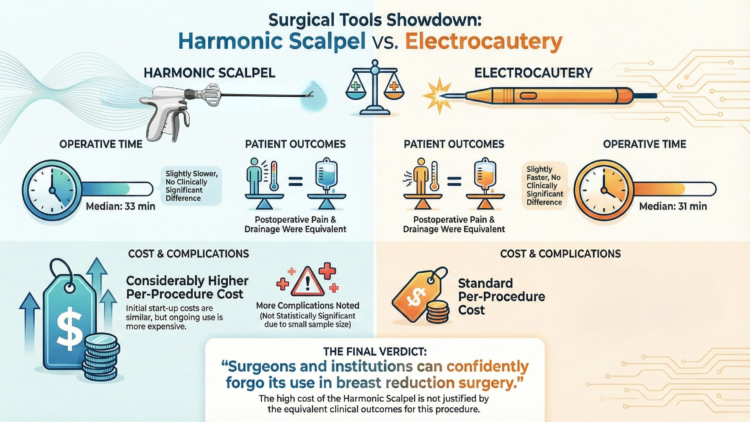
One such device is the Harmonic Scalpel. It claims to cut tissue and stop bleeding using ultrasonic vibrations rather than heat. But is it actually better than the standard tool surgeons have used for decades? A study from Dartmouth-Hitchcock Medical Center put this technology to the test.

The Tools: Electric vs. Ultrasonic

To understand the study, you must understand the tools:

  1. Electrocautery (The Standard): This tool uses electricity to heat tissue. It cuts and seals blood vessels simultaneously. It is the gold standard for breast reduction.
  2. Harmonic Scalpel (The Challenger): This device uses ultrasonic energy. It vibrates at high speeds to cut and coagulate tissue. It is often used in general surgery for procedures like thyroid removal.

The Experiment: A Side-by-Side Comparison

The researchers designed a clever study to remove outside factors like individual healing rates. They recruited 31 patients for bilateral breast reduction.

Here is the twist: They used both tools on the same patient.

One breast was operated on using the standard Electrocautery. The other breast was operated on using the Harmonic Scalpel. The assignment was random and blinded, meaning neither the patient nor the initial plan dictated which side got which tool.

The Results: Does Money Buy Better Results?

The study looked at three main things: speed, drainage (fluid buildup), and pain. The results might surprise you.

1. Speed (Operative Time)

The manufacturer claims the Harmonic Scalpel is more efficient. However, the study found the opposite. The median time for the Harmonic Scalpel was 33 minutes, compared to 31 minutes for standard electrocautery. While this difference was statistically significant, it is practically negligible. Basically, the fancy tool did not save time.

2. Pain and Drainage

Did the ultrasonic technology reduce pain or fluid buildup? No.

The researchers found no statistical difference in drainage volume or postoperative pain scores between the two sides. Patients felt the same, regardless of the tool used.

3. The Cost

This is the biggest difference. While the start-up costs for the machines were comparable, the per-procedure cost for the Harmonic Scalpel was considerably higher.

Expert Opinion: Why It Didn’t Work

In the accompanying discussion, Dr. Melissa Crosby from M.D. Anderson Cancer Center explains why this high-tech tool fell short.

The Harmonic Scalpel is excellent for surgeries like thyroidectomies because it replaces slow manual techniques like tying knots or using clips. However, in breast reduction, surgeons already use electrocautery for speed and sealing. Therefore, swapping it for the Harmonic device does not add efficiency; it just adds cost.

Dr. Crosby also noted that in an era of cost-effective medicine, we must critically appraise expensive gadgets to ensure they actually benefit the patient.

The Verdict

The study concludes that the Harmonic Scalpel is roughly equivalent to standard electrocautery—but it costs much more.

For patients, this is good news. You do not need to seek out a surgeon who uses this specific “high-tech” device to get a great result. The standard method is efficient, safe, and just as comfortable.


Frequently Asked Questions (FAQ)

Q: Does the Harmonic Scalpel reduce scarring?

A: This study did not find any advantage in terms of healing complications or drainage that would suggest better scarring. In fact, there were slightly more complications on the Harmonic side, though the number was too small to be certain.

Q: Why do some surgeons use it?

A: Some surgeons may prefer it for other types of surgery (like general surgery) and carry that preference over. However, evidence shows no specific benefit for breast reduction.

Q: Is Electrocautery safe?

A: Yes. It has been the standard in surgery for many years. It is effective at stopping bleeding (hemostasis) while cutting, which keeps the surgery safe and quick.


References

Infographic showing advantages for going for USG mapping of Blood vessels supplying the Breast
Written by revera-admin

Massive Breast Reduction: How Ultrasound Can Save Your Nipple Sensation

The Fear of the “Free Nipple Graft”

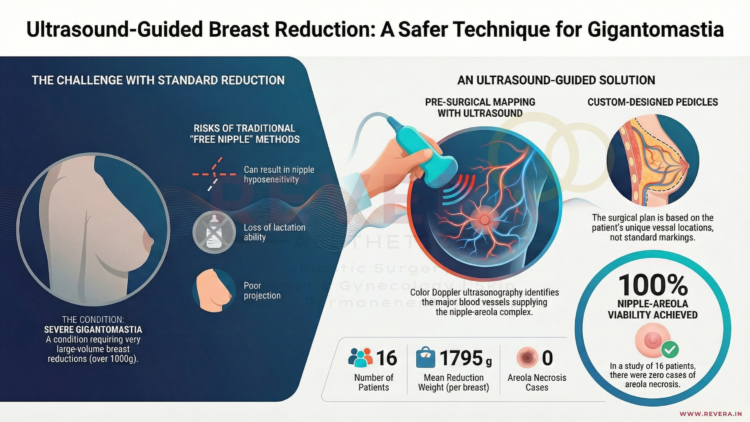
Women with extremely large breasts (Severe Gigantomastia) often face a difficult choice. They want relief from the heavy weight. However, surgeons often tell them they need a “Free Nipple Graft.”

This technique involves completely removing the nipple and sewing it back on as a skin graft. It is safe, but the trade-off is steep. Patients often lose nipple sensation, nipple projection, and the ability to breastfeed.

Why Is This Usually Necessary?

In standard breast reductions, surgeons rely on general anatomical rules to keep the nipple alive. We assume we know where the blood vessels are.

But in severe gigantomastia, the anatomy is stretched. The nipple sits very far away from the chest wall. Guessing the location of the blood vessels becomes risky. If the surgeon guesses wrong, the nipple could die. Therefore, many choose the Free Nipple Graft to be safe.

The Solution: Seeing Inside with Ultrasound

A study published in Plastic and Reconstructive Surgery offers a smarter, technology-driven alternative.

Researchers from Istanbul Medical Faculty decided not to guess. Instead, they used Color Doppler Ultrasonography before surgery to map out the breast.

How It Works

  1. The Scan: Before the operation, the surgeon uses an ultrasound probe to scan the breast.
  2. The Map: They identify exactly which blood vessels (perforators) are feeding the nipple-areola complex.
  3. The Design: The surgeon designs a custom tissue bridge (“pedicle”) specifically for that patient. It protects those specific vessels.

Customizing the Surgery

The study showed that every woman is different.

  • Some patients had strong blood supply from the inner breast (Internal Mammary artery).
  • Others relied on the outer breast (Lateral Thoracic artery).

By using ultrasound, the surgeons could tailor the cut to the patient. They used superomedial, superolateral, or mediolateral designs depending on what the scan showed.

The Results: Safety Without Sacrifice

The study followed 16 patients with severe gigantomastia (average age 41).

  • Massive Reduction: The average weight removed was nearly 1.8 kg (about 4 lbs) per breast.
  • Perfect Survival: Zero patients suffered nipple necrosis (tissue death).
  • No Free Graft: None of the patients required a Free Nipple Graft.

What This Means for You

Having massive breasts does not mean you must sacrifice nipple sensation or shape. Technology can act as a “guide” for your surgeon.

If you are considering a significant reduction, ask your surgeon about preservation techniques. A personalized approach, guided by ultrasound, can offer the safety of a Free Nipple Graft without the downsides.


Reference

Başaran, Karaca M.D.; Ucar, Adem M.D.; Guven, Erdem M.D.; Arinci, Atilla M.D.; Yazar, Memet M.D.; Kuvat, Samet Vasfi M.D. “Ultrasonographically Determined Pedicled Breast Reduction in Severe Gigantomastia.” Plastic and Reconstructive Surgery 128(4):p 252e-259e, October 2011.

Infographic comparing two techniques to correct Medially Positioned Nipples
Written by revera-admin

When Nipples “Point In”: A Specialized Technique for Better Positioning

The Challenge of Nipple Position

Breast reduction surgery is not just about making the breast smaller; it is about reshaping it to look proportional and centering the nipple on the new mound.

Most standard breast reduction techniques (like the popular Superomedial Pedicle) assume the nipple is starting from a standard sagging position. But what happens when a patient’s nipples are naturally positioned medially—meaning they sit closer to the cleavage or “point inward”?

In these cases, using standard techniques can be mechanically difficult. Trying to move an inward-facing nipple into a central position can restrict the blood supply or create tension, limiting how perfect the final result can be.

The Solution: The Superolateral Pedicle (SLP)

A new study published in Plastic and Reconstructive Surgery (August 2025) highlights a specific surgical approach designed exactly for this anatomy: the Superolateral Pedicle (SLP).

How It Works

In breast reduction, the nipple is kept alive on a “pedicle”—a bridge of tissue that preserves blood vessels and nerves.

  • Standard Way (Superomedial): The tissue bridge is usually kept on the inner/top side.
  • The SLP Way: For patients with medial nipples, the surgeon keeps the tissue bridge on the outer/top side (Superolateral).

By anchoring the nipple from the outside, the surgeon can more easily swing and rotate the nipple into the perfect central position without fighting the breast’s natural tissue resistance.

Is It Safe? The Research Say Yes

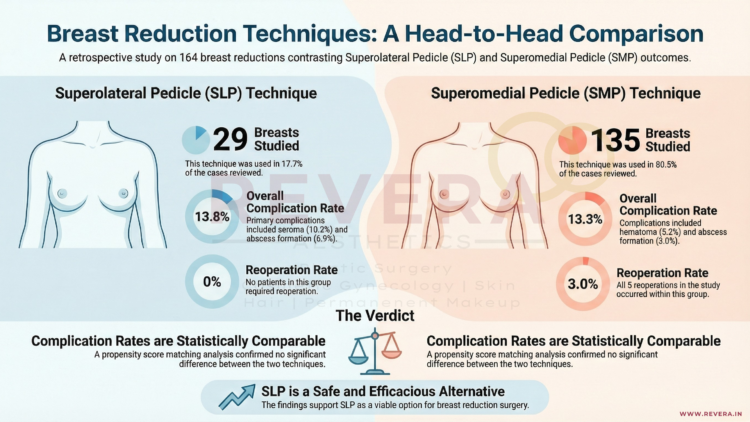
Researchers from MedStar Georgetown University Hospital in Washington, DC, reviewed 164 breast reductions to compare the safety of this specialized SLP technique against the standard method.

The Findings:

  • Comparable Safety: The complication rates were nearly identical between the two groups (13.8% for SLP vs. 13.3% for standard), proving that this technique is just as safe as the traditional method.
  • Effective Reduction: The technique worked well for significant reductions, with an average tissue removal of over 700g.
  • No Re-operations: In this specific study group, zero patients in the SLP group required a return to the operating room for complications, compared to 5 cases in the standard group.

Why This Matters For You

Anatomy is unique. If you have noticed that your nipples sit closer to your breastbone or point inward, standard techniques might not offer you the best aesthetic result. This research confirms that your surgeon has a validated, safe “tool in the toolkit” to correct medially positioned nipples and achieve a beautiful, centered look.


Frequently Asked Questions (FAQ)

Q: How do I know if I have “medially positioned” nipples?

A: If your nipples seem to sit closer to your cleavage rather than the center of your breast mound, or if they point inward towards each other, you likely have medial positioning. Your surgeon will assess this during your consultation.

Q: Does this technique leave different scars?

A: generally, no. The Superolateral Pedicle refers to the internal tissue handling. The external scars usually follow the standard “Wise Pattern” (Anchor) or Vertical (Lollipop) shape, just like a regular breast reduction.

Q: Is the recovery harder with this technique?

A: According to the study, complications such as wound healing issues (dehiscence) or fluid collection (seroma) were comparable to the standard technique, suggesting the recovery process is very similar.

Q: Can I still breastfeed with this technique?

A: Like the standard Superomedial technique, the SLP preserves a bridge of tissue carrying blood and nerve supply to the nipple. While breastfeeding can never be guaranteed after reduction surgery, techniques that preserve the pedicle generally offer a better chance than those that do not.


Reference

Lava, Christian X. MS; Li, Karen R. BBA; Episalla, Nicole C. MD; Snee, Isabel A. BS; Bell, Alice C. BA; Fan, Kenneth L. MD; Jabbour, Samer F. MD. “Superolateral Pedicle Breast Reduction for Patients with Medially Positioned Nipple-Areola Complexes.” Plastic and Reconstructive Surgery 156(2):p 174e-182e, August 2025.

1 2 3 4